Showing posts with label Third Reich 1933-1938. Show all posts

Tuesday, 10 March 2026

Messerschmitt Bf.110 in service with the Luftwaffe. Part one. The Bf.110 before the war.


The Messerschmitt Bf.110 was a German twin-engined Zerstörer (German word for 'destroyer' or heavy fighter) designed by Bayerische Flugzeugwerke and produced by its successor company, Messerschmitt. It was mainly operated by the Luftwaffe throughout the whole World War 2.
Its inception traces back to the early 1930s when the main air forces of the world were transitioning from biplanes to monoplanes. Most of the theorists concentrated on single-engined fighters, but, back then, the range was quite a problem. The Reichluftfahrtministerium (German Ministry of Aviation - RLM for short), encouraged by Hermann Göring issued a request for a new multipurpose fighter known provisionally as Kampfzerstörer (battle destroyer) with long range and internal bomb bay. This order called for a twin-engined, three-seat, all-metal monoplane armed with cannon and a bomb bay. Seven German companies were requested, but eventually only three, Bayerische Flugzeugwerke (Messerschmitt), Focke-Wulf and Henschel responded the request.
Focke-Wulf submitted the Focke-Wulf Fw.57, Henschel the Henschel Hs.124 and Messerschmitt submitted the Messerschmitt Bf.110, which skipped the internal bomb load request of the specification to increase the armament of the type. Thanks to this, the Bf.110 proved far superior to its rivals in speed, range and firepower and Messerschmitt was granted funds to to build several prototypes. By the end of 1935 the Bf.110 concept had evolved into an all-metal, low-wing cantilever monoplane of semimonocoque design with vertical stabilizers, powered by two Daimler-Benz DB-600A engines and featuring Handley-Page wing slots. 

Construction of the prototype, called Bf.110 V1, began in the summer of 1935 and took off for the first time on 12th May 1936 at Augsburg-Haunstetten airfield with test pilot Rudolf Öpitz at the controls. It was powered by two Daimler-Benz DB.600As engines rated at 986 hp each. Those engines were the fastest ones available for the, back then, clandestine Luftwaffe and the aircraft turned to be slightly faster than RLM's request, faster even than the Messerschmitt Bf.109B. The next two prototypes, Bf.110 V2 and V3 flew for the first time on 24th October and 24th December 1936 respectively, with official trials being conducted at Erprobungsstelle Rechlin (Evaluation unit Rechlin) in January 1937. Those trials showed two serious flaws of the type. It was too slow accelerating and it was not very manoeuvrable, however, both the RLM and Hermann Göring did not consider those handicaps important compared to the potential of the new aircraft and decided to go ahead by building four pre-production examples, designated A-0, rejecting this way the other competitor's designs. 

The four pre-production series Bf.110 A-0 were built between August 1937 and March 1938. Although they were initially going to be powered by the Daimler-Benz DB.601A engines, they were not available, so they were fitted with Junker Jumo 210 engines, rated at 610 hp, way too underpowered. In spite of the lack of power, those machines were employed for testing purposes.
While awaiting for the DB engines, it was decided to put the Bf.110 into mass production, so the first production version, Bf.110B-0 was launched, powered by the Junkers Jumo 210G engines, with some aerodynamic changes applied in order to fit the armament. This armament, which was only fitted from the B-1 version onwards, consisted on four 7,92 mm MG 17 machine guns in the nose plus two 20 mm Oerlikon MG FF cannons placed in the lower part of the nose. Those cannons could be reloaded in flight by the radio operator/gunners. It was equipped also with a defensive flexible 7,92 mm MG 15 machine gun at the back of the cockpit. 
The Bf.110B were assigned first to the newly created Schwere Jagdgruppen (heavy fighter groups), which were created ad hoc in July 1938 by Hermann Göring himself who wanted to form an elite corps. Accordingly many of the best fighter pilots of the time were put in command of these units causing tensions with the German fighter units, as they were cut of a large number of their pilots and resources. In fact, at the time there were not enough Bf.110 manufactured and many Zerstörergeschwadern (destroyer wings meant to be equipped entirely by Bf.110s) were equipped with the Bf.109C and D. 
The last Bf.110B variants were the B-2 and B-3, which were employed for reconnaissance and training respectively. 
In total 45 examples of the Bf.110B were manufactured, although some sources rise that number to 88. Anyway as the B variant was already outdated at the beginning of the war, many B-1s and B-2s were converted into B-3 trainers and remained in service with various Zerstörer schools until 1941.


Sources:
1st https://en.wikipedia.org/wiki/Messerschmitt_Bf_110#Early_variants
2nd Histoire & Collections - Avions et Pilotes 11 - Messerschmitt Bf.110 & Me.210-410 1939 -1945
3rd https://www.armedconflicts.com/prehled-verzi-t15722

Tuesday, 27 September 2022

Focke-Wulf Fw.200 Condor. Part Four. Pre-war and early-war German users.

 
The Focke-Wulf Fw.200 came from a proposal made by Kurt Tank, of Focke-Wulf to Dr. Rudolf Stüssel of Deutsche Lufthansa to design a completely land-based passenger plane capable of flying from Europe to the United States across the Atlantic Ocean. This was quite a revolutionary concept at the time as airlines employed seaplanes to cover long-range sea distances. In order to cover long distances in an economic fashion, the Fw.200 was designed to cruise at an altitude of over 3.000 m (9,800 ft), which was the highest possible attainable altitude without a pressurized cabin. Back then, airliners cruised at an altitude of 1.500 m (4,900 ft). When it was completed, the Fw.200 was, for a brief period of time, the most advanced airliner of the world, until more modern passenger planes appeared on the scene like the Boeing 307 Stratoliner in 1940 or the Douglas DC-4 in 1942. It received the denomination of "Condor" because, due to its large wingspan, it resembled a condor bird.
Deutsche Lufthansa issued a specification in June 1936 and, later, the aircraft was designed by Ludwig Mittlehuber and Wilhelm Bansemir. The first prototype, labelled as Fw.200 V-1 flew for the first time on 27th July 1937 and was flown by Kurt Tank himself. This first prototype was entirely made out of metal and was powered by four American Pratt & Whitney Hornet engines rated at 875 hp each. It could carry up to 26 passengers divided in two cabins and had a range of up to 3.000 km (1.900 milles). Two additional prototypes, V-2 and V-3 were powered by four BMW 132G-1 radial engines. 
In civilian service it was used mainly by Deutsche Lufthansa and some other airlines around the world. On 14th April 1945, Lufthansa flew the last scheduled flight before the of the World War 2, from Barcelona, in Spain to Berlin. 
The first prototype was upgraded with extra fuel tanks and had its engines replaced. It was redesignated as Fw.200 S-1 and made several record flights. The V-1 became the first heavier-than-air aircraft to fly nonstop from Berlin to New York, covering a distance of around 6.400 km (4.000 milles) on 10th to 11th August 1938 in 24 hours and 56 minutes. The return trip was shorter and took 19 hours and 47 minutes. Later, on 28th November, it flew from Berlin to Tokyo via Basra (Iraq), Karachi (British Raj - nowadays Pakistan) and Hanoi (French Indochina - nowadays Vietnam).
Outside Lufthansa, the Luftwaffe operated the type too (more on that in the next posts), with one unit, Fliegerstaffel des Führers, having the type as its major aircraft during pre-war and the whole world war 2. It was used to fly high-ranking political and military figures of Germany, from Hitler downwards. 


Sources:
1. https://en.wikipedia.org/wiki/Focke-Wulf_Fw_200_Condor
2. Osprey Publishing - Combat Aircraft 115 - Fw 200 Condor Units of World War II
3. Hall Park Books - Warpaint 13 - Focke-Wulf Fw.200 Condor

Thursday, 14 July 2022

Messerschmitt Bf.163 recon plane

 
The Messerschmitt Bf.163 (NOT to be confused with the Messerschmitt Me.163  Komet the rocket-powered interceptor) was a German STOL (acronym standing for Short Take Off and Landing) designed by Bayerische Flugzeugwerke and built by Weserflug during the late 1930s.
During Autumn 1935 the Fieseler Fi.156 Storch project was showing a lot of potential in the field of short-range reconnaissance and aerial observation that the Reichsluftfahrtministerium (RLM - German air ministry) issued a requirement for an army cooperation and observation aircraft with an stipulated performance parameters. The required engine to work with was the Argus As.10 or the Hirth Hm.508 stressing on the STOL capabilities. Maximum possible field of view for a crew of two and a range wide of speed were requested too. A total of three designs were presented for this requirement, the Siebel Si.201, the Fieseler Fi.156 and the Messerschmitt Bf.163. 
The Messerschmitt Bf.163 resembled in some regards the Fi.156 as it was a high-wing braced monoplane with a structure made entirely out of metal. It had also automatic edge wing slots, double slotted flaps and a specially tall fixed undercarriage. Its most innovative feature was its capacity for varying the incidence of the entire wing which swiveled on its main axis, with the bracing struts attached to the main fuselage by ball joints which could change their angle with the movement of the wing. The only prototype was built by Weserflug, although, as it was designed by Bayerische Flugzeugwerke (BFW) before 11th July 1938 when that company changed its name to Messerchmitt AG, it retained the Bf. prefix given by the RLM.
The only prototype flew for the first time on 19th February 1938. It was powered by a single Argus As.10C rated at 240 hp of power. The Bf.163 V1, when tested, had similar flight characteristics as the Fieseler Fi.156, but it was more complex and expensive, hence why, although a second prototype was underway, the whole project was cancelled in favour of the Fi.156.
In a strange decision, the RLM reissued the fuselage designation number 8-163 for the Me.163 Komet rocket-powered interceptor, after having allocated that number for the Bf.163. Therefore, both aircraft can be distinguished by their prefix, the earlier Bf.163 and the later Me.163. This was done because BFW changed its name to Messerschmitt, after Willy Messerschmitt bought the entire BFW on 11th July 1938.


Sources:
1. https://en.wikipedia.org/wiki/Messerschmitt_Bf_163
2. http://all-aero.com/index.php/contactus/53-planes-l-m-n-o/6681-messerschmitt-bf-163
3. http://airwar.ru/enc/other2/bf163.html (translated as best as we could)

Tuesday, 21 December 2021

Morane-Saulnier Ms.230, foreign users, part one.

 
The Morane-Saulnier Ms.230 was a French military elementary trainer aircraft that was used by France, but by another countries too:
  • Belgium: During the early years of the Belgian Aéronautique Militaire (Military Aeronautics), they saw themselves in the need of an advanced aeronautic basic trainer. That's why they bought 5 or 6 (numbers change depending on the source) Ms.230 from France, back in 1931.
    As the type satisfied Belgian authorities, they ordered additional 19 machines, this time powered by a single Armstrong Whitworth Lynx 4C radial engine which yielded 215 hp of power. This engine was slightly less powerful than the original Salmson 9AB with its 230 hp. 
    These new machines were branded as Morane-Saulnier Ms.236 and were manufactured by SABCA in Brussels. The engine switch was chosen for communality as the Lynx was already powering other Aéronautique Militaire airplanes such as the SV.22, SV.26, RSV 22/215, Avro 626 Prefect and, the Avro 504N, albeit it had a less powerful version. Most Ms.230 and 236 were employed by piloting school at Wevelgem, and by 1937 all every Ms.230 had been withdrawn from service. The remaining Ms.236 were kept active until the eve of the World War 2. However, many of them were used as communications aircraft in 1939-1940. 
  • Brazil: Apparently Brazil had an unknown number of Ms.230. Some sources claim it was nine of them. However, we couldn't find graphical info, nor textual one, so the drawing shown below should be considered as speculative.
  • Czechoslovakia: After World War 2, many ex-Luftwaffe (which acquired them as was prizes) Ms.230 were employed by private aeroclubs in Czechoslovakia, one of them was Medlánky Aeroclub, located in the city of Brno. They used the type from 1948 until 1957. Nowadays there's one Ms.230 shown at the Prague's Aviation museum painted in French colours.
  • Germany: During the late 1930s some private German owners owned at least 5 Ms.230 as their private airplanes. After the fall of France, many Ms.230 were captured by the Germans, which pushed them into service in their elementary flying schools. Apparently they were used during the whole World War 2.


Sources:
1. https://en.wikipedia.org/wiki/Morane-Saulnier_MS.230
2. https://www.belgian-wings.be/morane-ms230-ms236
3.http://www.airhistory.org.uk/gy/reg_D-a16.html
4.http://www.historyofwar.org/articles/weapons_morane_saulnier_MS230.html
5. https://alchetron.com/Morane-Saulnier-MS.230
6. http://www.cs-letectvi.cz/imatrikulace/morane-saulnier-ms-230-ok-qhl-id-b4271 (translated)

Tuesday, 14 December 2021

Arado Ar.79

 
The Arado Ar.79 was a German two-seat aerobatic trainer and touring aircraft of the 1930s. 
It was a monoplane with retractable tailwheel undercarriage with plywood wings covered in fabric and forward fuselage made of steel tube covered in fabric too. The rear fuselage was of monocoque structure. 
Designed in 1937 by engineer Dr. Walter Blume and Wilhelm von Nees, a total of three prototypes were made with a total of three variants with improvements made to the airframe. 
A total of 48 machines were built between 1938 and 1941 and the production model was powered by a single Hirth HM 504 A-2 engine inline engine which yielded 104 hp of power and drove a two-bladed propeller. 
A re-edition of the Ar.79 was planned in 1952 in the German Democratic Republic, however, the uprising of 1953 thwarted the project. In 1958 another machine, the Wimmer R-110 took over the design of the Ar.79 in the Federal Republic of Germany, however, due to its high price, it wasn't successful.
All three prototypes were tested in the flight around Germany between May 22nd and 29th 1938 and later, in July a speed record was achieved by test pilot Lüber as his machine reached an average speed of 229,397 km/h over a distance of 1.000 km. (621.371 miles). Later that same month, a second world record was achieved over a distance of 2.000 km (1242.742 miles) with an average speed of 227,029 km/h. 
A third Ar.79 made history when, with Lt. Pulkowski and Lt. Jenett at the commands,  flew  non-stop from Benghazi (Italian Libya) to Gaya (British Raj) covering a total distance of 6.303 km. Their original intention was to fly to Australia and, after stoping at Bangkok, Sumatra and Bali, on 14th January 1939 they reached Darwin and two days later, Sydney. During return flight, on 10th February 1939, their machine crashed when it collided against a bird of prey when they were performing a sightseeing flight over Madras killing Pulkowski and an Indian passenger.
The Ar.79 also served with the Royal Hungarian Air Force. A comparison flight took place in Budapest on 9th December 1938 between an Ar.79, a Bücker Bü.131 and a Klemm Kl.35 resulting in the sales of almost 20 machines to private customers in Hungary. István Horthy, son of Admiral Miklós Horthy - Regent of Hungary-, owned one Ar.79 as his personal aircraft.
It was also used by the French High Commissioner in the Saar Protectorate as his personal aircraft.


Sources:
1. https://en.wikipedia.org/wiki/Arado_Ar_79
2. https://de.wikipedia.org/wiki/Arado_Ar_79 (translated)
3. http://www.aviastar.org/air/germany/arado_ar-79.php
4. https://www.valka.cz/Arado-Ar-79-t57840

Thursday, 9 December 2021

Arado Ar.66

 
The Arado Ar.66 was a German single-engine two-seat training biplane developed during 1933.
Walter Rethel, Arado's chief designer, began its design back in 1931 looking for a new two-seat trainer. However, Rethel was hired by Messerschmitt and Walter Blume had to continue with the project. The first prototype, named Arado Ar.66a flew for the first time in 1932. 
The Ar.66 was powered through all its variants by a single Argus As.10 air-cooled inverted V8 engine which yielded around 240 hp of power and drove a two-bladed propeller. 
The fuselage had an oval cross-section and was entirely made of welded steel-tubes, covered in fabric. The double wings provided very high lift, also at low speeds. Both wings had the same span and were turned 8º backwards. It was made out of a double pine wing spar structure, with lime tree ribs and fabric covering. Both wings were fitted with ailerons and the tail was of conventional design with horizontal stabilizers mounted on the fuselage upper edge. the rudder was placed behind the elevators and both of them were made out of steel tube covered in fabric. These were one of the few changes that were made to the prototype, to make them bigger, since it presented balance problems. The undercarriage was welded to the fuselage in a "V" shape and used high-pressure rubber suspension. 
The crew consisted in two, a pilot and a trainee, seated in open tandem cockpits, equipped with dual controls. The aircraft was equipped with instrument flight systems with photographic cameras mounted as optional equipment.
There were three versions, the Ar.66a which was the first prototype, of which only a single machine was build, the Ar.66b and Ar.66B which was a floatplane variant, of which only 10 machines were completed and the Ar.66C which was the series production with modified elevators, larger rudder and larger-diameter wheels. 
The Ar.66 entered service with the Reichluftfahrtministerium (Reich's Aviation Ministry) in 1933 and then with the Luftwaffe in 1934, serving as a basic and ground-attack trainer well into World War 2. In 1937, a total of six Ar.66Cs were exported to Spain, to serve with the Aviación Nacional (National Aviation) the Air Force of the Nationalist faction of the Spanish Civil War, being that the only export sale of the type.
Since 1942, it was also used as a night-harassment ground-attack aircraft in the Eastern Front, and, in that role it was equipped with a single defensive MG-15 machine gun mounted in the observer's rear position and could carry a small amount of bombs or mines, in a similar manner that the Soviets did with the Polikarpov Po-2.
They saw service, together with the Gotha Go.145, in Nachtschlacthgruppen (Night Harassment Squadrons) 2, 3 and 5 serving in the Eastern Front, Nachtschlachtgruppe 8, in Finland and Nachtschlachtgruppe 12 in the Latvian region. 
During the latest stages of the War, when Romania switched sides, some Ar.66Cs were captured and pushed into service with the Romanian Air Force. Czechoslovakia also captured a bunch of those machines, as the Luftwaffe had set up many flying schools there. They were used as trainers with the newly re-built Czechoslovak Air Force during the postwar years.


Sources:
1. https://en.wikipedia.org/wiki/Arado_Ar_66
2. https://de.wikipedia.org/wiki/Arado_Ar_66 (translated)
3. http://www.airwar.ru/enc/other1/ar66.html (translated)

Tuesday, 4 May 2021

Junkers Ju.52/3m, part two


Many improved models were made before and during World War 2. The main production model was the Ju.52/3mg7e, with advances such like autopilot, enlarged doors to the cabin and other general enhancements. It was configured to serve as a pure transport aircraft, capable of carrying up to 18 fully-equipped troops. Defensive weaponry consisted on a dorsal-mounted 13mm MG 131 and two sideways mounted 7.9mm MG 15 machine guns. Further models were improved in many different ways, such as revised glazing, newer engines, reinforced undercarriage, and increased take-off weight. 
The Ju.52 had a low cantilever wing , whose mid section was built into the fuselage, shaping its underside. It was formed around four pairs of circular cross-section duraluminium spars with a corrugated surface that provided torsional stiffening. A thin control surface, with its outer section acting as the aileron, while the inner section functioned as a flap. These sections ran along the whole trailing edge of each wing panel, well split from it. The inner flap section lowered the stalling speed and the arrangement was known as the "Doppelflügel" ("Double wing in German).
Outer sections operated diferentially as ailerons, projecting slightly beyond the wingtips with control horns. The strutted horizontal stabiliser featured horn-balanced elevators which projected and showed a significant gap between them and the stabiliser itself, which could be adjusted in-flight. All stabiliser surfaces were corrugated too. 
The Ju.52/3m featured an unusual, for the time, corrugated skin made out of duraluminium, pioneered by Junkers during World War 1. The purpose of the corrugation was to strengthen the whole structure over a smoother approach. The fuselage was of rectangular section with a domed decking, comprising a tubular steel tube that was completely covered by the corrugated metal skin. A port-sided passenger door was placed just aft the wings, which also acted as a loading hatch for freight, with the lower half acting as a platform to ease cargo movements. The cabin was lined with numerous windows stretching forward to the pilots' cockpit. The main undercarriage was fixed and divided, with some of them with wheel fairings, while others not, as many crew decided to remove them to ease maintenance duties. A fixed tailskid, or tailwheel in later models, was also used. Some aircraft were fitted with floats of skis instead of wheels. 
The type saw action as a bomber for the last time during World War 2 during the Invasion of Poland, as the type took part in the bombing campaign against Warsaw in September 1939, during the course of which only two Ju.52/3m bombers were lost. After the end of the Spanish Civil War, no further bomber versions were made and the Luftwaffe relied on the type entirely for transport and paratroop drops.


Sources:
1. https://en.wikipedia.org/wiki/Junkers_Ju_52
2. https://en.wikipedia.org/wiki/Bombing_of_Warsaw_in_World_War_II
3. Osprey - Combat Aircraft 120 - Ju 52/3m Bomber and Transport units 1936-1941

Thursday, 29 April 2021

Junkers Ju.52/3m. Part one

 
The Junkers Ju.52/2m was similar to the company's previous W.33, albeit larger. It was designed in 1930 by aeronautical engineer Ernst Zindel  and his team at Junkers factory in Dessau. According to some authors, it was drawn directly upon the Junkers J.I, world's first all-metal aeroplane.
The first prototype was flown on 13th October 1930, under the designation of Ju.52/ba. It was initially powered by a single Junkers-built liquid-cooled V-12 engine which could generate up to 800 hp of power. During the long prototype testing stage, it was re-engined with the BMW IV engine which delivered up to 755 hp of power. The second prototype, denominated Ju.52de, had an increased wingspan and, although it was powered by the BMW IV at first, soon it was replaced with the 750 hp Armstrong Siddeley Leopard which the company bought from British stocks. Consequently, the prototype was renamed as the Ju.52di. This machine was re-engined again with the 750 hp Junkers Jumo 204 and received the denomination of Ju.52do. The third prototype, designated as Ju.52ce, featured an strengthened structure, a modified leading edge and could be fitted with both wheeled and float undercarriages.
In May 1931, during one of test flights, Ju.52cai, one of the prototypes, crashed and was written off. While all those initial prototypes were powered by a single engine, Junkers decided to develop the Ju.52 into a trimotor, and so, the Ju.52/3m (drei motoren - three engines) started development process, being powered by an arrangement of three radial engines. By mid-1930s the Ju.52/3mce and Ju.52/3fe were the two primary production variants, both powered by the BMW 132 radial engine. 
In 1934 work commenced on a militarised model, named Ju.52/3mg3e on behalf of the, back then, secret Luftwaffe. This model could work as a medium bomber and be equipped with two defensive gun turrets if needed, with a crew of four. Between the years 1934 and 1935 a total of 450 Ju.52/3mg3e were delivered to the clandestine Luftwaffe.
In May 1932 Lufthansa, Germany's main airline, took delivery of its first Ju.52/3m. The type was heavily employed by Lufthansa, which covered both Berlin-Rome and Berlin-London routes with the Ju.52/3m as it could complete the first one in just 8 hours, quite a respectable time for the time. Lufthansa's Ju.52 fleet numbered 231 machines at its peak, before World War 2, as it was flown in various routes in Europe, Asia and South America.


Sources:
1. https://en.wikipedia.org/wiki/Junkers_Ju_52
2. Signal Squadron - Aircraft in Action 186 - Junkers Ju.52 in Action

Thursday, 10 December 2020

Arado Ar.96, German users, part one

 
The Arado Ar.96 was a German single-engined trainer aircraft of the second half of the 1930s. It was manufactured by Arado Flugzeugwerke and was equipped with an enclosed cockpit and a retractable landing gear. During World War II, it was the standard advanced trainer of the Luftwaffe.
It was designed by Walter Blume (the same designer who, years later, would design the Arado Ar.234) in 1936 after a request made by the Reichluftfahrtministerium (Reich's Aviation Ministry - RLM). The prototype, which flew for the first time in 1938, was powered by a 240 hp Argus As.10C engine. This trainer was designed as a stop gap between the biplanes used for basic training and the advanced monoplane fighters that were entering service, namely the Messerschmitt Bf.109. 
The Ar.96 was a clean low-wing monoplane made entirely out of metal, employing many light alloys. The instructor and student sat in tandem in an enclosed cockpit. On the V1 prototype, the wheels retracted outwards, just like in the Bf.109, but that meant that the gap between the wheels was too small when deployed, so from the second prototype onwards, they were changed. The rear section was typical Arado-ish with the horizontal surfaces at the very rear, and a tail finn and rudder just in front of them, remaining of other aircraft of the firm like the Ar.68. 


Sources:
1. https://de.wikipedia.org/wiki/Arado_Ar_96 (translated)
2. https://en.wikipedia.org/wiki/Arado_Ar_96
3. http://www.historyofwar.org/articles/weapons_arado_ar_96.html

Tuesday, 23 June 2020

Arado Ar.195

The Arado Ar.195 was a German carrier-borne torpedo-bomber which was built by Arado Flugzeugwerke for service with the aircraft carrier Graf Zeppelin.
It was designed and developed during 1937 and intended to serve on the Graf Zeppelin aircraft carrier, which in that year was still under construction. It was directly based on the Arado Ar.95L.
It was a single-strut braced biplane with foldable wings, arrestor hook and catapult equipment.
In order to get good cockpit visibility during carrier landings, the cockpit was pushed forward as much as possible. It was powered by a single BMW 132 K radial engine which yielded 830 hp of power for take off.
It was armed with one fixed forward-firing 7.9 mm (0.311 in) MG 17 machine gun, located at starboard side of the engine, plus another 7.9 mm (0.311 in) MG 15 machine gun mounted at the back of the cockpit in a defensive position. It had a crew of two, a pilot and a radio-operator/rear-gunner.
Its main armament, however, was the 700 kg (1.543 lb) torpedo placed under the fuselage plus the bomb load which, could be partially placed underwings.
Although three prototypes were completed in 1937 at Arado's factory in Warnemünde, close to the city of Rostock, the Fieseler Fi.167 proved to be superior and the Ar.195 was considered outdated so the project was discarded.


Sources:
1. https://en.wikipedia.org/wiki/Arado_Ar_195
2. https://de.wikipedia.org/wiki/Arado_Ar_195 (translated)
3. https://www.militaryfactory.com/aircraft/detail.asp?aircraft_id=534
4. https://www.valka.cz/Arado-Ar-195-t57834

Saturday, 2 November 2019

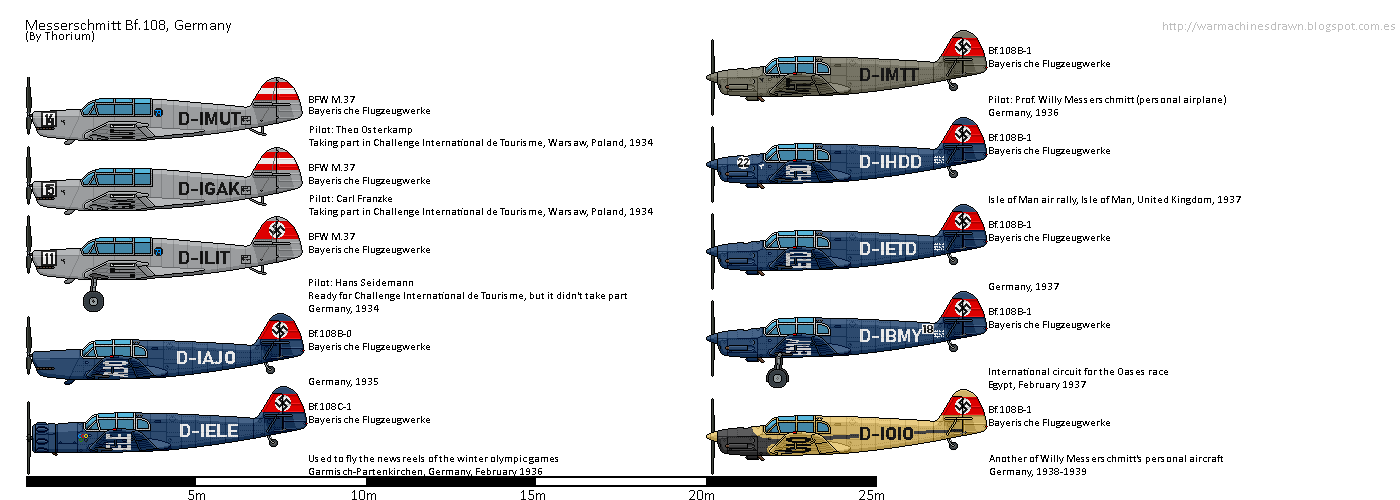
Messerschmitt Bf.108, part six

The Messerschmitt Bf.108 was a German single-engine sport and touring aircraft that was developed by the Bayerische Flugzeugwerke in the 1930s.
It was originally designated as M 37 and was designed as a four-seat sports/recreation aircraft to compete in the 4th Challenge International de Tourisme that was held in the year 1934.
The M 37 prototype flew for the first time in spring 1934 and was powered by a single Hirth HM 8-U that yielded a power of 247 hp and drove a three-bladed propeller.
It was outperformed by many other contestants in the competition, however, its overall performance marked it as a popular choice for record flights. One very popular feature was its low fuel consumption rate, good handling and nice take-off and landing characteristics.
The first production version, the Bf.108 A (of which just 7 exemplars were manufactured) flew for the first time in 1934, after the challenge, and the Bf.108 B variant (which was the most produced one with more than 600 of them being manufactured by Messerschmitt alone) flew for the first time the next year, in 1935. The B variant was slightly larger and was powered by a single Argus As-10 C-3 engine which delivered 247 hp of power and drove a two-bladed propeller. It was given the nickname Taifun (German word for "Typhoon") by Elly Beinhorn (a popular German pilot of the time) as that's how he called his own aircraft, so the nickname was generally adopted.
It was also Willy Messerschmitt's personal airplane, among many other German high officers of the time.
There was a third variant, the Bf.108 C, of which just a single aircraft was completed (although some sources claim that it never went beyond the drawing board). It was powered by a Siemens-Halske Sh-14 radial engine which had a power of 125 hp. It was used only once to fly newsreels of the Winter Olympic Games in Garmisch-Partenkirchen, in Bavaria.


Sources:
1. https://en.wikipedia.org/wiki/Messerschmitt_Bf_108
2. https://www.valka.cz/Messerschmitt-Bf-108-t85448 (translated)
3. Wydawnictwo Militaria 149 - Messerschmitt Bf-108 Taifun

Tuesday, 1 October 2019

Blohm & Voss BV.138, part one

The Blohm & Voss 138 was a World War II German trimotor flying boat that served as the Luftwaffe's main seaborne long-range maritime patrol and naval reconnaissance aircraft.
It was originally developed by the Hamburger  Flugzeubau and the prototypes were initially denominated as Ha.138 V1, and Ha.138 V2 which were completed on 15th July 1937 and August 1937 respectively, although they weren't tested until November that year.
Their appearance was unique with its combination of unusual design features with its twin boom tail unit, short fuselage and trimotor engine configuration. The short hull with its hydrodynamic step beneath and flat sides, earned it the nickname "Fliegender Holzschuh" - the flying clog-.
The three prototypes were powered, by three Junkers Jumo 205C which yielded a power of 592hp each and, unlike production versions, like the Bv.138A, they drove three-bladed propellers each.
Eventually it came to be the most numerous aircraft manufactured by the Blohm & Voss which was a shipbuilding company and founded its aircraft subsidiary, the Hamburger Flugzeubau on 4th July 1933 under the control of Walter Blohm. Their first aircraft, the Ha.135 was a conventional biplane trainer which was designed by Reinhold Mewes, but he was soon replaced by Dr. Ing. Richard Vogt who was responsible for many of Blohm & Voss designs. From 1933 to 1937 their aircraft carried the Ha. designation, but that changed to Bv. in 1937. As that changement took place during the development of the Bv.138, the prototypes were known as Ha.138 and the production aircraft as Bv.138.
It was the first flying boat to be produced by Blohm & Voss which previously had examined a series of possible designs before project P.12 was selected as the basis for a long-range reconnaissance aircraft. The original design had shorter hull and a high mounted wing with twin engines, booms and floats attached to the wings.
A mock-up was built in early 1935 and Blohm & Voss was awarded by the Reich Air Ministry with a contract to produce three prototypes, each to be powered by a different type of an engine that could reach 1000hp. All three of the engines ran into design problems and Vogt was forced to redesign the aircraft using the aforementioned trio of Junkers Jumo 205C engines with the third engine mounted above the centre of the wing. These engines, in this configuration, produced almost the same amount of power as two 1000hp engines, but the third one produced extra weight and drag.
Those first prototypes had short hulls, smaller tail surfaces and narrow booms. Testing revealed that they were unstable both in the air and in the water, so a complete redesign was imposed, which began in 1938.


Sources:
1. https://en.wikipedia.org/wiki/Blohm_%26_Voss_BV_138
2. https://en.wikipedia.org/wiki/Hamburger_Flugzeugbau
3. http://www.historyofwar.org/articles/weapons_blohm_und_voss_bv_138.html
4. https://www.valka.cz/topic/view/59211/Blohm-and-amp-Voss-BV-138-A-1

Thursday, 13 December 2018

Messerschmitt Bf.162

The Messerschmitt Bf.162 was a German light bomber prototype.
It was designed as a response to an specification issued by the Reichluftministerium (RLM - Reich's Aviation Ministry) made in 1935 for an schnellbomber (fast bomber) able of tactical bombing.
Messerschmitt presented their design, a modified Bf.110 with a glazed nose to accomodate a third crew member, the bombardier.
A pre-order of 65 aircraft was placed. However, after three prototypes were made (plus another two which were never completed and their parts were used for the Bf.110C production), and tested against its most direct competitors, the Junkers Ju.88 (which won the specification) and the Henschel Hs.127, the pre-order was cancelled. The Bf.162 was the only one that wasn't a completely new aircraft.
The specification was won by the Junkers Ju.88, which was selected for mass production, and therefore the development of the Bf.162 ended. However, in order to promote disinformation tactics, photos of the Messerschmitt Bf.162 circulated widely across the German press of the time, captioned as the "Messerschmitt Jaguar", a name that was never used in any other German aircraft.
The RLM's official airframe designation, 8-162, was later re-used for the Heinkel He.162 jet fighter, most probably for disinformation purposes.
The Bf.162 was powered by two Daimler-Benz DB600Aa liquid-cooled inverted V12 piston engines which delivered 986hp of power each. Initially it was going to be armed (as the prototype never got any kind of weaponry installed on) with one defensive 7,92mm MG 15 machine gun placed in dorsal position behind the pilot, however, most likely, another one would've been installed in the nose for the bombardier to operate. Expected payload was 500kg (1102lb) internally and two 250kg bombs externally, under wings, in an overload configuration which, most probably would've required the replacement of the engines.
The first prototype was scrapped after trials in 1937, the second one was also used for towing the Messerschmitt Me.162 at Messerschmitt's Augsburg factory and the third one was delivered to Rechlin, the test grounds of the RLM, where its fate is unknown, however it was most likely destroyed, either in fire testing trials or enemy bombings.


Sources:
1. https://en.wikipedia.org/wiki/Messerschmitt_Bf_162
2. http://www.histaviation.com/Messerschmitt__Bf_162.html

Tuesday, 11 December 2018

Messerschmitt Bf.161

The Messerschmitt Bf.161 was a German reconnaissance aircraft prototype.
It was a specialized reconnaissance aircraft heavily based on the Messerschmitt Bf.110 and similar to the Bf.162 light bomber.
Two prototypes were made at Bayerische Flugzeugwerke, in Augsburg. The first one, V-1, was powered by two Junkers Jumo 210 inline engines and flew for the first time on 9th March 1938 piloted by Dr. Würster.
It was shortly followed by a second prototype, labelled V-2, which was powered by two Daimler Benz DB600A engines, which flew for the first time on 30th August 1938.
It didn't enter production because shortly later the RLM (German Air Ministry) decided that a new aircraft type dedicated exclusively to reconnaissance role wasn't needed, as variants of the Messerschmitt Bf.110 could perfectly perform that role.
The two prototypes were used for aerodynamical research and development. The second prototype, V2, was used in Augsburg for towing the first prototype of the Messerschmitt Me.163 to Messerschmitt's proving airfield, and later to Peenemünde to perform official RLM trials and keep towing it.


Sources:
1. https://en.wikipedia.org/wiki/Messerschmitt_Bf_161
2. http://www.histaviation.com/Messerschmitt__Bf_161.html

Thursday, 14 December 2017

Junkers Ju.89

Since the German Luftwaffe was founded, its leader, General Walther Wever, realized the importance of Strategic Bombing, so a Langstrecken-Grossbomber (Long-range big bomber) was needed to fullfil that role.
The Ural-Bomber programme was issued with secret talks with the main German aircraft manufacturers, as back in 1933, the Treaty of Versailles was still in force, requesting them some designs for a long range bomber. The submitted designs were the Dornier Do.19 and Junkers Ju.89 respectively and prototypes for both aircrafts were ordered by the RLM (Reich's Aviation Ministry) in 1935.
Both aircraft proved to be promising, but when Wever died in a plane crash in 1936, his successors, Ernst Udet and Hans Jeschonnek, favoured smaller aircraft as they didn't require so much matherial and manpower, so the big bomber programme fell into disfavour. Udet and Jesschonnek were also the proponents of the close air support doctrine which advocated for attacking opposing forces on the battlefield rather than destroying enemy's industrial power. They convinced Hermann Göring about the need of Tactical Bombers acting in the army support role. Göring's beliefs proved to be right at the Battle of France, but it was the lack of Luftwaffe's Strategic Bombing capabilities the factor that hampered Germany in the Battle of Britain.
Back to the Ju.89, the first prototype was flown on 11th April 1937 by Hesselbach, it was powered by 4 Daimler-Benz DB600A engines rated at 560Kw (750hp) each and was going to be armed with 2 20mm MGFF cannons placed in a dorsal turret and another pair placed in a gondola above the fuselage. It was expected that additional defensive 7.92mm MG15 machine guns would be placed in the rear, front and even in the back of the cockpit making four the number of defensive light machine guns. However, just two weeks later of the first flight, on 29th April, the strategic bomber programme was cancelled by the RLM due to the high fuel consumption of heavy bombers and because bombers could only be manufactured in large numbers if they were medium ones, like the Junkers Ju.88.
However, a second prototype was manufactured in July 1937 and both of them were used by Junkers to learn about the stability and flight controls on large aircrafts. A third prototype was being manufactured but it was cancelled when the programme was cancelled.
On 4th June 1938, the Ju.89 achieved a new payload/altittude world record with 5000kg (11000lb) at 9312m (30500ft) outnumbering its most likely British counterpart in those pre-war years, the Short Stirling. Later, on 8th June 1938 the second prototype achieved an altittude of 7242m (23750ft) with a payload of 10000kg (22000lb). In late 1938 both aircraft were transferred to the Luftwaffe which used them as heavy transports.
Apparently both prototypes were scrapped in late 1939, however, some sources claim that they were still in active service in Norway during 1940. When it was being tested, Lufthansa expressed their interest in an airliner variant of the type and that leaded to the third prototype to be completed as the Junkers Ju.90.


Sources:
1. https://en.wikipedia.org/wiki/Junkers_Ju_89
2. Luftwaffe Secret Projects - Strategic Bombers 1935-1945

Sunday, 26 February 2017

Arado Ar.196 - Prototypes

All the prototypes of the Ar.196 were delivered in 1937. The first one, named V1 flew in May, as well as the second one, named V2 which had twin floats, just like the definitive version.
The next two prototypes, V3 and V4 had one central float and two auxiliary small ones in the wings.
As all of them showed excellent water handling capabilities, it was hard to choose which one choose for mass production, however, as there was a small chance that the smaller floats of the V3 and V4 models could "dig in", the floater configuration of the V1 and V2 was chosen and ordered into production.
An additional V5 was made in November 1938 in order to test final changes and was eventually completed as an Ar.196 A-0.


Sources:
1. https://en.wikipedia.org/wiki/Arado_Ar_196
2. http://www.kagero.pl/index.php?option=com_content&view=article&id=303:arado-ar-196&catid=95&Itemid=688&limitstart=1

Thursday, 5 January 2017

Arado Ar.95 - German Users

Now it's the turn for the native users of the Arado Ar.95.

The Arado Ar.95 was a single engined floatplane suitable for the reconnaissance and maritime patrol roles. It was designed and manufactured by Arado Flugzeugwerke.
It was designed in 1935 as a two-seated patrol airplane for coastal patrol, reconnaissance and light attack airplane. The first prototype, fitted with a BMW 132 engine flew in 1936 and the second one was powered by a Junkers Jumo 210. They were tested against the Focke-Wulf 62, it's most direct competitor.
The variant powered by the BMW won the competition and six of them were sent to Spain to be evaluated in combat.
It also served as the basis for the Arado Ar.195 torpedo bomber, one of the few types designed by Germany.
Although it wasn't ordered by any brand of the German Army, when the war started, the German authorities took over those planes that were built for Turkey. Those requisitioned were used for training and coastal operations in the Baltic Sea operating from the coast off Latvia and the Gulf of Finland from 1941 until 1944 serving with the Seeaufklärungsgruppe 125.


Sources:
1. https://en.wikipedia.org/wiki/Arado_Ar_95
2. http://www.warbirdsresourcegroup.org/LRG/ar95.html

Friday, 30 December 2016

Arado Ar.198

Welcome to the last aircraft of this 2016.
The Arado Ar.198 was a reconnaissance airplane that never went beyond the prototype stage made by the Arado Flugzeugwerke for the Luftwaffe. Initially it was the preferred one, over the Blohm & Voss BV.141 and the Focke-Wulf Fw.189 "Uhu" but after some flight tests, it didn't live up to the expectations and therefore only one prototype was made.

It all started when in 1936 the RLM (German Aviation Ministry) issued an specification for a short-range reconnaissance airplane that would have a nice ground vision. Three companies, Arado, Blohm & Voss, Focke-Wulf and Henschel presented their candidates, and eventually the Focke-Wulf Fw.189 "Uhu" won.

The Arado Ar.198 had a crew of three, a pilot, a gunner/radio operator and an observer. The first two ones were placed above the wing while the third one was placed underneath it having good communications with his partners thanks to a well laid-out fuselage.
Thanks to the wing shoulder configuration, the pilot had an unrestricted forward visibility and the fuselage was made of steel tube with an all-metal monocoque of the tail boom.
Initially it was going to be powered by an air cooled BMW 132 engine, but due to it's limited availability the Bramo 323A-1 was chosen for the prototype although it was slightly lower powered.
It was armed with a forward firing 7.92mm MG 17 machine gun and two defensive MG 15 machine guns placed in the radio and observer's post. It could carry up to four SC50 bombs underwings.

It flew for the first time in March 1938 at the factory airfield in Warnemünde and the tests proved it to be satisfactory except for the stability in low speed flights. In order to fix that problem, automatic slats were installed which improved the stability but it was still hard to handle. Anyway due to it's below the expectations results, Arado's technical office decided to cancel any related development in the late months of 1938.


Sources:
1. https://en.wikipedia.org/wiki/Arado_Ar_198
2. http://www.airwar.ru/enc/spyww2/ar198.html (translated)

Monday, 4 April 2016

Arado Ar.197

The Arado Ar.197 was a German biplane fighter designed for carrier operations in the never-completed Graf Zeppelin aircraft carrier.

It was designed to fullfil a requirement for a fighter capable of operating from the Graf Zeppelin and Peter Strasser aircraft carriers that were never completed. The basis of the design was the Arado Ar.68H that was the very first Arado airplane to feature a fully enclosed cockpit.

Three prototypes were built plus other three pre-production "A" versions. The first prototype, the V1 was powered by a 1086hp Daimler-Benz DB600A inline engine and a three bladed propeller, however it was a pure land fighter and had any carrier equipation whatsoever. Being almost similar to the V1, the V2 was the second prototype and was powered by a 838hp BMW 132Dc radial engine and was fitted with naval operations equipment that included an arrester hook and catapult spools. It flew for the first time, together with the V1 in the spring of 1937.

Later in that summer, a third armed prototype was flown. It was armed with two 7,92mm MG 17 machine guns in the fuselage plus a 20mm MG FF cannon in the upper wing. Thanks to the racks located under the fuselage, it could carry either four 50Kg. bombs, an auxiliary fuel tank or a smoke-laying cannister.

The pre-production airplanes were chosen for evaluation but, it was rejected because by the time the Graf Zeppelin would have been completed, biplanes such as this one would have been hopelessly obsoletes. In 1939, the Bf.109T, which was the navalized version of the renowned Messerschmitt Bf.109 was chosen as the naval fighter for the never completed carriers and in 1941 the Messerschmitt Me.155 was chosen as the successor of the Bf.109T.


Sources:
1. https://en.wikipedia.org/wiki/Arado_Ar_197
2. Salamander Books - The Complete Book of Fighters
3. http://histaviation.com/ar_197.html

Sunday, 3 April 2016

Arado Ar.80

The Arado Ar.80 a German pre-World War II fighter airplane designed by the chief engineer Walter Blume and manufactured by the Arado Flugzeugwerke in order to compete for the first major Luftwaffe fighter contract. It wasn't well received due to its disappointing performance and number of failures. The contest was eventually won by the Messerschmitt Bf.109 and the Ar.80 was used as a test aircraft.

It was completely made out of metal with a reverse-gulled cantilever low wing and a fixed undercarriage. The first prototype was powered by a 695hp Rolls Royce Kestrel V engine. The first prototype was destroyed when it crashed.
A second prototype was built powered by a 525hp Rolls Royce Kestre VI engine but it was soon replaced by a 640hp Junkers Jumo 210ca.
The third prototype, named V3, was also powered by the same Junkers Jumo 210ca and was the first prototype to be armed with one engine mounted 20mm cannon and two 7,92mm MG 17 machine guns in the engine cowling. It was also fitted with a revised wing that eliminated the inverted gull arrangement and was later modified as a two-seater trainer.
The fourth prototype, named V4, was powered by a fuel-injected Junkers Jumo 210Ga and featured an enclosed cockpit and this one, together with the fifth prototype, the V5, underwent extensive testing in Rechlin in order to test new flying instruments and in Tarnewitz later, in order to test the armament. It was returned to Arado to defend the company's airfield at Warnemünde.

A production version powered by a Junkers Jumo 210Ea and fully retractable undercarriage was discontinued when the Bf.109 was selected as the winner of the contract.


Sources:
1. https://en.wikipedia.org/wiki/Arado_Ar_80
2. Salamander Books - The Complete Book of Fighters
3. http://histaviation.com/ar_80.html