Showing posts with label Spanish Republic 1931-1939. Show all posts

Tuesday, 27 June 2023

Tupolev SB in Spain. Part one.

 
In the early days of the Spanish Civil War, the Soviet freighter ship Komsomol shipped the first 31 Tupolev SB bombers from Odessa to the port of Cartagena, Murcia, south-eastern Spain. The Spanish Republican Government did pay  $110.000 US dollars per aircraft. Those SBs were part of one of the first production batches completed at GAZ-22 factory. They were unloaded on 15th October 1936 and assembles at Los Alcázares airfield, in the region of Murcia. 
The bombers were assigned to Grupo 12 (Group 12), which also operated the Polikarpov I-15 and I-16 fighters. Flying personnel, most of them, were Soviet, however, some Spanish and other international volunteers worked with the Grupo from its origin. Since the beginning of the conflict the SB was nicknamed as Katiuska by the Spaniards, after a popular character of a Spanish operetta, back at the time.
On 28th October 1936 the SBs flew their first combat mission when four Katiuskas belonging to 1ª Escuadrilla / Grupo 12 (1st Squadron / Group 12), under the command of the Swiss Ernst Schacht raided the Tablada airfield at Seville. After the attack, the SBs flew away at very high speeds, so Nationalists fighters couldn't intercept them, causing consternation among the Nationalists.
On 1st November 1936, three Katiuskas attacked the Gamonal airfield, in the city of Burgos, destroying six Fiat Cr.32 Italian fighters on the ground. The next day, two Cr.32 shot down one SB 2M-100 over Talavera, in new Castile. This loss showed its main flaw: the lack of both crew armour and self-sealing fuel tanks. 
On 6th November 1936 the SBs raided the airfield of Ávila, old Castile, destroying two Heinkel He.51 fighters of the German Condor Legion. These kind of raids, where a small group of Katiuskas targeted Nationalists airfields were very common in the months of November and December 1936. The first Spanish Nationalist pilot to claim a downed SB 2M-100 was Bermúdez de Castro. On 7th December he shot down a Soviet bomber over Castilblanco, Extremadura. By the end of the year 1936, Grupo 12 had lost a total of six out of 31 Katiuskas to various reasons.
In January 1937 the 1ª and 2ª Escuadrillas (1st and 2nd Squadrons) of Grupo 12, flew missions from Marbella, Andalusia, to try to stop the Nationalist advance on Málaga. On 20th January, some Nationalists strongpoints in Ceuta (Spanish Morocco) were bombed. During early March, the Katiuskas took part in the Battle of Guadalajara (old Castile) by bombing positions of the Italian Expeditionary Force. On 29th May 1937 two Katiuskas attacked the German Deutschland Panzerschiffe (Armoured Cruiser), off the coast of Ibiza, damaging moderately the cruiser in the attack.
The cargo freight SS Aldecoa arrived at the port of Cartagena on 24th June 1937 with 21 more Katiuskas, these were complemented with 10 additional ones shipped by the freighter SS Artea Mendi the next 1st July. This second batch was composed of the more powerful and improved SB 2M-100A model. The 31 new Katiuskas were assembled at San Javier, Murcia and Líria, in Valencia. They were assigned both to Grupo 12 and the newly formed Grupo 24. This new group flew its first combat mission on 3rd July when its two squadrons raided Talavera, Salamanca and Ávila. 
Both Grupos saw action during the Republican Offensive in Brunete (west of Madrid) on 6th July 1937. On 8th July a Katiuska was shot down by a Messerschmitt Bf.109B of the Condor Legion. Four days later, a Katiuska managed to shot down a Bf.109B that was attacking the formation of bombers.
In the Fall of 1937 Soviet crews were withdrawn and replaced by Spanish personnel, leading to the dissolution of Grupo 12 and assigning every Katiuska to Grupo 24. 


Sources:
1st Signal Squadron - Aircraft In action 194 - Tupolev SB in Action
2nd https://en.wikipedia.org/wiki/Tupolev_SB
3rd https://massimotessitori.altervista.org/sovietwarplanes/pages/sb/tapani/spanish/spanishrepublican.htm

Tuesday, 4 January 2022

Morane-Saulnier Ms.230, foreign users, part two

 
The Morane-Saulnier Ms.230 was a French two-seat single-engine trainer aircraft from the late 1920s that served, in many variants, with various countries all around the globe until World War 2. We already covered some of them in our previous post, so here are the remaining ones:
  • Greece: Eighteen Ms.230 were ordered by the Royal Hellenic Air Force (RHAF) in October 1930 and were delivered in 1931. They were the main elementary trainer of the RHAF until 1936 when they were replaced by the Avro Tutor. The Ms.230s were not, however, written off, as they were kept as advanced trainers until the beginning of World War 2.
  • Portugal: This Iberian country had its own version of the Ms.230; the Morane-Saulnier Ms.233 was powered by a Gnome-Rhône 5Ba or, in the latest versions, the Gnome-Rhône 5Bc which delivered, both of them, 230 hp of power. Six of them were built in France and 16 in Portugal by OGMA (Oficinas Gerais de Material Aeronáutico - General Workshops of Aeronautical Material). The were the main trainer of the Portuguese Aeronautical Corps during the 1930s and some of them were exported to Spain.
  • Romania: In 1931 the Royal Romanian Air Force (RRAF) bought twenty Ms.230. They were used as their main trainer. As we couldn't find any graphical evidence of the Ms.230 serving in Romanian colours, the drawing should be considered as speculative.
  • Switzerland: In 1931 the Swiss Flugwaffe (Swiss Air Force) bought two Ms.229 for basic training. These machines were identical to the Ms.230 but were powered by an Hispano-Suiza 8a V8 engine. This engine turned to be problematic as the engine failed in mid air various times, luckily, without any loss. After some investigations on the causes, it was found that the engine wasn't suitable for acrobatics, so one of them, numbered 643, was re-engined in 1932 with an American Wright 9Qa radial engine, licensed made in Switzerland as Hispano-Suiza 9Qa. Flight performance was improved, but only one machine was brought to that standard. They were kept in active until 1939 when they were withdrawn from active service.
  • Slovak Republic: During late 1940 or early 1941, a single captured Ms.230 was given to the newly established Slovak Flying Corps. This single Ms.230 was kept at Vajnory airfield, as glider tug. It was probably destroyed in March 1945. Apparently there was a second machine which was given without its engine and was used for spare parts.
  • Republican Spain: The Fuerza Aérea Republicana Española (FARE - Spanish Republican Air Force) bought six Ms.233 from Portugal at the beginning of the Spanish Civil War. They were employed as elementary trainers at La Rivera flying school. 
  • Venezuela: In 1930 Venezuela acquired three Ms.230 for their Regimiento Militar de Aviación Nº1 (No.1 Military Aviation Regiment - de facto the Venezuelan Air Force during the 1930s and part of the 1940s). They were kept in active until late 1930s when they were replaced by more modern types.


Sources:
1. https://en.wikipedia.org/wiki/Morane-Saulnier_MS.230
2. https://www.haf.gr/en/history/historical-aircraft/morane-saulnier-ms230/
3. http://www.historyofwar.org/articles/weapons_morane_saulnier_MS229.html
4. http://www.historyofwar.org/articles/weapons_morane_saulnier_MS233.html
5. https://www.valka.cz/Morane-Saulnier-MS-230-t167614 (translated)
6. http://wings-aviation.ch/51-Profiles/M/M-Basis-en.htm (translated)
7. https://www.oocities.org/slovakaf/lietadla/ms-230/ms-230.en.htm
8. https://www.tapatalk.com/groups/forodemodelismo/morane-saulnier-ms-230-t4608.html (translated)
9. http://www.amigosdelmuseoarqueologicodelorca.com/alberca/pdf/alberca15/15_15.pdf (translated)
10. https://maquetas.mforos.com/353330/12935183-morane-saulnier-230-venezolano-esc-1-48-scratchbuilt/ (translated)

Tuesday, 30 November 2021

Caudron C.440 Goéland, Foreign Users Part Two

 
The Caudron C.440 Goéland (French word for "Seagull") was a French six-seat twin-engined utility aircraft of the 1930s that saw service with many foreign users:
  • Poland: The Caudron C.445 was used by the Polish Air Force in France in 1940 as a bomber pilot and navigator trainer. They were employed in the flying schools of Lyon-Bron, Clermont-Ferrand, Istres, Corbas, Rennes and St. Cyr. From 13th May 1940 until the end of the Battle of France, the Franco-Polish Goélands were used as utility and transport airplanes to transport both men and materiel to and from frontlines. Later, during the French retreat, they were employed to evacuate Polish transport personnel. In fact, on 23rd June two Goélands evacuated a group of 16 Polish pilots from Perpignan to Oran, in Algeria. 
    At the end of the war, one C.445A-T that was built in France during the German occupation, was captured by the Poles at the city of Dziwnów, in a very bad condition though. In spite of initial interests by the Polish Air Force for the plane, it was transferred to civilian aviation, where PZL-Mielec rebuilt it and used it for transport duties and company business trips. Oddly enough, the production license and technical documentation for the PZL-Mielec Lim-1 (the Polish MiG-15 license-built in Poland) was transported in this airplane. It was used by PZL from 22nd August 1947 until 12th September 1955.
  • Slovak Republic: Twelve C.445M (military variant of the regular C.445) were ordered by the Slovenské Vzdusné Zbrane (Slovak Air Force) in 1942 (although, according to other sources they were transferred by the Luftwaffe from captured machines). They were employed in the trainer and transport role, and their ultimate fate is unknown.
  • Spain: After the outbreak of the Spanish Civil War, the Republican Spanish Líneas Aéreas Postales Españolas (Spanish Postal Airlines - LAPE) acquired three ex-French Goéland machines. They were employed in various aerial routes inside the Republican territory during the Spanish Civil War. All three of them were either destroyed or captured by the Nationalists. After the war, in May 1940 some fleeing machines crash-landed in Spain and their crew and machines were interned.
  • Yugoslavia: The Yugoslavian National Airline Aeroput, bought two C.449 monoplanes in 1937 and 1938 as part of their modernization programme in order to cover more aerial routes. One of them was damaged beyond repair in 1939 and the other one was pressed into service with the Royal Yugoslav Air Force in 1941 when Germany invaded and was subsequently captured by them in April 1941.


Sources:
1. https://en.wikipedia.org/wiki/Caudron_C.440_Goéland
2. http://www.samolotypolskie.pl/samoloty/638/126/Caudron-C-445-Goeland (translated)
3. https://en.wikipedia.org/wiki/Aeroput
4. http://equinoxe.dk/SCWaircraft/did.html
5. http://incidentessgm.blogspot.com/2013/11/caudron-c-445.html (translated)
6. http://www.airhistory.org.uk/gy/reg_YU-.html
7. http://www.airhistory.org.uk/gy/reg_EC-.html

Tuesday, 20 April 2021

Junkers Ju.52/3m in Spain, part two

 
The Junkers Ju.52/3m was widely used during the Spanish Civil War by the Nationalist side and the subsequent Spanish State.
During the initial part of the conflict, a single Ju.52/3mg3e defected on 10th November 1936 to the Republican Side. This aircraft was piloted by Ananías San Juan Alonso, Sergeant of the Nationalist Grupo 22 de Bombardeo (Bombardment Group 22), who flew the Ju.52/3m from Escalona airfield, in Toledo, under Nationalist control to Alcalá de Henares airfield, in Madrid, under Republican control. This defection was made popular at the time by the Republican authorities and the captured Junkers was repainted to show loyalist colours. The fate of this machine is unknown, but was most probably destroyed on ground during a bombardment. San Juan was incorporated to Grupo 12, 1a Escuadrilla (Group 12, 1st Squadron) and flew Tupolev SB-2 bombers until the end of the conflict. After the war, he moved to Mexico where he lived until the end of his days in 1985.
The German Condor Legion, which served to the Nationalist side, had two Ju.52/3mW floatplanes. They were based at Pollença, close to the city of Mallorca, in the Balearic Islands and were used mainly in the transport and observation roles. One of them was destroyed in an accident during a vicious storm and the other one suffered an uncertain fate. Its known that one of them was involved in an aerial fight between two captured Republican Fiat Cr.32 when returning from a reconnaissance flight from Cadiz to Pollença.
After the Spanish Civil War, Iberia (the main Spanish Airline) was refounded in Madrid and in Autumn a new route with Lisbon was opened, served with Ju.52/3m. One year later, Iberia was granted by the Francoist authorities the monopoly of aerial transport of goods and persons inside Spanish lands for the next 20 years. Most of those routes were served by the Ju.52/3m which, although its exact number is unknown, it's estimated that around 75 machines (Iberia's official source places the number between 69 and 90) served with Iberia until 1960.
The Ju.52/3m was still under production after World War 2 in Spain, under the denomination of CASA C-352, but this aircraft will be the subject of its own post in the future.


Sources:
1. http://dbe.rah.es/biografias/95068/ananias-san-juan-alonso (translated)
2. https://www.sas1946.com/main/index.php?topic=23496.0
3. https://www.facebook.com/fotosiberia/posts/1584431005125652:0 (translated)
4. https://www.iberia.com/es/flota/aviones-historicos/Junkers_JU-52/ (translated)
5. http://falkeeins.blogspot.com/2010/12/spanish-civil-war-ju-52-floatplane.html


Tuesday, 25 February 2020

Airspeed Envoy, part four

The Airspeed Envoy was a British light, twin-engined transport aircraft designed and built by Airspeed Ltd.
It was used during the Spanish Civil War by both sides as ten of them were acquired by the Republicans.
The first one, arrived to Barcelona in early August 1936 and was later used in the front of Aragon as a bomber and reconnaissance aircraft. Two more arrived later in August but one was destroyed and the other one, piloted by Fernando Rein Loring (a famous pilot in Spain back then) defected to the nationalists becoming the personal aircraft of General Emilio Mola (one of the four main Generals in the nationalist side). It crashed later by flying into a mountain in June 1937 killing all its crew and passengers. Oddly enough, this aircraft had been the demonstrator for Airspeed.
In total, some sources claim that the total amount of Envoys that took part in the Spanish Civil War, was sixteen. However, that number seems too high.
Most of them (at least seven machines) were imported into Spain via the Air Pyrénneés. This airline was founded by the autonomous Basque Government in November 1936 which, after the occupation in September of the province of Gipuzkoa by the nationalist forces, the border with France was cut, so, in order to keep a link from Bilbao (the city headquarter of the Basque Republican forces in the north) with France, and considering that any communication was only possible via sea or by air, Air Pyréneés was founded and officially started operations in February 1937 covering the air-route Bilbao-Bayonne. One Envoy, registered as F-APPQ was shot down by nationalist aircraft over the Basque Country on 26th May 1937 injuring its pilot, Auguste Amestoy.
Once the Basque province of Biscay fell into the nationalists, most of the aircraft of the airline flew into Republican controlled territory like Valencia and with the French Air Ministry official protest (the airline's main office was in Bayonne, France), the company was dissolved in May 1938. All of their machines were pressed into service with LAPE (Líneas Aéreas Postales Españolas - Spanish Postal Airlines) and, like every other Envoy, were mainly used for VIP transport duties.
The machine registered as EC-AGE and another unidentified one survived the war and were taken over by the Spanish Ejército del Aire (Spanish Air Force), where they were re-registered with the code of "41-3" and "41-4" in late 1939. In 1945 they were re-coded as "L.11" and flew with the Spanish Air Force until well into 1947.


Sources:
1. https://en.wikipedia.org/wiki/Airspeed_Envoy
2. https://www.lasegundaguerra.com/viewtopic.php?t=14768 (translated)
3. http://britishaviation-ptp.com/airspeed_as6.html
4. https://www.ab-ix.co.uk/pdfs/airspeed_prewar.pdf
5. https://aeropinakes.com/wordpress/1937/08/17/la-aerolinea-de-la-republica-de-euzkadi/ (translated)
6. https://ianasagasti.blogs.com/mi_blog/2019/11/air-pyrénées-la-aerolínea-de-euzkadi.html (translated)
7. http://bioold.science.ku.dk/drnash/model/spain/did.html
8. http://www.aviationcorner.net/gallery_en.asp?aircraft_type=Airspeed%20AS.6%20Envoy&aircraft_type_id=2306 (translated)

Saturday, 15 February 2020

Airspeed AS.8 Viceroy

The Airspeed AS.8 Viceroy was a British twin-engined racing version of the Airspeed AS.6 Envoy. Only one exemplar was built by Airspeed Ltd. in Portsmouth in 1934. It was built to order of Captain T. Neville Stack and Sydney Lewis Turner to compete in the England-Australia MacRobertson Air Race.
The Viceroy was a modified Envoy with some changes. It was powered by two supercharged Armstrong-Siddeley Cheetah VI engines in long chord placed in smooth NACA cowlings. The engines yielded a power of 290 hp each.
The main landing gear was strengthened to allow for higher weight take-offs, an auxiliary petrol tank was installed in the aft part of the fuselage with capacity for 1.227 litres (270 imp. gallons) and its fuselage was modified to make it narrower and passenger windows were deleted.
The Viceroy started the race from RAF Mildenhall, in Suffolk, but, after suffering various reliability problems, some of them with the mainwheel brakes, it was withdrawn from the race at Athens. The pilots deemed unsafe to proceed and they would probably wouldn't be able of even finishing the race. A bitter set of legal actions followed with the pilots complaining that the aircraft hindered by various problems, wasn't ever really ready. Airspeed contested the action and, eventually the aircraft was returned to them without refund. The aircraft was taken back to Portsmouth and was stored until July 1936 when, the next month, it was sold to the French company SFTA (a company which bought war material to aid the Spanish Republicans) and departed to France on its way to the Spanish Civil War.
On 13th August 1936 the Viceroy reached Barcelona, being shortly taken into the Spanish Republican Air Force. It was named as "González Gil", after an aviation Captain who had died some days earlier in the skirmishes at the mountains north of Madrid. It was used for combat, reconnaissance and even bombing purposes during the first months of the conflict by the Republicans. However, due to its limitation, later was employed only for reconnaissance duties. In 1938 the aircraft was still active with the Republican Air Force, operating as a transport aircraft, however, it didn't survive the war and was destroyed in unknown circumstances shortly after.


Sources:
1. https://en.wikipedia.org/wiki/Airspeed_Viceroy
2. https://es.wikipedia.org/wiki/Airspeed_Viceroy (translated)
3. http://bioold.science.ku.dk/drnash/model/spain/did.html
4. Enciclopedia De La Aviación Militar Española  (translated)

Tuesday, 12 February 2019

Douglas DC-1

The Douglas DC-1 was the first model of the famous American DC (which stands for Douglas Commercial) commercial transport aircraft series. Only one aircraft was produced, but it served as the basis for the DC-2 and DC-3.
Its development dates back to 1931 after a TWA's (Trans World Airlines) Fokker F.10 crashed due to the failure of a wing caused by the water that had seeped between the layers of the wood laminate and dissolved the glue that held the layers together. After the accident, the Aeronautics Branch of the US Department of Commerce placed strict restrictions on the use of wooden wings on passenger airliners. Boeing answered with a new model, the Boeing 247 which was a twin-engined all-metal monoplane with a retractable undercarriage, but their production capacity was reserved to meet the needs of United Airlines, part of United Aircraft and Transport Corporation which also owned Boeing. Therefore TWA needed a similar aircraft to compete with the Boeing 247 and they asked five manufacturers to bid for construction of a three-engined, 12-seat aircraft of all-metal production with a range of 1080 milles (1740 km) at 150mph (242 km/h). The most difficult specification was that the aircraft had to be able to safely take-off from any airport on TWA's main routes with one engine non-functioning. The most difficult one to operate was Albuquerque's airport which is at high altittude and with sever summer temperatures.
Donald Douglas, president of Douglas Aircraft Company was initially reluctant to take part in the contest as he doubted that there was enough market for 100 aircraft, which was the number of sales needed to cover development costs. However, he submitted a design consisting on an all-metal, low-wing, twin-engined aircraft with capacity for 12 passengers, a crew of two and a flight attendant. The specifications exceeded the needs of the TWA even with only two engines, mainly through the use of controllable pitch propellers. It was also insulated against noise, heated and fully capable of flying and making a controlled taking-off on just one engine.
As stated by Donald Douglas, the DC-1 costed $325.000 (That's $5,956,917.88 adjusted for inflation) of the time to design and build.
Only one aircraft was produced and flew for the first time on 1st July 1933 at the hands of Carl Cover. It received the designation of DC-1 (standing for 'Douglas Commercial-1'). It was tested for half-year and performed over 200 test flights proving its superiority over other airliners of the time like the Ford Trimotor or Fokker Trimotor. It was flown accross the USA from New York to Los Angeles, on 19th February 1934 setting a new record of 13 hours and 5 minutes.
Back on 15th September 1933, TWA accepted the aircraft with some modifications like an increased passenger capacity from 12 to 14 and adding more powerful engines. They also ordered a production of 20 of them which, at its developed version would be known as the Douglas DC-2.
The DC-1 never entered active service with TWA but was used for promotion purposes. It was sold in May 1938 to Lord Forbes in the United Kingdom, who operated it for a few months as his personal aircraft and was sold in October to the French Société Française de Transports Aériens which sold it just weeks later, in November 1938 to the Spanish Republicans.
It was assigned to the LAPE (Lineas Aéreas Postales Españolas - Spanish Postal Airlines) where it saw at least two camouflage schemes (as shown below) and was notorious for having transported the Spanish Republican Cabinet to the exile on 6th March 1939 from Valencia to Toulouse, in France.
It was given back to the Francoist authorities after the end of the Spanish Civil War and it was assigned to Tráfico Aéreo Español (Spanish Air Traffic - the most inmediate predecessor of Iberia, Spanish national airline) which re-registered it and named it as "Manuel Negrón". It was lost in December 1940 when after having taken-off from the airport of Malaga, it crashed shortly after for unknown reasons and it was scrapped.


Sources:
1. https://en.wikipedia.org/wiki/Douglas_DC-1
2. https://es.wikipedia.org/wiki/Douglas_DC-1 (translated)
3. https://aeropinakes.com/wordpress/1938/11/13/douglas-dc-1-de-lape-ejemplar-unico/ (translated) 
4. http://jaon.es/dc1/index.htm (translated) 

Tuesday, 28 August 2018

Boeing P-26 Peashooter, Spanish and Philippine users

The Boeing P-26 Peashooter was the first all-metal American fighter and the first monoplane fighter used by the United States Army Air Corps.
It was used by many foreign users like the Republic of Spain and the Commonwealth of the Philippines.

  • Republic of Spain: Twelve Boeing Model 281 were manufactured as demonstrators and one of them was sent to Spain in March 1935 with the objective of winning the contract that the Spanish government issued for a modern fighter that could replace their ageing Nieuport-Delage NiD.52. The contest was won by the Hawker Fury and the Boeing Model 281 was left unarmed in Spain at the beginning of the Spanish Civil War and bought shortly later by the Fuerza Aérea Republicana Española (FARE - Spanish Republican Air Force) for the amount of 26000 dollars. It was piloted by Lt. Ramón Puparelli and was fitted with two Vickers 0.303in machine guns. However, it was shot down by a FIAT Cr.32 on 21st October 1936 close to the town of Getafe, shortly after the beginning of the Spanish Civil War.
  • Commonwealth of the Philippines: In 1937 the Philippine 3rd and 4th Pursuit Groups were created and by July 1941 they were fully equipped. After the Japanese attack on Pearl Harbor, they were reinforced with 12 more. The Filipino P-26 entered in combat when Japan invaded, and they managed to shot down some Japanese aircraft. In fact, they claimed one G3M and two or three A6M Zero before the last of the P-26 was burned by their own crew to prevent capture on 24th December 1941.


Sources:
1. https://en.wikipedia.org/wiki/Boeing_P-26_Peashooter
2. https://es.wikipedia.org/wiki/Boeing_P-26_Peashooter (translated)
3. Salamander Books - The Complete Book of Fighters

Tuesday, 25 April 2017

Martinsyde A.D.C. 1, Martinsyde A.D.C. Nimbus & Martinsyde F.4A

The Martinsyde A.D.C.1 was a development of the Martinsyde F.4 Buzzard made by the Aircraft Disposal Company that bought Martinsyde's stores when it went into bankruptcy in 1922.
John Kenworthy decided to fit an Armstrong Siddeley Jaguar engine delivering 380hp of power into the airframe of a regular Buzzard and retaining the original armament of two 0.303in Vicker Machine guns in the front. The first prototype flown for the first time on 11th October 1924 and it took part in the 1925 and 1926 King's Cup Races. It attracted some foreign interest when Latvia's Air Force ordered eight airplanes in 1926 that were delivered the same year. At least two of them were still active in 1938.
The Martinsyde F.4A was a two-seater conversion of the Buzzard that most of them served with the Spanish Aeronáutica Naval and Aeronáutica Naval Republicana (Naval Aeronautics and Republican Naval Aeronauticrespectively). They were bought in 1921 and assigned to the El Prat pilots school, in Barcelona and later, they were assigned to the San Javier aeronaval base, in south-eastern Spain. They were in active trainer role until 1936 when the Spanish Civil War started.
The Martinsyde A.D.C. Nimbus was a further development of the A.D.C.1 made by John
The Martinsyde ADC Nimbus
Kenworthy using a 330hp Nimbus six-inline water-cooled engine. It was basically the same airframe of the Buzzard with a modified vertical tail, a horn-balanced rudder and revised aft fuselage decking. It was going to be armed with the typical pair of 0.303in Vickers Machine guns but they never were installed. Two prototypes were completed in 1926 which took part in the King's Cup race of that same year and, one year later the first prototype was modified with faired undercarriage legs and cylinder head fairings. It didn't attract any interest and therefore no orders were placed. As we couldn't find any side drawings of blueprints of this airplane, we left it undrawn.


Sources:
1. https://en.wikipedia.org/wiki/Martinsyde_Buzzard
2. http://www.aviastar.org/air/england/martinsyde_adc-1.php
3. http://www.aviationcorner.net/gallery.asp?pg=45&fp=37&airline=Espa%F1a%20-%20Arma%20A%E9rea%20Armada&sort_order=votes&set_lang=true (translated)
4. Salamander Books - The Complete Book of Fighters

Monday, 24 April 2017

Martinsyde F.4 Buzzard - Part three

The Martinsyde F.4 Buzzard was a British fighter designed in 1918 that was planned to enter service in the Great War. It was powered by a 300hp Hispano-Suiza 8Fb inline engine and was armed with two 0.303 Vickers machine guns placed in the front of the fuselage.
The type was expected to equip the French Aéronautique Militaire, the Royal Air Force and the United States Army Air Service with more than 1500 airplanes ordered.
They served with the Spanish Aeronáutica Militar from 1922 when  10 or 12 were bought. Eight of them were sent to the African city of Melilla, while the rest were used to train pilots in Los Alcázares aerodrome, in the south of Spain. Those serving in Melilla formed the "Escuadrilla Martinsyde" until they were replaced by the Nieuport-Delage NiD.29 in 1924. After being retired from service they were used as trainers serving with the training squadron in Cuatro Vientos, in Madrid. They served there until 1931 when the Spanish Republic was declared and, as they were really outdated, they passed on to the Republican Aeronáutica Naval were they served in the base of San Javier, at the southern of Spain until the beginning of the Spanish Civil War in 1936.
Apparently one-hundred of them also served with the Soviet Workers' and Peasants' Air Fleet in 1919 until some date in the mid-late 1920s when they were retired from service.
The type also served with the Uruguayan Escuela Militar de Aeronáutica (which was the name of the predecessor of the Uruguayan Air Force) in 1925.


Sources:
1. https://en.wikipedia.org/wiki/Martinsyde_Buzzard
2.http://www.ejercitodelaire.mde.es/stweb/ea/ficheros/pdf/229800650173ACD6C1257C99003F6930.pdf (translated)
3. Salamander Books - The Complete Book of Fighters.

Sunday, 23 October 2016

Avro 504K European Users, part four

Now it's the turn for the penultimate post about the European users of this excellent airplane.


  • Spain: Avro gifted the Spanish King Alfonso XIII a single Avro 504K in 1919 which he handed it over to the army. As the Spanish Military Aviation judged it to be an excellent airplane, they ordered fifty of them. In 1923, they were delivered second hand machines which had previously served with the RAF and RFC. They served in the Spanish flying schools of Getafe, Cuatro Vientos, Alcalá and Albacete.
  • Republican Spain: When the Spanish was proclaimed in 1931, the Avro 504K were transferred to the Republican Naval Aviation, which used them in their air-sea base of San Javier, in the provice of Murcia. They were kept there in the training role until 1938, when, due to the Spanish Civil War newer and better trainer airplanes arrived.
  • Sweden: The Royal Swedish Naval Aviation bought some 504K during the early 1920s in order to use them in the training and school roles. They had the peculiarity of removable wheels in order to be replaced by skis during the winter months.


Sources:
1. http://www.ejercitodelaire.mde.es/ea/pag?idDoc=6D5611FEEB41557EC12570D700464507&idRef=C7B461BC45A0A4CFC12576AB002C9667&idImg=D6867819143F567CC12576AB002CB141 (translated)
2. http://avgce.blogspot.com.es/2015/04/avro-504k-aeronautica-naval.html (translated) 

Wednesday, 13 July 2016

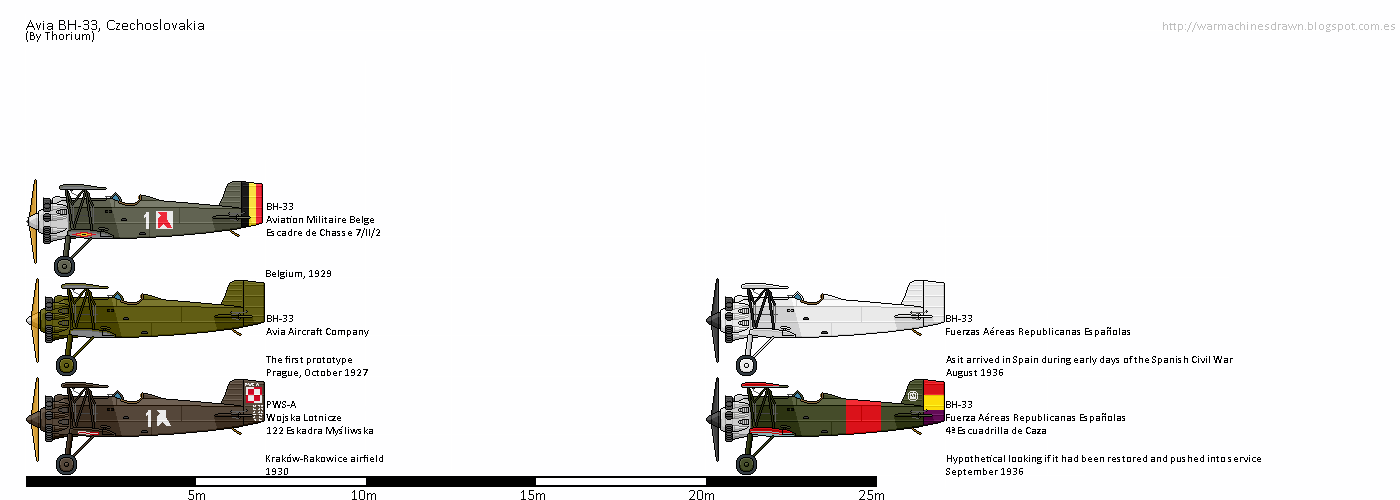
Avia BH-33

During 1926 Avia tested the Gnome-Rhône version of the Bristol Jupiter nine-cylinder radial air-cooled engine fitted to a BH-21 airframe, the BH-21J.

Trials were satisfactory and a new design was born, with the given name of Avia BH-33. It was the last fighter designed by Miroslav Hajn and Pavel Benes for Avia and was also the first Avia fighter to feature a fixed tail fin from the outset. Trials on the new design started in 1927 and were satisfactory enough for the Czechoslovak Army Air Corps, but not brilliant enough that they only ordered 5 airplanes. It was powered by a Walter-built Bristol Jupiter VI engine delivering 543hp at take-off and was armed with two Vickers 0.303in machine guns.

In Belgium, one Avia BH-33 powered by a Bristol Jupiter VII engine was one of the contenders for the Aéronautique Militaire fleet standaristation programme which was eventually won by the Fairey Firefly.
Regarding to Spain, apparently a single BH-33 painted entirely in white flew to Spain in the early days of the Spanish Civil War loosing it's machine-guns and synchronisation gear en route. It's unknown what happened to it, but we couldn't resist the impulse of thinking how it would've looked like if it had been repaired, repainted and push into service.
Poland adquired a manufacturing license in 1928 with PZL building 10 pre-production airplanes of this type and PWS building 50 of them as the PWS-A from 1930 onwards.


Sources:
1. https://en.wikipedia.org/wiki/Avia_BH-33
2. Salamander Books - The Complete Book of Fighters
3. http://bioold.science.ku.dk/drnash/model/spain/did.html
4. http://www.belgian-wings.be/Webpages/Navigator/Photos/MilltaryPics/interbellum/avia_bh33.htm