Showing posts with label Poland 1930-1938. Show all posts

Tuesday, 18 April 2023

Breguet 14, part eight. European Users, part five. Polish users.

 
Preliminary note: Almost every Polish word has been translated by Google, as none of us speaks Polish, so expect typos, and even grammar failures when you read that language. Apologies.

The Bréguet 14 was a French biplane of the World War I which was used both in the bomber and reconnaissance roles. It was employed by many nations around the globe, among them, Poland.
The newly created Government of the Second Polish Republic acquired both the Br.14A and Br.14B in vast numbers from French Escadrilles that were in Poland as part of the occupation force. 
Those escadrilles were:
  • BR 39: Equipped with 15 Br.14A.2s, this unit was initially based at Lublin, to take part in the Ukrainian Front against the Soviets, as both Poland and the Russian SFSR were in war against each other. In September 1919, the French gave the aircraft of this escadrille to the Wojska Lotnicze (Polish Air Force) who transferred them to the 16 Eskadry Wywiadowczej (16th Reconnaissance Squadron). This unit served until June 1920 when it ran out of serviceable aircraft and was, therefore, disbanded.
  • BR 59:  Equipped also with 15 Br.14A.2, this unit was also based at Lublin and was transferred to the Wojska Lotnicze in September 1920. It was renamed as 17 Eskadry Wywiadowczej (17th Reconnaissance Squadron) and by mid-July 1921 the unit was disbanded.
  • BR 66: Based at Wilno in January 1919, this unit was designated as 4 Eskadry Wywiadowczej (4th Reconnaissance Squadron) and was equipped with Br.14B.2, the bomber variant. It was disbanded in July 1920 as there were no serviceable aircraft available and some machines passed on to the Republic of Central Lithuania.
Apart from those French units, some native units of the Wojska Lotnicze employed the Br.14 as the Polish Government ordered seventy additional Br.14s directly from France and, in November 1919 there were enough machines to form a new squadron:
  • 10 Eskadry Wywiadowczej (10th Reconnaissance Squadron). This unit was initially based at Lwow, but it was sent to Brzesc in August 1920 and then to Poznan-Lawica airfield in October, to be re-equipped with Bristol F.2B fighters in early 1921. 
  • 1 Pulk Powietrzny (1st Aerial Regiment): This unit was formed when even more machines arrived in 1921 (which were ordered in 1920). Based in Warsaw, this regiment was composed of two squadrons, each one of them hosting two Eskadras (flights). Those squadrons were 1 and 4 Dyon Wywiadowczej (1st & 4th Intelligence Squadrons) with 12 , 16 and 3 and 8 Eskadras respectively. This unit replaced their Br.14 with Potez 15 in 1924. 
After the mid-1920s, when almost every Br.14 was withdrawn from active service, they were used as elementary trainers, forest dusters or even bomber trainers until 1933 when the last Polish Br.14 was written off.


Sources:

1st https://en.wikipedia.org/wiki/Bréguet_14
2nd Flying Machines Press - French Aircraft of the First World War
3rd Windsock Datafile Special - Breguet 14

Saturday, 27 March 2021

Junkers Ju.52/3m in Norwegian and Polish service

 
The Junkers Ju.52/3m is a German cargo plane which was manufactured by the thousands and saw service worldwide, in every continent. Among its many users, we're covering the following ones in this post:
  • Norway: The Norwegian airline Det Norske Luftfartselskap (DNL - Norwegian national airline, forerunner of Norwegian Air Lines) acquired 6 float-equipped Junkers Ju.52/3m (according to some sources they were just four) in 1935. In June 1936 the first Ju.52/3m (which crashed shortly after making its first maiden voyage, on 16th June and had to be replaced by a new one two weeks later) was delivered to serve in a seasonal summer route between Bergen and Tromso with flights three times per week with stopovers at Alesund, Molde, Kristiansund, Trondheim, Bronnoysund, Sandnessjoen, Bodo, Narvik and Harstad. 
    In 1937 DNL moved the departure point to Gressholmen seaplane port, in Oslo, the Norwegian capital. 
    They kept on serving with DNL until the outbreak of the war when the Marinens Flyvevesen (Norwegian for Royal Norwegian Navy Air Service) took one into service in January 1940 (though some sources claim it was in December 1939) and fitted with a ventral defensive machine gun gondola, plus another one in a dorsal position. It served until 9th April. 
    When Norway was occupied, the Luftwaffe took over every aircraft from DNL. However, after the war, one that was originally registered as LN-DAH was taken back and served until 1956.
    Two ex-Luftwaffe Ju.52/3mg7es were taken over on VE-Day (8th May 1945) and, together with LN-DAH, they were incorporated into DNL's fleet. One Ju.52/3m registered as LN-LAB, crashed in May 1946 at Snaroya, close to Oslo. In August that year some Ju.52 were taken by the Kongelige Norske Luftforsvaret (KNL - Royal Norwegian Air Force) and served until September 1950 when they were sold to Portugal.
  • Poland: On 16th November 1936, LOT (Polskie Linie Lotnicze LOT S.A.) received a single Ju.52/3m powered by Bristol Pegasus engines in exchange for nine Junkers F-13s. This Ju.52/3m was registered as SP-AKX and, from early 1937 onwards, it flew regular flights from Warsaw to Berlin, Rome and Salonique, in Greece. As this machine was powered by Pegasus engines, which were heavier than the original BMW's ones, an extra water tank was installed at the rear of the aircraft to get the right centre of gravity when in flight. 
    This machine was widely used, recording a total of 600 flight hours in 1937 and 843 hours in 1938 suffering no accidents or setbacks whatsoever. At the outbreak of World War 2, it was flown from Zabczyce, close to the city of Pinsk, in Polesie, to the Romanian capital, Bucharest on 12th September 1939 where it was planned to be sold to Turkey but, eventually, it was fictionally sold to Imperial Airways and received the registration G-AGAE.


Sources:
1. https://en.wikipedia.org/wiki/List_of_Junkers_Ju_52_operators
2. https://en.wikipedia.org/wiki/LOT_Polish_Airlines
3. https://no.wikipedia.org/wiki/Det_Norske_Luftfartselskap (translated)
4. https://en.wikipedia.org/wiki/Norwegian_Air_Lines
5. https://no.wikipedia.org/wiki/Snarø-ulykken (translated)
6. https://www.polrail.com/Aerolot/history/ju52inlot.html
7. Signal Squadron - Aircraft In action 186 - Junkers Ju-52 in Action

Sunday, 26 March 2017

10TP Tank

The 10TP was a Polish light cruiser tank prototype. It was designed back in 1935 by a team of engineers leaded by Major Rudolf Gundlach as "natural" development of the previous 7TP light tank.
By 1936, even if the design wasn't complete, it was approved to be included in the programme of armoured forces that was part of a bigger plan to modernize and expand the Polish Army during the period of 1936-1942. This tank was expected to be part of the tank battalions for the newly created motorised units.
The prototype was started to be built in 1937 at the State Engineering Plants, located at the outskirts of Warsaw, where every Polish tank during the period of 1931-1939 was manufactured. At the same time, two motorised cavalry brigades were raised, in order to be equipped with this tank.
It was completed on 16th August 1938 and its trials were kept in secret as the activities of the German Abwehr were becoming more intensive. In January 1939 it was further tested and it managed to travel a distance of 610km (379 milles). Before it could be massly produced, Poland was invaded by Germany in September 1939 and any further development was halted.


Sources:
1. https://en.wikipedia.org/wiki/10TP
2. Salamander Books - The Illustrated Encyclopedia of the World's Tanks and AFVs.

Wednesday, 13 July 2016

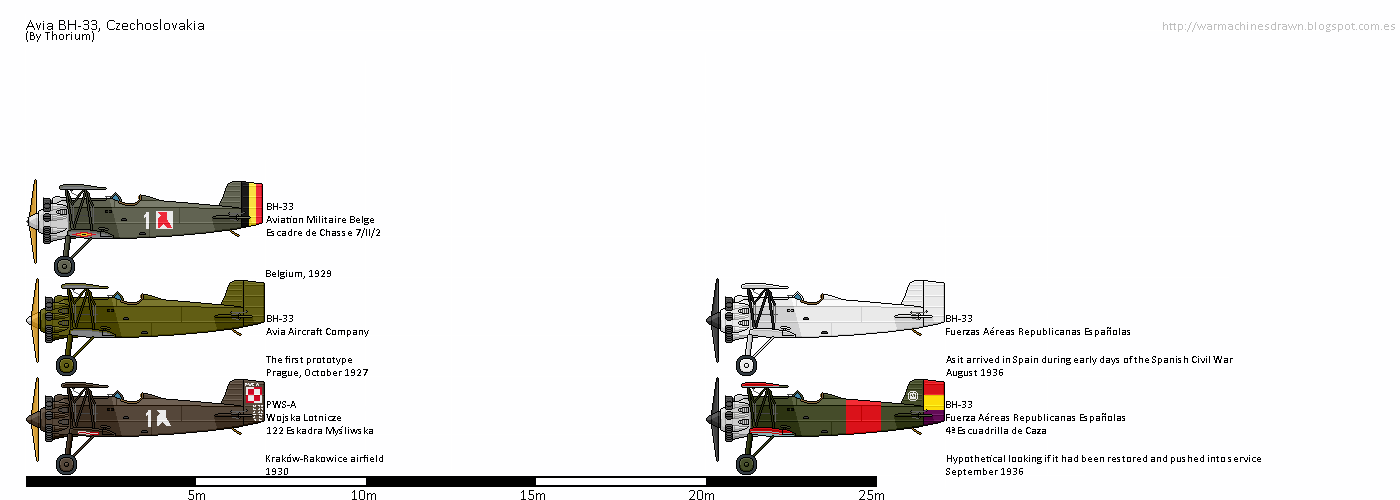
Avia BH-33

During 1926 Avia tested the Gnome-Rhône version of the Bristol Jupiter nine-cylinder radial air-cooled engine fitted to a BH-21 airframe, the BH-21J.

Trials were satisfactory and a new design was born, with the given name of Avia BH-33. It was the last fighter designed by Miroslav Hajn and Pavel Benes for Avia and was also the first Avia fighter to feature a fixed tail fin from the outset. Trials on the new design started in 1927 and were satisfactory enough for the Czechoslovak Army Air Corps, but not brilliant enough that they only ordered 5 airplanes. It was powered by a Walter-built Bristol Jupiter VI engine delivering 543hp at take-off and was armed with two Vickers 0.303in machine guns.

In Belgium, one Avia BH-33 powered by a Bristol Jupiter VII engine was one of the contenders for the Aéronautique Militaire fleet standaristation programme which was eventually won by the Fairey Firefly.
Regarding to Spain, apparently a single BH-33 painted entirely in white flew to Spain in the early days of the Spanish Civil War loosing it's machine-guns and synchronisation gear en route. It's unknown what happened to it, but we couldn't resist the impulse of thinking how it would've looked like if it had been repaired, repainted and push into service.
Poland adquired a manufacturing license in 1928 with PZL building 10 pre-production airplanes of this type and PWS building 50 of them as the PWS-A from 1930 onwards.


Sources:
1. https://en.wikipedia.org/wiki/Avia_BH-33
2. Salamander Books - The Complete Book of Fighters
3. http://bioold.science.ku.dk/drnash/model/spain/did.html
4. http://www.belgian-wings.be/Webpages/Navigator/Photos/MilltaryPics/interbellum/avia_bh33.htm