Showing posts with label Belgium 1950-1959. Show all posts

Monday, 4 November 2024

Supermarine Spitfire. European Users, part one. Belgium.

Sources:


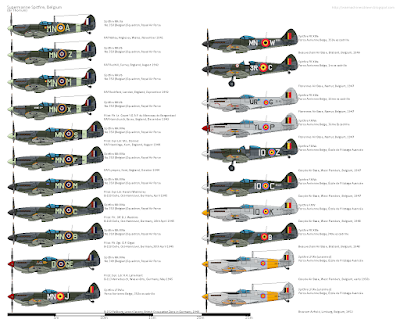
The Supermarine Spitfire was also employed by Nos. 349 and 350 squadrons, composed by Belgians during World War 2.
  • No. 349 Squadron: This unit switched their Curtiss Tomahawk for Spitfires Mk.V-s in June 1943 and was rebased to southern England to take part in bomber escort duties and fighter sweeps over mainland Europe. The squadron took part in Operation Overlord and kept the same role, escorting bombers and providing some ground support. In August 1944 the unit was rebased to France performing armed reconnaissance missions. 
    In February 1945 they returned to England to be re-equipped with the Hawker Tempest, however, the pilots did not appreciate the aircraft and opted for the Spitfire Mk.IX instead. They were rebased to the Netherlands and finally to Belgium, where it was transferred to the Belgian Air Force on 24th October 1946. 
    Once in Belgian command (renamed as '349e Escadrille') it was equipped with the Spitfire Mk.XIV. 
  • No.350 Squadron: This formation acquired the Spitfire Mk.II in November 1941 and shortly later, in February 1942 they transitioned to the Mk.V and were assigned to convoy protection duties over the Irish Sea. In April 1942 they were relocated to south-east England where they carried out many offensive sweeps over occupied France. They took part in Operation Overlord and, in August 1944 they engaged many V-1 flying bombs attacking England. The squadron was rebased to Belgium in December 1944, where it remained until the end of the war. 
    On 15th October 1946 it was transferred to the Belgian Air Force, was renamed to 350e Escadrille, and kept their Spitfire Mk.XIV until July 1949 when they were replaced by the Gloster Meteor. 
Aside from those two squadrons, the École de Pilotage Avancée (Advanced Flying School) also employed the Spitfire Mk.IX. Those were supplied from RAF surplus stockpiles in August 1947 when 28 machines were ordered, followed by 18 second-hand more, as attrition was taking a toll on the Mk.IX-s. 
In 1952 a demonstration team was created for a short period of time but an unfortunate accident led to the disbandment of that unit. They were gradually written off and acquired by Cogea Nouvelle of Oostende which used them as target tugs. Most of them survived and were used for filming, some of them appearing in the 1969 movie Battle of Britain.


Sources:
1st https://en.wikipedia.org/wiki/349th_Squadron_(Belgium)
2nd https://en.wikipedia.org/wiki/350th_Squadron_(Belgium)
3rd https://www.belgian-wings.be/supermarine-spitfire-lf-ixc-e

Tuesday, 2 June 2020

Airspeed AS.10 Oxford, part three, Belgian & Czechoslovak users

The Airspeed AS.10 Oxford was a British twin-engined multi-purpose aircraft that was designed and developed by Airspeed Ltd.. It was conceived as a trainer variant of Airspeed's previous design, the Airspeed Envoy, but it quickly grew as an aircraft of its own. It was exported to many countries, among them, Belgium and Czechoslovakia:

  • Belgium: In July 1939 a single Oxford owned by Airspeed Ltd. was flown to Evere Airport, in Brussels. It was piloted by Georges B.S. Errington and the aircraft was to be displayed at the IIe Salon Aéronautique de Bruxelles (Brussels' Aeronautical Show). Shortly later, in August, the Belgian Aéronautique Militaire (Belgian Army's Aeronautical branch) announced the purchase of that particular machine. It was intended to be used for advanced training and communications role. In fact, back in March 1939 the Oxford had been selected as the winner competing against the French Potez 561, the Germans Focke-Wulf Fw.58 Weihe and Siebel Si.204 Halle and the Italian Caproni Ca.310.
    After successful further trials, apparently the Belgian Oxford was registered as D-1. However, some sources claim it wasn't registered at all. Anyway, an order for further 5 machine was placed. Those additional Oxfords were to be assembled by both Renard and SABCA. However, that process was halted when Germany invaded Belgium in May 1940 and the Germans captured the aircraft (its fate is unknown). This single Oxford was used by the Ecole d'Aeronautique (Aeronautical School) based at Evere Airport, in Brussels and then it was transferred to No.3 Squadron of the Ecole de Pilotage (Pilots School) in Deurne, in Antwerp.
    After the war, for the newly founded Belgian Air Force, 30 Oxfords were ordered on 16th January 1947. Most of the Oxfords served with the Ecole Pilotage Avancé (Advanced Piloting School) and the 15th Transport Wing. Many of them were also used as base hacks in different wings through the Royal Belgian Air Force. In July 1955, the Belgian Air Force decided that every Oxford should be flown to their next main overhaul after which they were scrapped at Evere because their wooden structure didn't allow them to extend their useful live. Nowadays a single Oxford is preserved at the Royal Army Museum in Brussels.
  • Czechoslovakia: A single Oxford T.1 (the trainer variant) which belonged to No.311 (Czechoslovak) Squadron of the Royal Air Force (RAF) flew, in September 1945 from RAF Manston, in Kent, to Prague with a crew of three. The machine was pushed into service with the back then, newly founded Czechoslovak Air Force. The Oxford then received various different codes and served with various units until 1950 when, due to a lack of spare parts the machine was abandoned and scrapped.


Sources:
1. http://www.belgian-wings.be/Webpages/Navigator/Photos/MilltaryPics/post_ww2/Airspeed%20Oxford/airspeed_oxford%20frontpage.htm
2. http://www.belgian-wings.be/Webpages/Navigator/Photos/MilltaryPics/interbellum/Airspeed%20Oxford%20I/Airspeed%20Oxford%20I%20Frontpage.html
3. https://en.wikipedia.org/wiki/Airspeed_Oxford#Other_users
4. https://www.super-hobby.com/products/Airspeed-Oxford-Mk.I-II-Foreign-Service.html

Thursday, 16 April 2020

Avro Anson, part six, some European Users

The Avro Anson is a British twin-engined multi-role aircraft that was used by many countries all around the globe. The following European countries had the Ansons serving with them:

  • Belgium: In 1947 the British Government authorised deliveries of a number of Ansons Mk.I for the new Belgian Air Force. They were delivered to Evere airfield, in Brussels though few of them survived for long time. One was flying by No.7 Wing as a squadron hack flying crews to Schiphol, Amsterdam to work in Fokker's factory to pick up the newly built Gloster Meteor F.8 which were being manufactured under license there in 1950.
    The No.21 Smaldeel (Squadron) was equipped with Ansons which were separated into various different flights when the unit received the Douglas DC-4 for long range transportation.
    The Air Force's Main Transport Flight had also Douglas C-47s as its personnel was part of the No.525 Squadron during the War. This squadron was known as the 'Verbindingsflight' and took two Ansons into service when they departed RAF Hendon in August 1946. The flight was later upgraded to squadron-strength and named 'No.367 Squadron' and was later renamed as '21 Smaldeel' and was used for communications duties.
    One C.19 one was also used by SABENA (Belgian National Airline) to cover some internal aerial routes before it was sold to Air Congo and sent to the Belgian Congo. Two more served with Air Congo (making a total of three) and one of them served with John Mahieu Aviation in Brussels.
  • Czechoslovakia: Three Ansons were given in total to Czechoslovakia after the War. Two Mk.XII and a single Mk.I but one of them crashed into the sea off the Danish coast. The remaining two were assigned to the Air Traffic Regiment of the newly formed Czechoslovak Air Force in 1946 and 1947. Their fate is unknown.
  • Estonia: One Anson Mk.I was delivered to the Estonian Air Force in 1936 (although some sources claim it was in 1937). It received the serial 158 and when the country was occupied by the USSR, it was passed on to the Soviet Air Force.
  • Finland: Before the War, the Ilmavoimat (Finnish Air Force) ordered three Ansons Mk.I. Finnish pilots were trained at Woodford in Stockport, Greater Manchester and the first Anson arrived in Utti, Finland, on 27th September 1936. The three Ansons were initially used for twin-engined aircraft training, while the Bristol Blenheim bombers arrived. When the Winter War started on 30th November 1939, they were used for aerial reconnaissance works. During one of those missions, one of them was lost to a crash in February 1940, another one crashed in 1943, when it was written off. The last one survived until 1947 when it made its last flight.


Sources:
1. Hall Park Books - Warpaint 53 - Avro Anson
2. https://en.wikipedia.org/wiki/Avro_Anson
3. http://britishaviation-ptp.com/avro652_3.html
4. https://www.armedconflicts.com/Avro-Anson-C-Mk-12-t50511
5. http://www.svazletcu.cz/eng/csl2_2.html#

Saturday, 21 May 2016

Armstrong Whitworth Meteor NF.11 - Various foreign users

Note: So far we're only covering those variants of the Gloster Meteor built and designed by Armstrong Whitworth.

The Armstrong Whitworth Meteor in it's night fighter variant was used by many countries, those countries were:


  • Belgium: In July 1949 Belgium decided to create three night fighter squadrons before the end of 1951 and, in May 1948 the No.10 night-fighter squadron equipped with De Havilland Mosquitos NF.30 was formed at Beauvechain. On 1st July 1951 the No.11 Night-Fighter Squadron was formed and the Mosquitos were split between those two squadrons until the Armstrong Whitworth Meteor NF.11 arrived in the summer of 1952. Initially they were used by both squadrons but later all of them were allocated to the No.11 Night Fighter squadron. In 1953 the Mosquitos were written-off and the pilots were allocated to the No.11 Squadron. Later, in 1956 more second-hand Meteors were bought in order to re-equip both squadrons. They were replaced by the Avro Canada CF-100 Canuck. 
  • Denmark: The Royal Danish Air Force equipped their night-fighter squadron, Eskadrille 723 with the Meteor NF.11. They were replaced in 1959 by the North American F-86D Sabre Dog.


Sources:
1. https://en.wikipedia.org/wiki/Gloster_Meteor
2. Salamander Books - The Complete Book of Fighters
3. http://www.belgian-wings.be/Webpages/Navigator/Photos/MilltaryPics/post_ww2/Gloster%20-AW-%20Meteor%20NF.11/Gloster%20Meteor%20NF11%20Frontpage.htm
4. https://da.wikipedia.org/wiki/Eskadrille_723 (translated)