Showing posts with label Mikoyan-Gurevich MiG-17F. Show all posts

Thursday, 2 January 2020

Mikoyan-Gurevich MiG-17F, part eleven, more Asian and Middle-East users

The Mikoyan-Gurevich MiG-17F was supplied to many countries all around the globe. Among them, the following ones:

  • Indonesia: As Indonesia grew closer to communism, the country got closer to the Easter bloc, so in the early 1960s many Soviet-built aircraft were supplied. At least 40 of them were deployed in three airfields in Morotai (northern Makulu), Amahai (Seram) and Letfuan (Banda islands, south-west of Papua). They were deployed at Morotai against PRRI-PERMESTA and the Republic of South Maluku separatists. Their primary mission was to provide air cover for airlift and aerial logistics during the infiltration in Papua and, if the war broke out, they would've provided escort for both Tupolev Tu-16 and Ilyushin Il-28. Some of them were part of an Indonesian aerobatics squadron commanded by Rusmin Nurjadin, who became Chief of Staff of the Indonesian Air Force in 1966.
  • Iraq: After the King or Iraq was overthrown in 1958, the Soviets quickly supplied MiG-17Fs among other aircraft to the Iraqi Air Force, to replace the De Havilland Vampire. During the 1960s and early 1970s many more of them were purchased and then forwarded to Syria or Egypt to aid them in the Arab-Israeli Wars. In 1961 the 5th Squadron, based at Rashid Air Base and the 7th Squadron, based at Kirkuk Air Base, were fully equipped with MiG-17F. They were all replaced by more modern types during the 1970s.
  • Israel: On 12th August 1968 two Syrian MiG-17Fs landed at the abandoned Betzet air strip, in the northern part of the country. It seems that the pilots were using very outdated maps and landed there by mistake. Both pilots, Lt. Walid Adham and 2nd Lt. Radfan Rifai, were taken prisoners and were released two years later in an exchange of prisoners. The machines were transported to Ramat-David Air Force Base where they were tested, and then sold to the United States. 
  • Mongolia: As Mongolia was a Soviet puppet, the Mongolian People's Army Air Force acquired in the mid 1950s at least 36 MiG-17F fighters which were kept in active service until 1990. As we couldn't find graphical information about the MiG-17F in Mongolian colours, the drawing and serial number must be considered as speculative.
  • North Korea: The North Korean People's Army Air and Anti-Air Force acquired many MiG-17F in the early 1960s and has kept them in active service even nowadays. Apparently the ones that are officially active are in very bad condition and their flightworthiness is at least questionable. 
  • North Yemen: Apparently the Yemen Arab Republic Air Force had in service some few MiG-17F in the 1960s. They saw action during the border clashes between North and South Yemen and many of them were used against royalist rebels. It seems that during those conflicts, the Yemen Arab Republican Air Force only lost two MiG-17Fs.


Sources:
1. https://en.wikipedia.org/wiki/Mikoyan-Gurevich_MiG-17
2. https://en.wikipedia.org/wiki/Yemeni_Air_Force
3. https://warisboring.com/45650-2/
4. https://en.wikipedia.org/wiki/Mongolian_People%27s_Army
5. https://en.wikipedia.org/wiki/Iraqi_Air_Force
6. https://en.wikipedia.org/wiki/Indonesian_Air_Force
7. https://www.iaf.org.il/4450-46914-en/IAF.aspx
8. Salamander Books - The Complete Book of Fighters

Thursday, 29 August 2019

Mikoyan-Gurevich MiG-17F, part ten, Egyptian users

The MiG-17F was used in a big number of wars, among them the middle-east ones. They saw action for the first time in Egyptian hands in October 1956 at the Suez Crisis facing the French fighters Dassault Ouragan and Dassault Mystére IV.
However, during that conflict, the Egyptian Air Force had just 12 MiG-17F, so the bulk of the fighting was undertook by the MiG-15bis, as the MiG-17F played a small role. According to Egyptian sources, during the aerial battle that took part over Kabrit Air Base, close to the Suez Canal, in Egypt, three Egyptian MiG-17Fs shot down another Dassault Mystére IV without suffering any casualties at all in the Egyptian side.
It was also used during the next Arab-Israeli War, the Six-Days War in 1967 and again during the Yom-Kippur War in 1973 but already in 1967, as the MiG-17F lacked radar, and Egyptians had better fighter aircraft, the MiG-17F was used in the ground support role, for which some of them were ad-hoc modified by the Egyptian General Aero Organisation with two bomb racks under the fuselage and rocket launchers at the tip of the wings.
From the late 1950s, when the first MiG-17Fs arrived until the 1980s, the MiG-17F served with the Egyptian Air Force when it was replaced by more modern types and put into reserve (status that keeps nowadays).
After the big losses that the Egyptian Air Force took in the Six-Days War, they decided to camouflage their MiG-17Fs with a variety of colours applied directly to the bare metal fuselages. In emergency, and lacking suitable colours, the Egyptians decided to use paint stock from a car factory at Helwan. This particular colour scheme was popularly known as the "Nile Scheme" due to their flashy and gaudy combination of green, sand and black-green.


Sources:
1. https://www.globalsecurity.org/military/world/russia/mig-17-action.htm
2. https://en.wikipedia.org/wiki/Egyptian_Air_Force
3. https://en.wikipedia.org/wiki/Mikoyan-Gurevich_MiG-17
4. Salamander Books - The Complete Book of Fighters

Tuesday, 27 August 2019

Mikoyan-Gurevich MiG-17F, part nine, African users, part three

As we've said many times before, the MiG-17F was the fighter backbone of many African nations, among them the following ones:

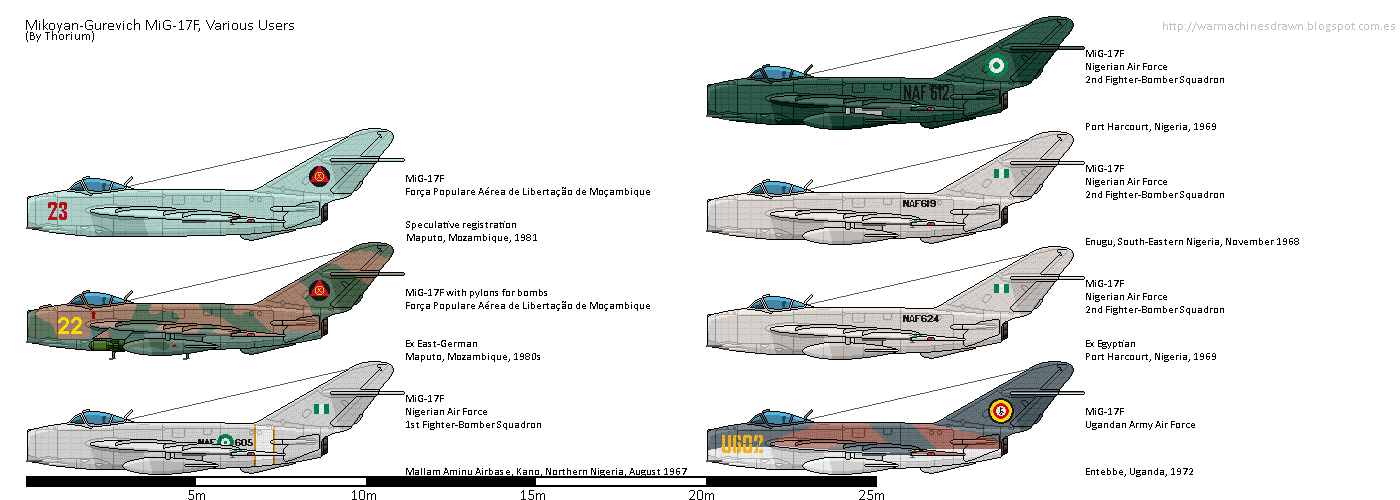
  • Mozambique: Just like it happened with Angola, People's Liberation Air Force of Mozambique (PLAFM) was created in 1975 after Independence War and the subsequent Civil War. Twelve MiG-17Fs were supplied to the PLAFM most of them to perform ground support missions as they didn't have to keep the skies clear. Many of them were ex-East German which were already modified for fighter-bomber operations and had already underwing pylons for carry either bombs or air-to-ground rocket launchers.
    The fighter-bombers were delivered to the port of Beira in August 1981 with a detachment of East-German pilots and technicians to put the aircraft together and test-flight them. In fact, the first test flight took place in Beira on 9th September 1981 at the hands of an East German pilot. By October it was officially accepted into the PLAFM. There are reports about additional shipping of two 12-plane batches in 1983 and 1984 but they were never confirmed. During the whole duration of the Mozambican Civil War, the MiG-17F were flown by two fighter-bomber squadrons based at Maputo Air Base and it's known that all of them were inoperative by the early 1990s.
  • Nigeria: The MiG-17 first and the MiG-17F second, gave the Nigerian Air Force (NAF) combat capability after a Biafran attack on 13th August 1967 that damaged the already weakened NAF. After that attack, the USSR supplied the Nigerian Air Force with deliveries taken from Egyptian ports to Kano IAP. Initially just 8 MiG-17F were delivered. In July 1971 it was estimated that all of them were still active. They were taken out of service in 1975 following the delivery of the MiG-21 which replaced them. 
  • Uganda: From 1966 until 1972 around 12 MiG-17Fs were supplied to Uganda, whose Air Force (from now on Ugandan Army Air Force - UAAF) was strongly influenced by the Israeli Air Force back then, hence that atypical camouflage configuration. At least four of them were destroyed in the Entebbe Raid in 1977 and the last ones were flown during the Uganda-Tanzania War in 1978 and 1979. One of them was shot down by Tanzanian SA-7 on 11th October 1978 and the remaining ones (just two or three) captured and destroyed by Tanzanian troops in April 1979. 


Sources:
1. https://en.wikipedia.org/wiki/Mikoyan-Gurevich_MiG-17
2. https://en.wikipedia.org/wiki/Mozambique_Defence_Armed_Forces
3. https://en.wikipedia.org/wiki/Nigerian_Air_Force
4. https://en.wikipedia.org/wiki/History_of_Uganda_(1971–79)
5. https://en.wikipedia.org/wiki/Uganda–Tanzania_War
6. Salamander Books - The Complete Book of Fighters
Saturday, 24 August 2019

Mikoyan-Gurevich MiG-17F, part eight, Vietnamese users part two

A little bit later, but here it comes, Saturday's post.
On 4th April 1965 the USAF tried to take down the Thanh Hóa bridge, this time with a force composed of 48 Republic F-105 Thunderchiefs belonging to the 355th Tactical Fighter Wing, loaded with bombs. The Thunderchiefs were escorted by a flight of F-100 Super Sabres belonging to the 416th Tactical Fighter Squadron. The Thunderchiefs were ambushed by four MiG-17Fs of the 921st Fighter Regiment, which came from above, bypassed the F-100s and dove into the Thunderchiefs themselves shooting two of them down. One F-105D was shot down by the group leader Tran Hanh of Maj. F.E. Bennett. His element leader Le Minh shot down another F-105D piloted by Cpt. J.A. Magnusson. When the F-100 engaged them, one MiG-17F piloted by Pham Giay (Tran Hanh's wingman) was shot down and killed with the guns after a Sidewinder missile failed. After that action, Tran Hanh stated that at least three of his pilots were shot down by USAF fighters.
Of the four MiGs that attacked, only Tran Hanh survived and those three aircraft shot down were the first American aerial victories of the Vietnam War.
In 1965 the North Vietnamese Air Force (NVAF) had just 36 MiG-17s and a similar number of pilots which were increased to 180 MiGs and 72 pilots by 1968. This contrasts with the American numbers of at least 200 F-4 Phantoms and 140 F-105s just from the USAF, plus at least 100 US Navy aircraft (F-8, A-4 and F-4s) which operated from various aircraft carriers in the Gulf of Tonkin.
The MiG-17F was the main interceptor of the weak NVAF in 1965, which was responsible for the first aerial victories of the war and saw extensive use during the Vietnam War. Some Vietnamese pilots preferred the MiG-17 over the MiG-21 given its agility although being slower. In fact, three of the NVAF's aces of the war, flew the MiG-17. Those were Nguyen Van Bay (seven victories), Luu Huy Chao and Le Hai (both of them with six victories each) and the rest of their aces gained the ace status flying the MiG-21.
The MiG-17F flew their interceptor with ground controller's guidance who directed the MiGs to ambush American formations. The MiGs made fast attacks from many directions, while the MiG-21 attacked usually from behind. After shooting down some American aircraft and forcing the F-105Ds to drop their bombs prematurely, the MiGs didn't wait for retaliation but disengaged quickly, performing some sort of "guerrilla warfare" in the air, which proved very successful.
Although the MiG-17 wasn't designed as a fighter bomber, the NVAF stated in 1971 that American warships were to be attacked, requiring some MiG-17s to be fitted with bomb mounting and releasing mechanisms. Two MiGs were modified for this role and, after three months of works, they were ready. They belonged to the 923rd Fighter Regiment and, on 19th April 1972 they attacked the destroyer USS Higbee (DDR-806) and the light cruiser USS Oklahoma City (CLG-5), destroying destroyer's main aft 5" gun, inflicting no fatalities, as the crew had already evacuated the turret due to a malfunction.
From 1965 until 1971 the MiG-17s belonging to either the 921st or 923rd Fighter Regiments would claim 71 aerial victories, while losing 63 MiG-17s in combat.
Overall, thanks to its agility, the MiG-17 was feared and it shocked American fighter pilots in 1965 to the point that some exercises were performed by the USAF to simulate dogfights between an F-86H and either a F-100 or a F-105 and they reached to the conclusion that, in a dogfight, the more modern fighters were very vulnerable to a subsonic one like the MiG-17 was.
The MiG-17 continued serving until the end of the Vietnam War and they were phased out almost immediately after when they were replaced by more types like the Sukhoi Su-22.


Sources:
1. https://en.wikipedia.org/wiki/Mikoyan-Gurevich_MiG-17#Vietnam_War
2. Salamander Books - The Complete Book of Fighters
3. Osprey Publishing- Aircraft of the Aces 130 - MiG-17-19 Aces of the Vietnam War

Thursday, 22 August 2019

Mikoyan-Gurevich MiG-17F, part seven, Vietnamese users part one

In 1960 the first group of around 50 North Vietnamese pilots were transferred North to the People's Republic of China to receive training to the MiG-17. By that time, the first group of Chinese trained MiG-15 pilots had returned to North Vietnam and a group of 31 pilots were deployed in the Vietnam People's Air Force base at Son Dong to be converted to the MiG-17.
Shortly later, by 1962 the first North Vietnamese pilots had finished their pilot courses in the USSR and PRC, and returned to their units. To mark that occasion, the USSR sent an additional "gift" of 36 MiG-17 fighters and MiG-15UTI trainers to Hanoi in February 1964 creating North Vietnam's first fighter regiment, the 921st. The next year, in 1965, another group of pilots returned to North Vietnam from Krasnodar, in the USSR as well as from the PRC, forming the second fighter unit, the 923rd Fighter Regiment. The newly created 923rd FR operated only MiG-17Fs and initially were the only ones which could face the American supersonic jets before the arrival of MiG-19s and MiG-21s in North Vietnam.
American fighter-bombers had been in the theatre flying combat sorties since 1961 and the US had many experienced pilots from the Korean War and even the World War II. Untried MiGs and rookie pilots of the VPAF (Vietnam People's Air Force) were sent in combat against some of the most combat experienced pilots of the USAF and the US Navy. On 3rd April 1965 six MiG-17Fs took off from Noi Bai Airbase in two groups of two and four, with the first group acting as a bait and the second one acting as shooters. Their target were US Navy aircraft which were supporting an USAF 80-aircraft strike group trying to knock out the Thanh Hóa Bridge. The MiG-17 leader, Lt. Pham Ngoc Lan, attacked a group of Vought F-8 Crusaders belonging to the VF-211 squadron operating from USS Hancock (CV-19) and damaged an F-8E flown by Lt. Cdr. Spence Thomas, who managed to land the aircraft at Da Nang airbase, then in control of the Republic of Vietnam Air Force). A second F-8 was claimed by his wingman Phan Van Tuc.


Sources:
1. https://en.wikipedia.org/wiki/Mikoyan-Gurevich_MiG-17#Vietnam_War
2. Salamander Books - The Complete Book of Fighters
3. Osprey Publishing- Aircraft of the Aces 130 - MiG-17-19 Aces of the Vietnam War

Tuesday, 20 August 2019

Mikoyan-Gurevich MiG-17F, part six, various European users

The MiG-17F was the main fighter of many Warsaw Pact Users, among them, the following ones:

  • Bulgaria: During the mid-to-late 1950s, the People's Republic of Bulgaria was supplied with batches of the newest Soviet jet fighters. The MiG-17F was active in the Bulgarian People's Army Air Force through the 1960s until the 1970s when it was withdrawn following a modernization period of the Bulgarian Air Force.
  • Czechoslovakia: Some few MiG-17F served with the Czechoslovak Air Force before being locally produced as the Aero S-104. One of them was the personal aircraft of Gen. Jozef Kúkel who was the commander in chief of the 10th Air Army. Further details are unknown.
  • East Germany: In 1956 the Soviet Union provided the newly established East German Air Force with many jet fighters and bombers, among them the MiG-17F. It served as their main interceptor/fighter until 1962 when the MiG-21 was introduced. After that, some of them were modified with added pylons to attach either bombs or rocket launchers. These modified machines were commonly known as the East German fighter-bomber and, while some of them were kept in active until the late 1980s, most of them were sold to African countries like Mozambique.


Sources:
1. https://en.wikipedia.org/wiki/Mikoyan-Gurevich_MiG-17
2. https://en.wikipedia.org/wiki/Bulgarian_Air_Force
3. https://en.wikipedia.org/wiki/Czechoslovak_Air_Force
4. https://en.wikipedia.org/wiki/Air_Forces_of_the_National_People%27s_Army
5. Salamander Books - The Complete Book of Fighters

Saturday, 17 August 2019

Mikoyan-Gurevich MiG-17F, part five, Romanian and Soviet users

The Mikoyan-Gurevich MiG-17F was also used by every Warsaw Pact country member. Among them Romania and the USSR, as expected.

  • Romania: In 1952 the People's Republic of Romania received a batch of 48 MiG-17Fs which were delivered in three stages with the last one being delivered in 1955. When, in 1958 the first MiG-19s were delivered, they were gradually withdrawn from active fighter service and sent to ground support duties, although they were technically never used in combat. During the 1960s some of them were still active and they were kept in active service with the Romanian Air Force until as late as 1992 when they were written off.
  • USSR: The MiG-17F was designed for interception of enemy bombers, and not for dog fighting. As it's a subsonic fighter, it was effective against slower (0.6-0.8 mach) heavily loaded American fighters, as well as the main American bombers during its development period in the early 1950s like the piston-powered B-50 Superfortress or the Convair B-36 Peacemaker which was mixed jet and piston-powered. The MiG-17F (which composed the bulk of every Soviet Air Arm during the early-to-mid 1950s) wasn't however able of intercepting the newer generation of bombers that appeared in the mid-1950s like the Avro Vulcan or the Handley-Page Victor as they could flight higher. As the USAF introduced strategic bombers capable of supersonic dashes like the Convair B-58 Hustler or the General-Dynamics FB-111 in the early 1960s, the MiG-17 was rendered obsolete for front-line PVO (Soviet Air Defence Forces) service and they were replaced in that service branch by the MiG-21 and MiG-23.
    In 1958 PVO's MiG-17Fs shot down an American reconnaissance Lockheed C-130 Hercules that was flying over Armenia causing 17 casualties and, during the Prague spring in 1968, the Soviet Forces destined there, used MiG-17Fs to flight over Czechoslovakia.


Sources:
1. https://en.wikipedia.org/wiki/Mikoyan-Gurevich_MiG-17#Operators
2. https://en.wikipedia.org/wiki/Soviet_Air_Defence_Forces
3. https://en.wikipedia.org/wiki/Romanian_Air_Force
4. http://www.aeroflight.co.uk/tag/romanian-air-force
5. Salamander Books - The Complete Book of Fighters

Tuesday, 13 August 2019

Mikoyan-Gurevich MiG-17F, part four, African users, part two

Continuing from the previous post, the MiG-17F was used by many African nations. Among them the users were:

  • Guinea-Bissau: After achieving independence in 1974, Guinea-Bissau's Air Force officers were trained both in Cuba and USSR. It equipped with Soviet aid material in which the first fighters were introduced. They barely flew and nowadays every MiG-17F is placed in "storage" (most probably abandoned to rot) at the Osvaldo Vieira International Airport.
  • Guinea-Conakry: After gaining independence in 1958 the Guinean Air Force was formed with Soviet assistance that delivered ten MiG-17F fighters along with another Soviet aircraft. They were in active use until 1986 (although they didn't see any combat action) when they were replaced by MiG-21PFMs.
  • Madagascar: Back in 1961 when Madagascar was granted independence, the USSR supplied them with a small number of MiG-17Fs, estimated in less than ten. Apparently, some additional ones were also bought from other countries like North Korea. Those have been active until nowadays, which are in "storage" status (abandoned to rot) at the Ivato airport outside of Antananarivo.
  • Mali: In the mid 1960s the Soviets supplied the newly-created Malian Air Force with five MiG-17F fighters. They composed a small squadron based on Bamako-Sénou and were initially manned by Soviet pilots. In 1974 they served alongside with some MiG-21, and saw some combat during the Agacher Strip War, against the Upper Volta. After that conflict the MiG-17Fs were either replaced by the MiG-21 or left to rot.


Sources:
1. https://en.wikipedia.org/wiki/Mikoyan-Gurevich_MiG-17
2. https://en.wikipedia.org/wiki/Guinea-Bissau_Air_Force
3. https://en.wikipedia.org/wiki/Republic_of_Guinea_Armed_Forces
4. https://en.wikipedia.org/wiki/Armée_de_l%27Air_du_Mali
5. https://en.wikipedia.org/wiki/Madagascar_People’s_Armed_Forces
6. Salamander Books - The Complete Book of Fighters

Saturday, 10 August 2019

Mikoyan-Gurevich MiG-17F, part three, African users, part one

The MiG-17F served with many African nations. Among them the following ones:

  • Algeria: Immediately after the independence in 1962, the Algerian Air Force acquired some MiG-17Fs from the USSR, with some of them (most probably the regular older variant) being donated from Egypt. They took part in the border clashes with Morocco in 1963 with the MiG-17F performing the light bomber role. Later, during the Yom Kippur War in 1973, Algerian MiG-17Fs took part in the conflict under Egyptian command performing strafing and light bombing missions. Many of them were shot down in October 1973 by Israel. Some years later, in 1976, they returned to Algeria. It wasn't until the decade of the 1980s when they were retired and replaced by either the MiG-23 or the MiG-25.
  • Angola: When the Angolan Civil War broke out, the Cubans agreed to send a squadron 9 MiG-17F which became de facto in the first Angolan combat aircraft founding the Angolan Air Force which was called "Força Aérea Popular de Angola" (Angola People's Air Force) in December 1975. They were composed entirely by Cubans and was formally constituted in a ceremony by the Angolan President Agostinho Neto on 21st January 1976. On the ceremony the MiG-17s paraded together with the MiG-21s. The commander of the MiG-17Fs squadron was Maj. José A. Montes. The MiG-17Fs act based on Cabinda attacking ground targets controlled by the separatist group FLEC (Front for the Liberation of the Enclave of Cabinda), specially in the Northern regions. In April 1976 FLEC was practically defeated so they were switched against UNITA targets in mainland Angola. Shortly later some more MiG-21s arrived to replace the MiG-17Fs and, therefore, they were handed over to the Angolans. 
  • Burkina Faso: Apparently a single MiG-17F was operated by the Air Force of Burkina Faso and even saw action in the Agacher Strip War in 1985-1986 between Mali and Burkina Faso. Apparently, it survived the war as in the 1990s it was still in active (in the reserve though) with the Air Force of Burkina Faso. 
  • Ethiopia: During the Ogaden War, in 1977, the Cuban Air Force supported the revolutionary Ethiopian Government, so, in December 1977 the Cuban MiG-17Fs arrived. Among them there were a squadron of MiG-17Fs piloted and manned entirely by Cuban pilots. They took part on the counter-offensive that started on 22nd January 1978 that eventually ended with the Somalian defeat and the total conquest of Ogaden on 13th March. The Cuban pilots performed 1.013 combat missions, half of them being ground support ones, during the course of which many enemy tanks, cannons and other targets are destroyed. One MiG-17F piloted by Lt. Eladio Campos was shot down by Somalian anti-air fire killing the pilot. Curiously, in this conflict, CUban MiG-17s and MiG-21s served together with Ethiopian Northrop F-5 Freedom Fighters against another country armed only with MiG-17 and MiG-21 (and mainly with Pakistani pilots). However, there weren't aerial fights between MiGs as the Ethiopians had already achieved aerial superiority when the Cubans arrived. Cuban manned MiGs remained in Ethiopia for some more time but didn't see any more action in spite of the Ethiopian Border Clashes with Eritrea during the 1980s, regardless of some founded rumours. In September 1989, attending to the new international situation, last Cuban pilots abandon Ethiopia taking all the material with them.  


Sources:
1. https://en.wikipedia.org/wiki/Mikoyan-Gurevich_MiG-17
2. https://en.wikipedia.org/wiki/Algerian_Air_Force
3. http://www.urrib2000.narod.ru/EqMiG17.html (translated)
4. https://en.wikipedia.org/wiki/Burkina_Faso_Armed_Forces#Air_Force
5. Salamander Books - The Complete Book of Fighters

Thursday, 8 August 2019

Mikoyan-Gurevich MiG-17F, part two, Sri Lankan and Syrian users

Continuing with the Asian users of the MiG-17F, now it's the turn for two more countries: Sri Lanka and Syria.

  • Sri Lanka: During the March 1971 communist insurrection that placed a left-leaning government in power, the Ceylon Air Force received five MiG-17F from the USSR. They served with the Sri-Lankan Air Force, mostly in the ground support role. After the insurgency, the country became a republic and the name was changed to Sri-Lanka. The Sri-Lankan Air Force kept the MiG-17Fs until the early 1980s when they withdrawn as they were clearly outdated.
  • Syria: After the creation of the United Arab Republic in 1958, the Syrian Air Force was merged with the Egyptian one and nearly all of its aircraft and personnel were redeployed to Egypt. There, they were replaced by two squadrons of MiG-17Fs. After the dissolution of the United Arab Republic in 1961, the new Syrian Air Force - designated as Syrian Arab Air Force (SyAAF) - was re-established later in that same year, acquiring aircraft left by the Egyptians; around 40 MiG-17Fs.
    During the Six-Days War of 1967, the SyAAF flew some strikes on Northern Israel's bases but was shortly evacuated to other air bases in remote parts of Syria, preventing this way the destruction of their Air Force on the ground just like it had happened with both Egyptian and Jordanian ones. After that war, Syria kept on buying small amount of MiG-17s from East Germany. After the Yom-Kippur War in 1973, the SyAAF suffered heavy losses, prompting the Soviets to establish an air-bridge with Damascus and, in April 1974 they received the first batch of MiG-23 which redeemed the MiG-17fs as obsolete and replaceable.


Sources:
1. https://en.wikipedia.org/wiki/Sri_Lanka_Air_Force
2. https://en.wikipedia.org/wiki/Syrian_Air_Force
3. Salamander Books - The Complete Book of Fighters

Tuesday, 6 August 2019

Mikoyan-Gurevich MiG-17F, part one, Afghan and Cambodian users

The Mikoyan-Gurevich MiG-17F (NATO Codename "Fresco-C") was an improved variant of the regular MiG-17. It was a revised version with a better Klimov VK-1F engine which delivered 26.5 kN (6000 lbf) of thrust in dry and 33.8 kN (7600 lbf) with afterburner. It also included a new and improved air-brake which proved to be much better than the original one.
In this post we're going to post about two Asian users:

  • Democratic Republic of Afghanistan (DRA): After the Soviet Invasion of Afghanistan and the subsequent foundation of the Democratic Republic of Afghanistan in December 1979, the DRA's Air Force was established with Soviet material. Among it were some MiG-17F (which by the date were highly outdated) which remained grounded for most of the time due to maintenance issues or limited availability of crews. Most of them were destroyed or left to rot in the subsequent conflicts.
  • Cambodia: In November 1963, after having received permission from the USSR to train their pilots there, the Kingdom of Cambodia received a batch of three MiG-17F fighter jets. It was followed later, in 1967 by a second batch of five more. Considering that Cambodia was, theoretically, neutral during the Vietnam War, from 1963 until 1970, the MiG-17Fs were assigned to the intervention squadron responsible for keeping Cambodian aerospace free.
    After the March 1970 coup with overthrew the monarchy and set up the Khmer Republic, the country fell into a bloody civil war, were the air force, composed of mixed American and Soviet material, played an important role. In fact, the recorded sorties of the MiG-17 during the period of March-October 1970 rose up to 360. Most of those were to support ground troops. It's worth pointing that some MiG-17Fs were modified to carry American Mk.82GP bombs underwings. Most of the Cambodian MiG-17Fs were either destroyed or abandoned in on of the subsequent wars.


Sources:
1. https://en.wikipedia.org/wiki/Mikoyan-Gurevich_MiG-17#Variants
2. https://www.valka.cz/Mikojan-Gurevic-MiG-17F-kod-NATO-Fresco-C-t12484
3. https://en.wikipedia.org/wiki/Democratic_Republic_of_Afghanistan#Air_Force
4. https://en.wikipedia.org/wiki/Khmer_Air_Force
5. Salamander Books - The Complete Book of Fighters