Showing posts with label Armstrong Whitworth Whitley. Show all posts

Tuesday, 10 November 2020

Armstrong Whitworth Whitley, part six

 
The Whitley, unlike the Handley Page Hampden or the Vickers Wellington, was always intended to be a night bomber and, therefore, the model escaped from the heavy losses that the other two mentioned types suffered during the initial day-time raids over German shipping. Considering that it was the oldest of the three models, it was effectively obsolete at the beginning of the war, yet more than 1.000 more aircraft were produced before a suitable replacement was found. The Mk.VII had a particular problem with its drag-producing antennas; it couldn't keep altitude on one engine. The Whitleys of the Bomber Command flew a total of 8.996 operations, dropped 9.845 tons of bombs and a total of 269 of them were lost in action.
The last operational mission by a Whitley-equipped bomber squadron took place on the night of 29/30th April 1942, when Whitleys bombed the port of Ostend, in Belgium. In late 1942 the Whitley was retired as a frontline aircraft for bomber squadrons and was assigned to other roles. The type kept on service delivering agents and supplies with special service squadrons (Nos. 138 and 161) until December 1942. as well as serving as a transport of paratroopers, freight and a tow for aircraft gliders. In 1940 the Whitley was selected as the standard paratroop transport. In this role, the ventral turret's hole was modified to allow paratroopers jump through it. No.100 Group of the Royal Air Force (RAF) used Whitleys as an airborne platform to perform airborne radar sweeps and electronic counter-measures. In February 1942, Whitleys were used to carry the paratroopers who took part in the Bruneval raid, in Northern France, where German radar technology was captured. This raid received the codename of Operation Biting.
The Mk.VII Whitleys were among the last ones to remain in service with the Long-Range RAF Coastal Command, as by early 1943 they were still active. The first U-Boat kill attributed to the Whitley Mk.VII was the sinking of the U-751 on 17th July 1942, which was achieved in collaboration with an Avro Lancaster. After evaluating the Whitley in 1942, the Fleet Air Arm (FAA) used some modified ex-RAF Mk.VIIs from 1944 to 1946 to train aircrews in Merlin engine management and fuel transfer procedures.

In April/May 1942 the British Overseas Airways Corporation (BOAC) had in inventory 15 Whitley Mk.V aircraft which had been converted into freighters. This conversion involved the removal of all defensive armament, with the turret recesses being faired over, the installation of additional fuel tanks in the bomb bay and the adaptation of the interior fuselage for freight stowage and one aircraft was fitted with a larger cargo door. This type was routinely used for night supply flights from Gibraltar to Malta, route which took seven hours and often it required to land during Axis attacks on the island of Malta. These freighters also flew the dangerous route between Leuchars Station, in Scotland and Stockholm, in Sweden. The Whitley consumed a disproportionately huge amount of fuel to carry relatively small payload so, together with some other reasons which rendered the type as 'less than ideal', in August 1942 the type was replaced by the Lockheed Hudson and the 14 survivors were returned to the RAF.


Sources:
1. https://en.wikipedia.org/wiki/Armstrong_Whitworth_Whitley#Operational_history
2. https://www.valka.cz/Armstrong-Whitworth-A-W-38-Whitley-t15610
3. Hall Park Books - Warpaint 21 - Armstrong Whitworth Whitley

Saturday, 7 November 2020

Armstrong Whitworth Whitley, part five


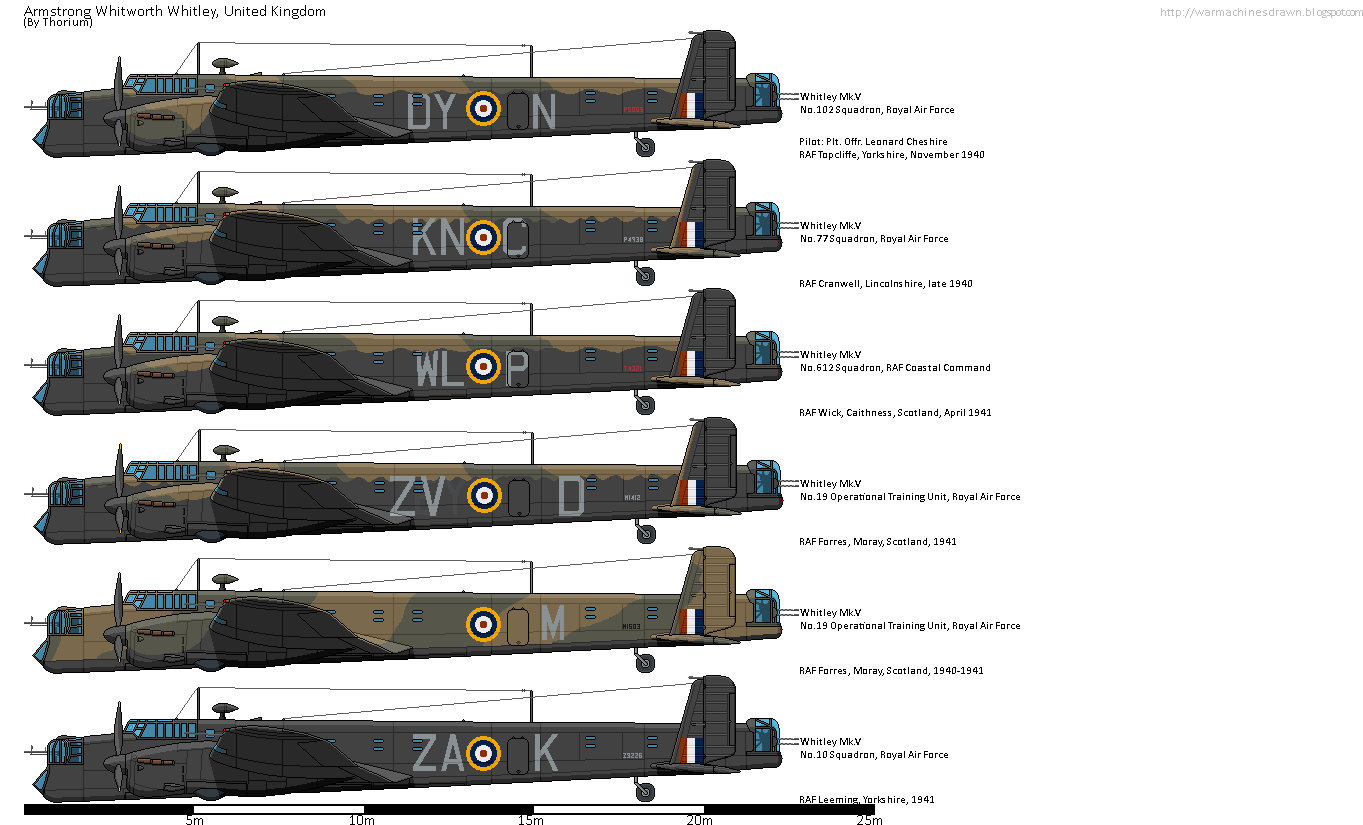
On 9th March 1937 the Whitley Mk.I entered service with the No.10 Squadron of the Royal Air Force (RAF) replacing the outdated Handley Page Heyford biplane. Later, in January 1938, the Mk.II entered squadron service for the first time with No.58 Squadron and, shortly later, in August, the Mk.III was supplied to the No.51 Squadron. In May 1939 the Mk.IV served for the first time with the No.10 Squadron and later, in August the Mk.IVA entered operational service with the No.78 Squadron. At the beginning of the World War II a total of seven Whitley squadrons were operational, most of them equipped with the Mk.III or Mk.IV, while just a very few Mk.Vs were introduced, a total of 196 Whitleys of every type were serving with the RAF.
At the beginning of the war, the No.4 squadron, equipped with the Whitley, was the only trained night-bomber unit in the world. Together with the Handley Page Hampden and the Vickers Wellington, the Whitley bore the burden of the early fighting and saw action during the first night of the war, when they dropped leaflets over Germany. This action made the Whitley the first RAF Bomber Command's aircraft to fly into German territory. Further propaganda flights were made to places as far as Prague and Warsaw. On the night between the 19th and the 20th March 1940, together with some Hampdens, the Whitley made the first bombing raid into Germany, attacking the Hörnum seaplane base, located at the island of Sylt, in Schleswig-Holstein. After that raid, the Whitley routinely patrolled the Frisian islands targeting shipping and seaplane activity.
On the night between  11th and 12th of June 1940 the Whitley performed Operation Haddock, the first RAF bombing raid on Italy, just some hours after Italy waged war on both France and the British Empire. The Whitleys bombed Turin and Genoa, reaching northern Italy via a refuelling stop in the Channel Islands. Many of the leading RAF's bomber pilots of the war flew the Whitleys at some point in their careers. 


Sources:
1. https://en.wikipedia.org/wiki/Armstrong_Whitworth_Whitley#Operational_history
2. https://www.valka.cz/Armstrong-Whitworth-A-W-38-Whitley-t15610
3. Hall Park Books - Warpaint 21 - Armstrong Whitworth Whitley
Thursday, 5 November 2020

Armstrong Whitworth Whitley, part four


The Armstrong Whitworth Whitley was a twin-engined heavy bomber which, as we wrote in previous posts, was initially powered by two Armstrong Siddeley Tiger IX radial engines yielding 795 hp of power each. More advanced versions of the Tiger engine powered subsequent variants of the Whitley, while from the Mk.IV onwards, they were replaced by a pair of Rolls Royce Merlin IV V12 engines which yielded a power of 1.030 hp each. These new engines boosted considerably Whitley's performance.
The Whitley had a crew of five: a pilot, a co-pilot/navigator, a bomb aimer, a wireless radio operator and a rear gunner. The pilot and the co-pilot sat side by side in the cockpit with the wireless operator further back. The navigator had his seat mounted on rails to be able to pivot, slid backwards and rotated to the left to use the table chart behind him after takeoff. Bomb aimer was positioned in the nose with a gun turret located directly above. The fuselage just aft of the wireless operator was divided horizontally by the bomb bay, behind which was the main entrance door and aft of that, the rear turret. The offensive armaments were stowed in two bomb bays housed within the fuselage, along with a further 14 smaller cells in the wings. According to some other sources, however, there were up to 16 in total; two groups of 2 in the fuselage, and four groups of 3 in the wings, plus two smaller cells for parachute flares in the rear fuselage. The Mk.III variant had bomb racks capable of holding larger bombs. 
Initial variants had a nose and rear turrets, both being manually operated and mounting a single Vickers 0.303 in machine gun. On the Mk.III this defensive configuration was revised and a new retractable 'dustbin' ventral turret with two Vickers 0.303 in was added. The nose turret was also replaced with a Nash & Thompson power-operated turret. On the Mk.IV, tail turret was replaced with a Nash & Thompson turret and the ventral one was eliminated. Once the tail turret was replaced, the Whitley became the most powerfully armed bomber in the world against rear attacks. 
The fuselage was divided in three sections, with the main frame being riveted with the skin and the intermediate sections being riveted to the inside flanges of the longitudinal stringers. Extensive use of Alclad sheeting was also made. Fuel was carried inside of three tanks all of them distributed all around the fuselage and the wings. In combat, the fuselage proved to be robust enough to withstand severe damage.
The Whitley featured also a large rectangular-shaped wing, which gave the aircraft its nickname of 'The Flying Barn Door'. Like the fuselage, the wings were formed from three sections, being built around a large box spar with the leading and trailing edges being fixed onto the spar at each rib point. The forward surfaces of the wings were composed of flush-riveted, smooth and unstressed metal sheeting, the rear being 2/3rds aft of the box spar to the trailing edge, as well as the ailerons and split flaps were covered in fabric. The inner structure of the split flaps was made out of duralumin and went between the ailerons and the fuselage, being set at a 15-20 degrees position for taking off and at a 60 degree for landing. Tailplanes used a similar construction style to that of the wings,with the fins braced to the fuselage using metal struts with the elevators and rudders having servo-balancing trim tabs.


Sources:
1. https://en.wikipedia.org/wiki/Armstrong_Whitworth_Whitley
2. https://www.valka.cz/Armstrong-Whitworth-A-W-38-Whitley-t15610
3. Hall Park Books - Warpaint 21 - Armstrong Whitworth Whitley

Tuesday, 3 November 2020

Armstrong Whitworth Whitley, part three


In spite of the reliability of the Tiger VIII engine, which powered the Mk.II and Mk.III variants, in 1938 the Whitley was tested with Rolls-Royce Merlin engines creating this way the Mk.IV variant. Three Mk.I served as the prototypes. These new engines greatly improved performance and some other changes were also carried out, like the replacement of the manually operated tail and retractable ventral turrets with a Nash & Thompson powered turret containing four 0.303 in (7.7 mm) Browning machine guns, the increase of fuel capacity, with two additional fuel tanks in the wings. On this variant and the Mk.IVA (a sub-variant featuring a more powerful version of the Merlin engine) a total of 40 machines were manufactured at Baginton in 1939.
For the production of the Mk.V, it was decided to introduce minor improvements. Among these there were the modification of the tail fins and rudder, the fitting of the leading edge de-icers, further fuel capability increases, a smaller D/F loop antenna housed in a streamlined fairing, and the extension of the rear fuselage by 15 in (381 mm) to improve the rear gunner's field of fire. The prototype flew for the first time on December 1938 and this variant was, by far, the most produced version of the Whitley with 1466 units being produced at Baginton from 1939 until June 1943 when production ended.
The Mk.VII was the last variant to be built. It was built to serve with the RAF Coastal Command and, therefore, it was equipped for maritime reconnaissance, rather than a general purpose bomber. A single Mk.V served as the prototype for this variant, and 146 Mk.VII were built at Baginton between 1941 and 1943, with additional Mk.V being converted as well. This variant, had to carry an additional crew member to operate the ASV Mk.2 radar arrangement, together with an increased fuel capacity for long endurance anti-shipping missions. Some Mk.VII were converted to trainers late in the war with additional seating and instrumentation for flight engineers.
Early variants of the Whitley featured bomb bay doors, fitted on both fuselage and wing bays which were hold by bungee cords. During bombing operations, the doors were opened by the weight of the falling bombs, and closed again by the bungee cord. This caused a short and unpredictable delay for the doors to open, making the bomb aiming highly inaccurate. The Mk.III introduced hydraulically actuated doors which greatly increased bombing accuracy. In order to aim the bombs, the bomb aimer opened a hatch located at the nose of the aircraft, which extended the bomb sight out of the fuselage. This system was replaced in the Mk.IV with a slightly extended plexiglas panel, making it more comfortable.


Sources:
1. https://en.wikipedia.org/wiki/Armstrong_Whitworth_Whitley
2. https://www.valka.cz/Armstrong-Whitworth-A-W-38-Whitley-Mk-VII-t6571
3. https://www.valka.cz/Armstrong-Whitworth-A-W-38-Whitley-Mk-IV-t6569
4. https://www.valka.cz/Armstrong-Whitworth-A-W-38-Whitley-Mk-V-t6570
5. Hall Park Books - Warpaint 21 - Armstrong Whitworth Whitley

Saturday, 31 October 2020

Armstrong Whitworth Whitley, part two


After the completion of the first 34 aircraft, the engines were replaced by the more reliable and supercharged Armstrong Siddeley Tiger Mk.VII. The 27th production Whitley is believed to have served as the prototype for this modification which would be known onwards, as the Mk.II. On this standard, a total of 46 machines were completed from 1938 onwards at Baginton and one of them was used as the test bed for the Armstrong Siddeley Deerhound radial engine which yielded 1.200 hp of power. 
On 6th January 1939, the first prototype of this variant made its maiden flight. Another Mk.I was modified to operate with a higher gross weight. 
The 29th production Whitley served also as the prototype for a more advanced variant, the Mk.III, as it featured numerous improvements, such as the replacement of the manually operated nose turret by a powered Nash & Thompson one and a powered retractable dustbin ventral turret equipped with twin-guns. This turret, however, proved to be hard to operate and added considerable drag, so it was removed in subsequent versions and the Mk.III was the only variant to feature it. Another smaller changes include increased dihedreal of the outer wing panels, superior navigational provisions and the installation of new bomb racks. On this variant, a total of 80 machines were completed from August 1938 onwards at Baginton. 


Sources:
1. 1. https://en.wikipedia.org/wiki/Armstrong_Whitworth_Whitley
2. Hall Park Books - Warpaint 21 - Armstrong Whitworth Whitley
3. https://www.valka.cz/Armstrong-Whitworth-A-W-38-Whitley-Mk-II-t6568
4. https://www.valka.cz/Armstrong-Whitworth-A-W-38-Whitley-Mk-III-t61036

Thursday, 29 October 2020

Armstrong Whitworth Whitley, part one


Back in July 1934 the British Air Ministry issued a specification, the B.3/34 looking for a heavy night bomber with troop transport capabilities that could replace the Handley Page Heyford Biplane bomber that was in service. 
John Lloyd, Armstrong Whitworth's chief designer, answered the specification with a design called the A.W.38, which later was given the name of 'Whitley' after the location of Armstrong Whitworth's main factory. This design, was a development of their previous design, the A.W.23 for a bomber/transport aircraft that had lost to the Bristol Bombay in the earlier C.26/31 specification. 
The Armstrong Siddeley Tiger IX radial engine was selected for the Whitley, as it was capable of generating up to 795 hp. One of the most innovative features of the Whitley was the adoption of a three-bladed two-position variable pitch propeller built by De Havilland, as the Whitley was the first aircraft to fly in such configuration. Considering that Lloyd was unfamiliar with the usage of flaps on large heavy monoplanes, they were initially omitted from the design. So, in order to compensate, the mid-set wings were set at a high angle of incidence (8.5º) to yield a good take-off and landing performance. Although flaps were introduced later in the design stage, the wing remained unaltered and, therefore, the Whitley flew with a pronounced nose-down attitude when flown with the wings in the cruising position, resulting in considerable drag.
The Whitley also holds the distinction of being the first aircraft with a semi monocoque fuselage, which was built using a slab-sided structure to ease production, to serve with the RAF. This method replaced the tubular construction method which was traditionally employed by Armstrong Whitworth. Instead, the frame was constructed from light-alloy rolled sections, pressings and corrugated sheets. This, according to some author, was a huge step forward as it allowed the Whitley to survive severe damage on operations.
Given the urgency to replace the old Heyford biplane, in June 1935 a verbal agreement was reached to produce an initial batch of 80, forty of them being Whitley Mk.I and the other forties being more advanced Mk.II. Production was initially overtaken at three factories in Coventry with assembly works being made at Baginton Aerodrome. During 1935 and 1936 various contracts were placed for the type, with the Whitley being ordered 'off the drawing board', before the first flights of the prototype. 
On 17th March 1936 the first prototype flew for the first time in Baginton Aerodrome, in Warwickshire. It was piloted by Alan Campbell-Orde, who was Armstrong Whitworth's chief test pilot. This prototype was powered by two Armstrong Siddeley Tiger IX radial engines which yielded 795 hp of power. The second prototype, however, was powered by two Armstrong Siddeley Tiger XI engines, which were a medium-supercharged variant of the IX version. 
The prototypes barely differed from the production version and a total of 34 Whitley Mk.I were completed.


Sources:
1. https://en.wikipedia.org/wiki/Armstrong_Whitworth_Whitley
2. Hall Park Books - Warpaint 21 - Armstrong Whitworth Whitley
3. https://www.valka.cz/Armstrong-Whitworth-A-W-38-Whitley-Mk-I-t6567