Showing posts with label France 1950-1959. Show all posts

Tuesday, 10 December 2024

Supermarine Spitfire. European Users, part six. The Spitfire in French hands, part two.

 
More Free French Spitfire units:
  • Groupe de Chasse II/7 "Nice"/No.326 Squadron: This squadron switched sides from Vichy France to the Allies during the Tunisian Campaign , where it received the Spitfire Mk. V in March 1943, and took part in the liberation of Corsica, where it was officially formed into a Royal Air Force's squadron, as No.326 Squadron in the village of Calvi on 1st December 1943. The squadron followed the Allied through Southern France & Germany as part of the Free French Forces until the end of the war in Europe and it was transferred to the French Air Force in November 1945. 
    It operated the Spitfire Mk. V until April 1944, when the Mk. V was replaced by the Mk. IX, though some few Mk. V were kept until October 1944. 
  • Groupe de Chasse I/3 "Corse/No.327 Squadron: This squadron was reformed at Oran La Senia air base, as it switched sides. In May 1943 they received the Spitfire Mk. V through the liberation of Corsica. On 1st December, together with G.C. II/7 (No.326 Sqn.) and G.C I/7 "Provence" (No.328 Sqn) they formed a wing, which took part in the Allied invasion of Southern France and its subsequent advance into Germany.
    They operated the Spitfire Mk. V together with the Mk. IX  and the Mk. IXe until the end of the war, with the exception of the Mk. V which were discarded in September 1944. 
    In June 1944 they also operated the Mk. VIII which kept them until May 1945, as the unit reverted back to the Mk. IX. On 1st November 1945 it was fully transferred to the Armée de l'Air.
  • Groupe de Chasse I/7 "Provence"/No.328 Squadron: This squadron was reformed in Algeria and received the Spitfire Mk. V in September 1943. On 1st December it was taken into RAF's command and was also known as No.328 Squadron, which together with the other Nos. 326 and 327, formed a Free French Fighter wing operating from Corsica. They covered the Allied invasion of Southern France and its subsequent advance into Alsace/Lorraine and Germany supporting French First Army. They were transferred to the Armée de l'Air together with many other units in November 1945.
    They operated the Spitfire Mk. V from September 1943 until September 1944 and both the Mk. IX and Mk. VIII from July and August 1944 respectively, until August 1945.
  • Groupe de Chasse II/18 "Saintonge": This squadron, was initially equipped with the  good but obsolete Dewoitine D.520. They were reformed at Toulouse and received the Spitfire Mk. V in March 1945. They were kept as a rear-guard unit. They were however, employed as a ground support unit in the Operation Indépendance, the Allied invasion of the Royan Pocket, from 14th to 19th April 1945.
  • Groupe de Reconnaissance II/33 "Savoie": This unit operated the Spitfire Mk. V from March 1944 and saw action, as a fighter-recon unit, during the Allied invasion of Southern Italian peninsula, Liberation of Corsica and the Allied advance into Southern France. They were not sent into Germany and, instead served as a rear-guard unit in Dijon, Lyon and Luxeuil. In January 1945 the Spitfire Mk. Vs were replaced with the American Lockheed F-5 Lightning, the reconnaissance variant of the P-38.
As you could've deducted, dear reader, as the end of the war was approaching, French units began to abandon RAF's structure as many new units were created directly under the command of the Free French Air Force, such as Groupe de Reconnaissance II/33 or Groupe de Chasse II/18. 
After the war, and as part of the Anglo-French agreement of November 1945, every French RAF squadron officially adopted only French names and were transferred to the new re-built Armée de l'Air (French Air Force). During this re-organization, G.C. II/2 "Berry" was merged with G.C. I/2 "Cicognes", G.C. II/18 into G.C. III/2 and G.C. IV/2 Île de France was disbanded.
After the war, France acquire officially 242 Spitfire Mk. IX and 65 Mk V. However, it is known that, thanks to the Anglo-French treaty, more than 400 Spitfires of every mark were in the ranks of the post-war Armée de l'Air. This difference in numbers comes from repaired aircraft left at airfields in both North Africa and mainland France.
In Autumn 1945 48 French Spitfire Mk IXs were sent to Indochina, which, at the time, was under temporal British control. Until the delivery was completed, the British had loaned the local French authorities 12 Spitfire Mk. VIII.
French Indochina kept its French colonial administration under Japanese control until March 1945, when the Japanese set up a coup d'etat in order to maintain a direct control on the region. Only when the colonial French government pledged allegiance to the Government of Gen. de Gaulle, the Japanese proclaimed an independent puppet-state in Indochina under the formal denomination of "Empire of Vietnam". Following the decisions taken at the Potsdam Conference, the capitulation of Japanese forces south of 16th parallel in Indochina was undertaken by British troops and by Chinese troops, north of 16th parallel.
In this political situation the Chinese showed themselves as supporters of the Viet Minh, a left-wing Vietnamese pro-independence organization, and on the day of Japanese capitulation, September 2nd 1945, China recognized the "Democratic Republic of Vietnam" with Ho Chi Minh (ruler of the Viet Minh) as independent from France. This went against the international agreements which granted France full control over Indochina so, in September 1945 the British handed over the administration of their territories to the French. This sparkled resistance from the local population, specially in the north, inspired by both Chiang Kai Shek and Mao Tse Dong. In December 1945 the French took important strategic positions in the Saigon area and began operations (code named "Giaur") to release garrisons in the interior, which were besieged by the insurgent Viet Minh troops.
It was during this period of time that, under the command of Colonel Pierre Fay, a French Air Force in Indochina was established called "Groupement de Marche du Extreme Orient". It operated between November 1945 and January 1951 and was composed by various Escade de Chasse, comprised by two squadrons which rotated.
These were:
  • 1ére Escadre de Chasse (November 1945 - August 1946)
    • G.C. I/7 "Provence"
    • G.C. II/7 "Nice"
  • 2éme Escadre de Chasse (August 1946 - September 1947)
    • G.C. I/2 "Cicognes"
    • G.C. III/2 "Alsace"
  • 4eme Escadre de Chasse (September 1947 - November 1948)
    • G.C. I/4 "Dauphine"
    • G.C. II/4 "La Fayette"
  • 3eme Escadre de Chasse (November 1948 - April 1950)
    • G.C. I/3 "Navarre"
    • G.C. II/3 "Champagne"
  • 6eme Escadre de Chasse (April 1950 - January 1951)
    • G.C. I/6 "Corse"
In April 1950 3eme Escadre de Chasse was relieved by only one squadron flying Spitfires, which was the result of equipment replacement. Note that those rotations only affected ground staff and the planes remained the same and after almost five year of continuous service in tropical conditions, it was time to replace the Spitfire Mk. IXs with something more modern. The Spitfire in Indochina was exclusively used as a ground support aircraft. 
During the post-war, in French mainland and French North Africa, both Spitfires Mk. V and Mk. IXs were employed to train fighter pilots of both the Armée de l'Air and the Aéronavale (French Naval Aviation).
Apart from the Spitfires, France also acquired 141 Seafire Mk. III between 1946 and 1948 and 15 Seafire Mk. XV in mid 1949. They were employed until 1950 in two naval aviation units which were initially going to be equipped with the SNCAC NC.900 which was the French post-war copy of the German Focke-Wulf Fw.190. 
During the post-war French Seafires were only employed for combat duties once: during the winter of 1948 to 1949, a single squadron of Seafire Mk. IIIs of the 1ere Flotille (1st Flotilla) on board of Arromanches carrier first and Bien Hoa Air Base later, took part in hostilities off the coast of Indochina.
It is worth pointing that both Spitfires and Seafires kept their RAF registration numbers while serving with France.


Sources:
1st https://en.wikipedia.org/wiki/List_of_Supermarine_Spitfire_operators#France
2nd AJ-Press - Monografie Lotnicze 40 - Supermarine Spitfire Part 3 (translated)
3rd http://www.cieldegloire.fr/gc_2_07.php (translated)
4th http://www.cieldegloire.fr/gc_1_07.php#provence (translated)
5th http://www.cieldegloire.fr/gc_1_03.php#corse (translated)
6th https://www.rafweb.org/Squadrons/Sqn310-347.htm
7th https://www.traditions-air.fr/unit/escadron/groupe_reco.htm#GR03302 (translated)
8th https://www.traditions-air.fr/unit/escadron/3C2-4C1.htm#3C219441201

Tuesday, 20 December 2022

de Havilland Vampire. Part Ten. More European Users


The de Havilland Vampire is a British jet fighter designed and developed by the de Havilland Aircraft Company. It was the second British jet fighter to see service with the Royal Air Force (RAF), but it was also employed by many users all around the globe. Among them, the following ones:

  • Austria: Austria was allowed to have an air force in 1955. The Österreichische Luftstreitkräfte (Austrian Air Force - ÖL) accepted an offer from Sweden in 1956 for 23 surplus Vampire single-seat fighters. Those were overhauled by Svensk Flygtjanst AB (a Swedish regional airline) and were acquired via a Belgian broker that same year. Eventually only three were delivered with registrations allocated for experimental or evaluation machines. By 1960 the ÖL had already disposed of them.
    In 1957 the ÖL ordered one Vampire T.11 and two T.55 directly from de Havilland. They were delivered in March. Later, five more trainers were ordered, including the last T.55 built at Chester. Three ex-RAF were refurbished at Hatfield and delivered to Austria in 1964. By April 1972 all the Vampires in the ÖL were withdrawn from active service.
  • Finland: In 1953 the Finnish Air Force (FAF) received six Vampires FB.52. They were operated by HavLv 11 and 13 (Havittajalaivue or fighter squadron in Suomi) based at Pori (Satakunta) first and Utti (Kouvola - Kymi province) later. As in 1953 there was a shortage of aviation kerosene in Finland, paraffin oil was used instead. This oil congealed at -35ºC causing some few flame outs, without accidents.
    The Vampires were grounded many times due to teething problems and lack of spares. They, however, became quite reliable with time. Between 4th July 1957 and 11th August 1958 the FB.52s were assigned to HavLv 21 of the Hame Wing, based at Luonetjarvi Air Force Base, located in the district of Tikkakoski, Jyväskylä. 
    As the Finnish were satisfied with the Vampires, they ordered four Vampire trainers in  March 1955. They consisted on a company demonstrator and three coming from the cancelled Ceylon order. This order was later increased to 9 aircraft.
    One Vampire FB.52 was supplied to the FAF 1961 by Interarmco, a weapons dealer. It was used as a ground instructional frame until 1963.
    The last flight of a Finnish FB.52 took place on 2nd February 1965 while the last T.55 flew with the FAF for the last time on 15th July 1965.
  • France: In 1948 the Armée de l'Air (French Air Force) sought to replace its fighter squadrons with jet fighters, so they ordered 30 Vampires F.Mk.1 straight from Hatfield. To this end, five French pilots were sent to Hatfield in October 1948 for a conversion course, at the end of which, they ferried the Vampires to France.
    Those 30 Vampires F.Mk.1 were delivered between 15th December 1948 and 8th January 1950 and, before that order was completed, an agreement was reached for 94 ex-RAF Vampires FB.Mk.5, all of them delivered between 31st May 1949 and 9th March 1950. 
    Meanwhile, the Société Nationale de Constructions Aéronautiques du Sud-Est (SNCASE - South-Western National Society of Aeronautical Constructions) signed an agreement with de Havilland to manufacture 67 Vampire FB.51 under license with parts supplied by de Havilland. It was also agreed that SNCASE would build 120 FB.51 machines with parts made in France, including the Rolls-Royce Nene engine, built under license by Hispano-Suiza. 
    Design differences between the FB.Mk.5 and Se.535 was considerable and had direct impact on production parts. The only similarities between both aircraft were the forward part of the fuselage, the tailplane, booms and avionics. One significant albeit small change, was the air intake in the wing roots. This part was modified by adding a thin protective section to allow the enlargement of the intake for the Nene and the fitment of a flexible fuel tank. The whole fuel system had to be redesigned so that there were 15 tanks around the aircraft against 9 in the FB.Mk.5.
    This increased the fuel capacity of the Mistral, but created other problems. Pressure air-venting was required to prevent flexible tanks parting from the wing. Therefore, engine mountings were completely redesigned and the cowlings reinforced causing deformation and variation to the profile, leading to unwanted in-flight vibration. The cowling needed to be larger and stronger, so it was completely redesigned. Landing wheels were also modified by de Havilland to allow for better braking and higher tyre pressures to compensate for the increase in weight.
    The first French-assembled FB.51 flew on 27th January 1950 and the first French-built FB.51 on 21st December. SNACSE divided production of the aircraft between Marignane, Marseille, where fuselage, tail booms and canopy were produced, La Corneuve, at the Seine department, where fuselage fuel tanks were produced and Toulouse, Haute-Garonne department, where sub-assemblies were built. 
    Flying with the Hispano-Suiza Nene 104B engine it was known as the Se.532/535 Mistral. This variant saw a total of 247 machines completed plus four pre-production machines between June 1953 and February 1954. 
    French Vampires were widely used against North African natives during the Algerian war of 1951-1961 as counter-insurgency aircraft fitted with rockets, bombs and napalm.
    Some Vampires, among them four F.Mk.1, were modified as radio-controlled drones to test the air-to-air MATRA missile. One FB.Mk.5 was modified to test a reverse thrust Goblin engine in 1951 and two Mistrals were experimentally fitted with oleo-pneumatic skis attached to the mainwheels for trials between 1954 and 1956.


Sources:
1st Hall Park Books - Warpaint 27 - De Havilland Vampire
2nd: https://en.wikipedia.org/wiki/De_Havilland_Vampire
3rd https://en.wikipedia.org/wiki/List_of_de_Havilland_Vampire_operators

Thursday, 27 January 2022

Morane-Saulnier Ms.475/Ms.477 and Ms.479

 
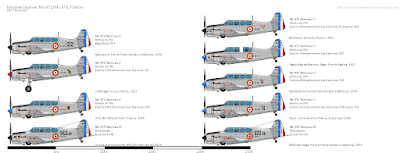
The Morane-Saulnier Ms.475 was French two-seat trainer aircraft which was the last production version of the Ms.470 saga. It was in use from the early 1950s until the 1960s as Armée de l'Air's (French Air Force) main trainer.
Its roots can be traced back to the Ms.470 which was designed during the war, and, at the postwar, it was ordered into production as the Ms.472 which was itself a more refined version of the Ms.470.
The Ms.472 was refined as well and work on an improved version was shortly later on its way. In fact, the prototype of the Ms.475 'Vanneau V' (Vanneau being the French word for 'plover' - the bird) flew for the first time on 8th August 1947. This new variant was powered by a single Hispano-Suiza 12Y-45 inline engine which yielded 850 hp of power (though according to some other sources, the power output was rated at 922 hp) instead of the Gnome-Rhône of the Ms.472. The Ms.475 had also a revised and improved wing, together with some minor improvements. It was also armed with a pair of 7.5 mm MAC 1934 machine guns placed in the wings. It had also underwing racks for either small bombs or underwing rockets. 
It was manned by a crew of two, trainee and instructor, which seated in a tandem position under a glazed cockpit.
These changes made the Ms.475 faster and more maneuverable than the preceding Ms.472 and Ms.474 (though the Aéronavale - French Navy's Air Arm - never used the Ms.475).
A total of 200 production Ms.475 were manufactured by Morane-Saulnier at Puteaux, from 1947 onwards, though deliveries to the Armée de l'Air began in March 1950. 
They were employed as basic trainers, but also as light support airplanes in Algeria until 1957 when the North American T-6 Texan was suited as more suitable for that role and therefore, they were replaced. In the trainer role it served well until the 1960s. It was also the basis for a somewhat improved variant, the Ms.476, which had bigger expanded wing, but apparently, the results were not satisfactory and work on it was abandoned.
The Morane-Saulnier Ms.477 was another experimental variant of the Ms.475 which was powered by a single Renault 12S-02 light inline engine which yielded 580 hp of power. This engine was a French copy of the German Argus As.411. It flew for the first time in November 1950 (though some French sources claim it was on 28th December 1951). With a single machine built, it was deemed as seriously underpowered and therefore, work on it was abandoned. 
The Morane-Saulnier Ms.479 was a variant coming straight from the previous version, the Ms.472. It was basically a Ms.472 powered by a single SNECMA 14X-04 'Super Mars' radial engine rated at 820 hp of power. It flew for the first time on 4th March 1952 and was tested all along that month, but the project was soon cancelled.
There were also some projected never-built variants like the Ms.471 which was going to be a Ms.470 powered by a Béarn 12B engine or the Ms.478 which was going to be a Ms.472 but powered by an Italian Isotta Fraschini Delta inline engine, but none of them went beyond the drawing board.


Sources:
1. http://www.historyofwar.org/articles/weapons_morane_saulnier_MS475_vanneauV.html
2. http://www.historyofwar.org/articles/weapons_morane_saulnier_MS476_vanneau.html
3. http://www.historyofwar.org/articles/weapons_morane_saulnier_MS477_vanneau.html
4. http://www.historyofwar.org/articles/weapons_morane_saulnier_MS479_vanneau.html
5. https://www.armedconflicts.com/Morane-Saulnier-MS-475-Vanneau-V-t167690
6. http://all-aero.com/index.php/contactus/53-planes-l-m-n-o/7034-morane-saulnier-ms470-vanneau--ms472--ms474--ms475
7. https://fr.wikipedia.org/wiki/Morane-Saulnier_Vanneau (translated)
8. https://en.wikipedia.org/wiki/Morane-Saulnier_Vanneau
9. https://www.aviafrance.com/aviafrance1.php?ID=914&ID_CONSTRUCTEUR=931&ANNEE=0&ID_MISSION=0&MOTCLEF=
10. https://www.aviafrance.com/aviafrance1.php?ID=9754&ID_CONSTRUCTEUR=931&ANNEE=0&ID_MISSION=0&MOTCLEF=
11. https://www.aviafrance.com/aviafrance1.php?ID=913&ID_CONSTRUCTEUR=931&ANNEE=0&ID_MISSION=0&MOTCLEF=

Tuesday, 25 January 2022

Morane-Saulnier Ms.472 'Vanneau II'

 
The Morane-Saulnier Ms.472 'Vanneau II' (French word for 'Plover' - the bird) was the first production version of the Ms.470. It was a two-seat trainer used by the Armée de l'Air (French Air Force) from 1946 until the 1960s.
The Ms.472 was itself a developed version of the Ms.470 which was designed by Paul-René Gauthier during the German occupation. The Ms.470 pleased the newly re-established Armée de l'Air so much that they decided to adopt it as their standard two-seat trainer, under the condition of making some revisions. Such revisions were carried out and three prototypes were ordered, the first of which flew for the first time on 12th December 1945. A total of 230 production aircraft were manufactured by Morane-Saulnier at their factory in Puteaux, close to Paris. 
The Ms.472 was identical in many aspects to the Ms.470. However it had a slightly different fuselage section with horizontal stabilizers moved upwards and it was powered by a single Gnome-Rhône 14M 05 radial engine which yielded 690 hp of power at take off (though, according to some sources, the engine was rated at 700 hp). It was made out of metal and both crew members, trainee and instructor sitting in tandem under a long-glazed canopy and was armed with two 7.5 mm MAC 1934 machine guns placed in the wings. It could also carry small bombs or rockets under the wings, if it was equipped with racks. 
It was introduced and delivered to the Armée de l'Air in December 1946 and they were employed in the light ground support role during the Algerian War of Independence until 1957 when they were replaced by the North-American T-6 Texan. 
The success of the Ms.472 attracted attention of the French Navy and, therefore a carrier borne variant was also developed for the Aéronavale (French Navy's air arm). This version, called Ms.474 'Vanneau IV' was identical to the Ms.472 but was equipped with an arrestor hook at the tail, which was often removed when operated from shore bases, and some minor modifications, like external chords. This variant flew for the first time on 27th February 1947, was powered by the same engine the Ms.472 was and was also armed with two MAC 1934 on the wings. A total of 70 machines were manufactured at Puteaux and, just like the Ms.472 it remained in service until the 1960s when they were replaced by other types.


Sources:
1. http://www.historyofwar.org/articles/weapons_morane_saulnier_MS472_vanneauII.html
2. http://www.historyofwar.org/articles/weapons_morane_saulnier_MS474_vanneauIV.html
3. https://www.valka.cz/Morane-Saulnier-MS-472-Vanneau-II-t167686
4. https://www.valka.cz/Morane-Saulnier-MS-474-Vanneau-IV-t167688
5. https://en.wikipedia.org/wiki/Morane-Saulnier_Vanneau
6. https://www.aviafrance.com/aviafrance1.php?ID=911&ID_CONSTRUCTEUR=931&ANNEE=0&ID_MISSION=0&MOTCLEF= (translated)
7. https://www.aviafrance.com/aviafrance1.php?ID=912&ID_CONSTRUCTEUR=931&ANNEE=0&ID_MISSION=0&MOTCLEF= (translated) 

Tuesday, 7 December 2021

Caudron C.440 'Goéland'. Home Users Part Two.

 
The Caudron C.445 model, which would eventually, be the most produced variant, began in 1939 and continued during German occupation, at Renault's factory in the Seine department, close to Paris. A total of 690 Goélands were manufactured for the Luftwaffe alone, which, as we already saw it, used the type in the trainer, transport and liaison roles.
Under Vichy's government, the Goéland constituted the backbone of the Services Civils de liaisons aériennes metropolitaines (Metropolitan Air Connection Civil Service - the official paramilitary airline of Vichy France) and its subsidiaries in the French West Africa and Algeria. A dedicated variant of the C.445 - called C.445EF - was made for the Vichy French Air Force, of which just 120 exemplars were manufactured between 1942 and 1943. 
The next major version was the C.449 which was manufactured at Ateliers Aéronautiques in Issy-les-Molineaux, in the Seine department, close to Paris, after the liberation. The main user of this variant was the Aéronavale (French Navy's Air Arm) which employed the type from 1945 onwards (they also have been using some C.445 since 1943). The Aéronavale used the C.445 and C.449 until 1954, for liaison and training purposes in various units and they served also with the Escadrilles (Squadron) 51.S and 55.S plus many flying schools located in Morocco. A total of 349 exemplars of this variant were made, though, according to other sources, that number falls to 325. They were manufactured between the years 1944 and 1948. 
After the war, Air France acquired several Goélands for pilot and crew training and night postal services. On 1st January 1946, there were 23 C.445 and 19 C.449 serving with this French airline. They would be, however, sold, loaned or ceded to other operators and most of them were transferred to Madagascar and the French North Africa.
Some other minor French airlines like Air Azur also employed the type after the war and it was reportedly, also employed by the Beglian SABENA airline. 


Sources:
1. https://en.wikipedia.org/wiki/Caudron_C.440_Goéland
2. https://aviatechno.net/vilgenis/46-49/caudron440.php (translated)
3. https://aeronavale.org/lhistoire-de-laeronautique-navale/les-avions/ (translated)
4. https://www.valka.cz/Caudron-C-440-Goeland-t168115 (translated)

Thursday, 18 March 2021

Junkers Ju.52/3m - Amiot AAC.1 Toucan

 
The Amiot AAC.1 Toucan was a French copy of the Junkers Ju.52/3m which was manufactured after the World War 2. 
During the war, Amiot's factories in Colombes (located close to Paris) manufactured hundreds of Ju.52/3m on behalf of the Luftwaffe. After the war, in order to re-equip the Armée de l'Air (French Air Force) and, to make it affordable, the French government opted to take advantage of the available stocks and the acquired skills to relaunch aircraft production. Therefore, a total of approximately 400 Amiot AAC.1 Toucan (AAC stands for Ateliers Aéronautiques de Colombes) were manufactured between late 1944 and 1947/1948 and receiving serial numbers from number 001 onwards.
Compared to its original German counterpart, the Toucan never featured any defensive armament, the landing gear's reinforcement was never present and further minor changes were made also. 
The main users of the Ju.52/3m (the original German one, not the Toucan) in France were both the Armée de l'Air and the Aéronautique Navale as they employed captured German machines or even bought from other Allied countries. These machines were also named as Toucan, however, in order to distinguish an original German from a Toucan, an extra digit was added to the serial number (ex. 1001 stood for the first original German one). This was done arbitrarily, without taking into consideration the original German serial number.
The main user of the Toucan was the Armée de l'Air, with at least 216 machines in active, flying with different units. 
In fact, the Toucan flew with every transport unit located in mainland France. One unit, Groupe de Transport (GT) III/15 'Maine', was equipped both with the Toucan and the Douglas C-47. Based at Bourget airport, in Paris, this unit took part, together with other C-47 equipped transport units like, GT II/15 'Anjou' or GT I/15 'Touraine' in the repatriation of French prisoners and deportees in Germany. 
The GT IV/15 'Poitou' was equipped with the Toucan in 1946. The following year twenty of them were deployed in Madagascar to counter the rebels present there. Here, some Toucans acted as makeshift bombers delivering a payload of one ton.
The Toucan took part too in the first years of the First Indochina War, specially with the GM III/64 'Tonkin', GT I/64 'Béarn' and GT II/52 'Franche-Compté'. The GSRA (Groupes sahariens de reconnaissance et d'Appui - Saharian Support and Reconnaissance Groups) 76 and 78 also employed the Toucan during the Algerian War. 
The Toucan was also present in other colonial units present at the French Equatorial Africa like the ESRA 77, present at Bangui (nowadays Central African Republic) as well as with other units like ELA 56 'Vaucuse' or EOM 82.
The Aéronautique Navale (Naval Air Arm) had around 51 Toucans in service with the last one being retired in 1962. They notably served with the 5S, 31S (based at Orly, in Paris) and 56S, among others.
There were many French civilian operators of the Toucan:
  • Air France: The French national airway operated the type starting from late 1944 in internal aerial routes and then, after the war, in international and colonial routes. They were retired by 1953. 
  • Aero Cargo: It seems that this airline had at least one Toucan in inventory.
  • Air Ocean:  Flew a single Toucan for a brief period of time. It crashed in Morocco in October 1946.
  • CTA Languedoc Roussillon:  This company has the sad record of having suffered the most deadly Ju.52/3m civilian accident with 23 out of 27 casualties in a crash at Saint-Léger-la-Montagne.
  • Société Auxiliare de Navigation Aérienne used the Toucan together with demilitarized Handley-Page Halifax bombers.
Many agencies of the French Government also employed the Toucan.


Sources:
1. https://en.wikipedia.org/wiki/List_of_Junkers_Ju_52_operators
2. https://fr.wikipedia.org/wiki/Amiot_AAC.1_Toucan (translated)
3. https://fr.wikipedia.org/wiki/Air_France (translated)
4. https://www.wikiwand.com/en/List_of_accidents_and_incidents_involving_the_Junkers_Ju_52
5. https://wwiiafterwwii.wordpress.com/2020/04/11/aac-1-toucan-frances-post-wwii-ju-52/

Tuesday, 22 December 2020

SIPA S.12

 
Considering the operating experience of the SIPA S.10 and SIPA S.11 (and S.111) all-wooden aircraft, SIPA (Société Industrielle Por l'Aéronautique - Industrial Company for Aeronautics) decided to return to the all-metal aircraft construction. The new version of the aircraft, a more refined and improved version of the previous S.11, was given the denomination of SIPA S.12 and, as the metallic fuselage made the aircraft heavier, a new and more powerful engine was installed. The selected powerplant was a single SNECMA 12S-02 engine which could deliver up to 600 hp of power. 
The armed variant of the S.12, named S.12A, retained the same armament as the S.11A (two MAC 34/39 machine guns in the nose plus underwing pylons for up to 100 kg (220 lb) in bombs or various MATRA T10 unguided rockets. 
The S.12 entered production in 1951 and a total of 52 machines of this and the S.12A (the armed one) type were produced. Some years later, in 1954, an identical, albeit lighter version was created, the S.121, featuring a lighter design and armament. On this new sub-variant, 58 machines were built making a total of 110 SIPA S.12 of every variant having been built. 
Some SIPA S.12, S.12A and S.121 were used by the Armée de l'Air (French Air Force) in the Algerian War in various roles such as reconnaissance, fire spotters and close support aircraft. They were also used as armed trainers in the various Armée de l'Air's flying schools until the early 1960s when they were replaced, in the trainer role by the jet-powered Fouga Magister. However, in 1968 the Centré d'Essais en Vol (Flight Test Centre - French Air Force's experimental unit) still had an S.121 in active which was used as a trainer or fast liaison aircraft. 


Sources:
1. http://www.airwar.ru/enc/other/s12.html (translated)
2. http://www.aviastar.org/air/france/sipa_s-12.php
3. https://www.avionslegendaires.net/avion-militaire/sipa-s-10-s-12/ (translated)
4. https://en.wikipedia.org/wiki/Arado_Ar_96

Saturday, 19 December 2020

SIPA S.10 & SIPA S.11

 
The SIPA S.10 was the French denomination for the German-developed Arado Ar.396 all-wooden trainer aircraft, which was designed entirely in France, at Société Industrielle pour l’Aéronautique (SIPA) where the prototype of the Ar.396, named Ar.396 V1 flew for the first time in December 1944 and served as a de facto prototype for the SIPA S.10.
After the liberation SIPA began the serial production of the S.10 for the Armée de l'Air (French Air Force). The S.10 differed from the Ar.396 in the powerplant; it was powered by a Renault 12S-00 engine which yielded 580 hp of power and was itself an updated version of the German Argus As.411 engine. Like the Ar.396 it was armed with a single machine gun which in this case was a 7.5 mm MAC instead of the German 7.92 mm MG 17. A total of 30 aircraft were built (only 6 according to some other sources) between late 1944 and 1945 and all of them served with the French piloting school. After that the production was switched towards the more advanced SIPA S.11.
The SIPA S.11 was a development of the S.10 brought to the standards of the Armée de l'Air who planned to use the aircraft not just as a trainer but also as a light-armed ground attack aircraft that could be used as a trainer too. 
The prototype of the S.11 took off for the first time on 4th July 1946 and, after successful trials, the contract was awarded to SIPA for the production of an initial batch for 54 machines, under the designation of S.111. The S.11 entered serial production in 1947, was armed with two machine guns placed in the cowling and had underwing racks for light bombs, which usually consisted on a single 50 kg or four 10 kg per block. Alternatively two MATRA T10 unguided rockets could be carried under each wing. When armed with bombs or rockets, this sub-variant was denominated as S.111A.
From the mid-1950s onwards some S.111 took part in the Algerian War. They took the advantage that, during the early part of the war, the Algerian rebels had not anti-air capacity, so the S.111 was used as reconnaissance, spotter or light-attack aircraft with success. 


Sources:
1. http://www.airwar.ru/enc/other/s10.html (translated)
2. https://www.armedconflicts.com/Arado-Ar-396-A-t6485
3. http://www.airwar.ru/enc/other/s11.html (translated)

Saturday, 22 August 2020

Airspeed AS.65 Consul, more European users

The Airspeed AS.65 Consul was a British twin-engined light airliner that saw service with many airlines around the world. It was basically a civilian conversion from the AS.10 Oxford trainer. On this post we're covering the next countries and airlines:

  • France: We've already wrote about the Consul in service with various French colonial airlines, specially in Indochina and Algeria. But it's worth pointing that there was a French airline, Airnautic, which operated from mainland France, that had three Consul in service. They were acquired in as late as 1957 and served until the early 1960s. One of them was used for survey works in French West Africa. By 1963 all three of them had been written off and sold for scrap. Oddly one of them, registered as F-BHVY wasn't scrapped until 1975.
    As we couldn't find graphical evidence of a Consul operating with this airline, the drawing should be considered as speculative.
  • Iceland: One aircraft was registered by Flugfedir, Iceland's national airline in 1951. This aircraft was intended to cover the air route between Reykjavik-Glasgow and Liverpool but it crashed near Sheffield in April that same year killing its pilot, Magnusson and two crew members. As we couldn't find photos or pictures about this aircraft, the drawing should be considered as speculative.
  • Ireland: Irish Government bought two Consuls in 1947 to be assigned one year later to Irish National Airway, Aer Lingus. One of them covered the regular route between Dublin and Liverpool until 1953 while the other one was sold to Pakistan one year later after being put into service with Aer Lingus, in 1949.
  • Italy: One Italian airline, Trasporti Aerei Mediterranei (Mediterranean Air Transports) operated three Consuls between 1955 and 1963. There were other two Consuls which served with Italian owners. One of them served with the charter airline Aerofotografica SA from 1963 until 1964 when it crashed, and another one was bought in 1953 by a private owner but was sold shortly later, in 1954, to a British owner. As it doesn't seem to exist graphical evidence of a Consul in Trasporti Aerei Mediterranei's colours, the drawing should be considered as speculative.
  • Monaco: A single Consul was registered as MC-ABA by Monte Carlo Airways in October 1946, but it wasn't delivered. As another aircraft on this post, the drawing is speculative. 
  • Crown Colony of Malta: Two Maltese airlines, Chartair and Air Malta operated a total of six Consuls. They were operated from 1946 until the early 1950s.


Sources:
1.https://en.wikipedia.org/wiki/Airspeed_Consul
2.https://www.ab-ix.co.uk/pdfs/airspeed_oxford_&_consul.pdf

Saturday, 18 April 2020

Avro Anson, part Seven, Franco-Greek Users

The Avro Anson was a British twin-engine multi-role airplane that, with more than 11.000 exemplars manufactured, was widely used by many countries.
France was among those users when the Free French Air Force took the delivery of eight Anson Mk.I in May 1943. They were delivered to French West Africa and were followed in December 1944 by nine more. All of them were assigned to Groupe Artois (Artois Squadron) which was formed in August 1942 and operated from Pointe Noire, in French Equatorial Africa. This squadron, which was committed to coastal defence duties, was initially equipped with Westland Lysanders until the Ansons replaced them.
After the War, the Armée de l'Air (French Air Force) set up many training units (named with the acronym B.E. which stand for 'Base École' - Basic School) which had the Anson as the main operating aircraft.

  • BE.710: The most important of these units. It was the French Military Academy at Salon-de-Provence, close to Marseille. By 1949 this unit had 31 Ansons on its rows. 
  • BE.702: It was another training unit which was formed in Avord, central France, for multi-engine conversion and had detachments at Cazaux, South-Western France. 
  • BE.703 was the radio-training school.
  • BE.705: This unit was the basic training school. It was located at Cognac, close to the French Atlantic coast. In 1949 it was transferred to Marrakech, in the French Protectorate in Morocco, and became BE.709.
  • BE.706: AKA E.M.N.E. (sorry but we couldn't find what this acronym means) this unit trained navigators and bombardiers at Cazaux. By 1949 it had 31 Ansons, 11 Miles Martinet, 35 Vickers Wellington T.Mark.X and 40 miscellaneous types on strength.
There were also some colonial units under French command which used the Anson Mk.I. Most of them were Escadrille de Police et Securité (AKA Escadrille d'Outre Mer - Overseas Squadrons) which operated mainly in French Africa and Madagascar.
The French Navy's Air Arm ('Aeronautique Navale' or 'Aeronavale') employed the Anson too for both communications and training. In 1946 an initial batch of 20 Ansons was delivered with a few more arriving later and being supplemented by surplus aircraft coming from the Armée de l'Air. In 1947 there was one communications unit at Querqueville, in Normandy, and two training squadrons, 50S and 52S with this last one having also the duty of giving officer cadets from the Ecole Navale at Lanvéoc, in Brittany, air experience flights, as part of their training. In October 1948 52S was renamed as 56S and used Ansons to train non-pilot aircrew including radar training. After having been temporarily based in many different locations, it was based in Agadir, French Protectorate of Morocco. 
One final French Anson was permanently based in the United Kingdom and was used by the French Naval Attache in London during late 1945-1946.

Another important user of the Anson was Greece. The Royal Hellenic Air Force received 12 Anson Mk.I during May-June 1939 and were used as communications aircraft during the Greco-Italian War of 1940-1941. During the German Invasion of Greece, five of them escaped to Egypt where they were repainted in Royal Air Force's colours.
After the War, four RAF Ansons Mk.XII were loaned to the Royal Hellenic Air Force between 1945-1946 and formed the Royal Hellenic Air Force's Communications Squadron with base at Maleme airfield, in Crete. Thirty-six additional ex-RAF Anson Mk.I were sold to the Greeks in 1946-1947.


Sources:
1. Hall Park Books - Warpaint 53 - Avro Anson
2. https://en.wikipedia.org/wiki/Avro_Anson
3. http://britishaviation-ptp.com/avro652_3.html

Saturday, 8 February 2020

Messerschmitt Me.208 / Nord 1100 Noralpha

During the occupation of France, the production of the Messerschmitt Bf.108 was transferred to the Société Nationale de Constructions Aéronautiques du Nord (commonly known just as "Nord"), at the French city of Les Mureaux, West of Paris in 1942. The company built two prototypes of the Me.208, an expected successor to the Messerschmitt Bf.108 during 1943. It was basically an enlarged version of the Bf.108 with a tricycle landing gear powered by an Argus As 10P which delivered 237 hp of power during take-off and drove a two-bladed propeller. The prototype flew for the first time in January 1944. Apparently there was a second prototype.
It was expected Nord to take the bulk of the manufacturing process in order to replace the existing, and ageing, Bf.108 that were already in service with the Luftwaffe. However, the course of the war prevented its mass production and only one prototype survived the War, which was renamed as Nord 1100.
After the War, Nord produced a re-engined version of the Me.208/Nord 1100 powered by a Renault 6Q-10 engine which delivered 233 hp of power and was designated as Nord 1101 Noralpha by the company and Ramier I (Woodpigeon I in English) by the French Armée de l'Air.
A single Nord 1101 was refitted with a Potez 6D-0 engine, yielding 240 hp of power for engine trials and was designated as Nord 1104. Two more Nord 1101 were converted with a Turbomeca Astazou II turboshaft engine in 1959 and were known as S.F.E.R.M.A. Nord 1100 Noralpha, being SFERMA a filial of SNCASO.
Both Noralpha and Me.208 were low-wing cantilever monoplane with a braced horizontal tail surface and single rudder. They had a retractable tricycle landing gear. In both cases the engine was mounted on the nose and they had an enclosed cabin with side-by-side seating for two and room behind for two passengers more.
Two-hundred exemplars of the Nord 1101 were manufactured and they served as communications aircraft with the Armée de l'Air and the Aéronavale. Later, many of them were civilianized with the final Air Force Noralphas being replaced in service with the Centre d'essais en Vol (CEV) at Bretigny-sur-Orge during 1974-1975 with some few ones serving with the Navy for a further brief period.


Sources:
1. https://en.wikipedia.org/wiki/Nord_Noralpha
2. https://de.wikipedia.org/wiki/Messerschmitt_Me_208 (translated)
3. https://www.net-maquettes.com/pictures/messerschmitt-me208-walkaround/
4. https://www.valka.cz/Messerschmitt-Me-208-t57830
5. https://fr.wikipedia.org/wiki/Nord_1100_Noralpha (translated)

Thursday, 19 October 2017

Avro Lancaster - French users

Fifty-nine Avro Lancasters were overhauled by Avro at Woodford and Langar and were delivered to the French Aéronavale because due to the common defence treaty of the Western European Union, they could have them for training, anti-submarine wars and sea patrol between 1952/1953 (when they were delivered) until 1962. They served in two key locations of French colonies, New Caledonia and French North Africa.
In New Caledonia they served with four squadrons performing search-and-rescue and reconnaissance missions. They were painted white because most of the belonged to the B.Mk.I (FE) variant.
An anti-submarine and patrol squadron was based in Morocco, at the French aeronaval base of Port-Lyautey, in Kenitra. They served until 1960 when they were replaced by the Lockheed P-2 Neptune.
There was also another Lancaster squadron based in Agadir, Morocco, that was also equipped with Lancasters during 1961/1962 when that city suffered a vicious earthquake.


Sources:
1. https://en.wikipedia.org/wiki/Avro_Lancaster
2. https://fr.wikipedia.org/wiki/Avro_Lancaster (translated)
3. Signal Squadron - Aircraft In action 52 - Lancaster in Action

Wednesday, 22 June 2016

Arsenal VG-90

The Arsenal VG-90 is a French carrier fighter built after the World War II that never went beyond the prototype stage.

In 1946 the French air ministry launched a jet-powered carrier-based fighter programme for the French Aéronautique Navale (the French Navy's air arm). Three aircrafts, all of them powered by the Rolls-Royce Nene, built under license by the Hispano-Suiza were presented in the Centre d'essais en vol (flight test centre) at Bretigny, among them the Aérocentre N.C.1080 the Nord 2200 and, of course the Arsenal VG-90.

Designed by the engineer Jean Galtier taking the Arsenal VG-70 as a basis, it was a high-winged monoplane with swept wings and stabilizers. The fuselage was made entirely out of metal and was of monocoque structure. Wings had a metal structure with a plywood covering. The air intakes were placed at both sides of the fuselage, tricycle configuration was chosen for the landing gear with the main wheels retracting into the wings. Planned armament changed during the development stage as initially it was going to be armed with 3 Hispano-Suiza 30mm cannons and up to 500kg of bombs under wings and later it was modified to two 20mm Hispano-Suiza cannons, seven 7,7mm machine-guns mounted in the wings, a retractable ventral pannel containing 36 rockets and external fuel tanks mounted under wings.

Three prototypes were built, flying the first one on 27th September 1949 and the flight tests at CEV Brétigny started on 10th April 1950 but on 25th May 1950 the first prototype crashed killing the test pilot, Pierre Decroo. The investigation concluded that one of the landing gear doors tore apart hitting the tail and rendering the prototype uncontrollable. It was replaced in June 1950 by a second prototype made completely out of metal but on 21st February 1952 the tail of the aircraft was torn off due to aerodynamic flutter. The test pilot, Claude Dellys couldn't make his ejector seat to work in time, killing him. Flight tests were interrumpted and the third prototype, which was being retrofitted with a 4000kgp thrust Snecma Atar 101F engine wasn't completed.

This programme in general was very disastrous as the other competitors had a lot of technical problems, the Aérocentre N.C.1080 which flew for the first time on 29th July 1949 was destroyed during a flight on 7th April 1950 killing the pilot Pierre Gallay and the last contender, the Nord 2200 was considered too heavy to operate from a carrier and was discarded. In the end, it was decided to buy a license to build the De Havilland Sea Venom, which was known as the Sud-Est Aquilon.


Sources:
1. https://fr.wikipedia.org/wiki/Arsenal_VG_90 (translated)
2. https://en.wikipedia.org/wiki/Arsenal_VG_90
3. Salamander Books - The Complete Book of fighters

Monday, 30 May 2016

Armstrong Whitworth NF.14 - Foreign Users

It's time for the foreign users of the last variant of the Meteor Night Fighter.


  • Biafra: In the context of the Nigerian civil war, the Biafran government was able of setting-up a tiny air force composed by second-hand airplanes like the Douglas A-26 Invader, piloted by mercenaries. As they lacked fighters, they managed to stage a fake film-producer company named Enterprise Films, that bought two Meteors NF.14, that by then, they were completely outdated in the United Kingdom with the subterfuge of being used in a war film. When sent to Biafra, one of them crashed during the ferry flight between Madeira island and Cape Verde (both of them under Portuguese rule back then) and the second had to land in the city of Bissau, also under Portuguese rule, due to some technological failure. It was abandoned there and was never handed over to the Biafran authorities in 1967.
  •  France: Apparently the French Centre d'Essais en Vol (CEV) bought even another variant of the Meteor to use it in the CEV. It was probably used to perform some experiments that would help to develop another airplanes.


Sources:
1. https://en.wikipedia.org/wiki/Gloster_Meteor
2. Salamander Books- The Complete Book of Fighters
3. Hall Park Books - Warpaint series 22 - Gloster Meteor
4. https://defenceoftherealm.wordpress.com/2015/07/26/the-biafran-meteor-caper/

Saturday, 28 May 2016

Armstrong Whitworth Meteor NF.13 - Foreign Users

Today it's the turn for the foreign users of the Meteor NF.13 which weren't few of them.


  • Egypt: In 1955 the Egyptian government received three Meteor T Mk.7, six Meteor NF.13 and eight Meteor F.8 as a consequence of an order placed by it's government back in December 1952. As Egypt was under an arms embargo, the United Kingdom allowed the sale with the hope of improving relations with Egypt, however the tensions over the Suez Canal would lead to another arms embargo. They equipped the Egyptian No.10 Squadron and took part in the 1956 Suez crisis. One Egyptian NF.13 claimed to have damaged a British Vickers Valiant bomber during the conflict. However, as the aerial bombing campaign carried-out by the Anglo-French forces in the Operation Musketeer destroyed many Egyptian airplanes stationed in the ground, the Egyptian Air Force decided to withdraw their operation from the Sinai peninsula.
  • France: The French CEV (Centre d'Essais en Vol - Centre of in-flight experiments) adquired at least one Meteor NF.13 which was used for experiments. Further details are unknown and the colours displayed in the drawing should be considered as speculative.
  • Israel: In early 1956 Israel placed an order to buy six Meteor NF.13, with three being delivered that year, before the month of October (when the Suez crisis sparked) and the other were delayed by an arms embargo, and were handed over in 1958. Those three airplanes played a key role in the crisis as an Israeli NF.13 shot down an Egyptian Ilyushin Il-14 carrying many Egyptian high-ranking military officers in the context of Operation Tarnegol. The Israeli NF.13 remained in active service with the 119 Tajeset (119th Squadron) until 1962.
  • Syria: The fledgling Syrian Air Force had only one active squadron back in the 1950s, the 1st one and it was equipped both with Meteor F.8 and one or two NF.13. However they lacked any radar and combat training wasn't provided, so the Syrian pilots had to train with their Egyptian counterparts. It's claimed that, in the context the Suez crisis an unknown Meteor shot down a British Canberra that was performing reconnaissance missions over Syria, more precisely over the city of Homs. Anyway, almost any Meteor was replaced in 1957 by the Soviet MiG-17 as that airplane was cheaper and the USSR offered also combat training. 


Sources:
1. https://en.wikipedia.org/wiki/Gloster_Meteor
2. Salamander Books - The Complete Book of Fighters
3. Hall Park Books - Warpaint Serie No.22 - Gloster Meteor

Sunday, 22 May 2016

Armstrong Whitworth Meteor NF.11 - French Users

As the French Air Force wanted to update their fighter fleet, and after testing a pair of Meteor MK.IV with very good results, the French Air Force ordered 25 new airplanes plus 16 ex-RAF ones.
They were purchased in 1954 and were delivered between September 1954 to April 1955.

The Meteor replaced the Mosquito NF.30 with the Escadre de Chasse 30, where it would serve until being replaced by the Sud Aviation Vautour in 1957.

Many Meteor NF.11 saw combat service in the Algerian war, where they were transferred to the Escadre Chasse de Nuit (Night Fighter Squadron) 1/7 which operated from Bône, in the north-east of Algeria. Those Meteor that weren't employed in combat, were used for training purposes, specially to train the crews that would serve with the Vautour.

Five of the were transferred to the Centre d'Essais en Vol (CEV) in 1958 where they served as testbed and chase planes for various purposes including radar and missile tests and during the development of the ill-fated Concorde airliner.


Sources:
1. https://en.wikipedia.org/wiki/Gloster_Meteor
2. Salamander Books - The Complete Book of Fighters