Showing posts with label Czechoslovakia 1919-1929. Show all posts

Thursday, 6 July 2023

Breguet 16

 
The Breguet 16 was a French night bomber biplane directly derived from the Breguet 14. It was conceived as a replacement for both Voisin VIII and Voisin X used by the night bombing squadrons of the Aéronautique Militaire (French Air Arm). 
The Aéronautique Militaire issued a specification in late 1917 calling for a Bn2 medium bomber (Bn2 stands for 'Bombardier Nuit 2' - Night Bomber 2, where the number means that it had to have a crew of two). It should not be confused with the other BN2 designation, intended for a heavy bomber.
The Breguet 16 was basically an enlarged variant of the Breguet 14 with a larger wingspan of 16.96 meters (55.64 ft) versus the 14.36 meters (47.11 ft) of the Breguet 14. This was done in order to carry heavier loads of fuel and bombs for strategic bombardment missions. 
The Breguet 16 was powered by a single Renault 12Fe engine rated at 300 hp and was armed with two 0.303 in Lewis machine guns, mounted on the observer's position. It could carry up to 550 kg (1212.54 lbs) of bombs under the fuselage.
The prototype was flown for the first time in June 1918 with M. de Bailliencourt at the controls, a test pilot working for Breguet. According to his initial evaluation, the rudder bar had to be changed as it was too near the seat. He also recommended to relocate the throttle and, because an inability to see the ground while climbing or diving, some indentations also to be performed in the edges of the lower wings. Further testing was uneventful. 
Anyway, as changes had to be made, the prototype was returned to Breguet's factory to make those suggested changes. Bailliencourt stated that Breguet was furious about the delay that those alterations caused to the Bn2 programme.
Two Breguet 16 were sent to Groupe de Bombardement 1 (GB 1) to be evaluated and soon the type was mass produced. However, it didn't make it in time to see active service as World War 1 ended. After the war, some were assigned to to the 22e Régiment Aérien de Bombardement (N) (Night Bombing Aerial Regiment - N, where the letter N stands for 'nuit', night) and the 21éme RAB (N). These units were assigned to Syria and Morocco, where they saw limited service as the nature of the conflict there wasn't adequate for a bomber of such characteristics. 
One Breguet 16 was tested with an American Liberty engine, but its wing failed during static trials so it didn't fly.
In total 200 Breguet 16 Bn2 were manufactured by Breguet, Ferbois, Lioré-et-Olivier and SECM (Société d'Emboutissage et de Constructions Mécaniques - Stamping and Mechanical Engineering Company, forerunner of Amiot). 

The Breguet 16 saw also service abroad:
  • China: In 1923 the Fengtian Clique's warlords purchased 12 Breguet aircraft through Eurasia Aviation Corporation (a Shanghai based Chinese airline). Among those aircraft there were 4 or 5 Br. 16 Bn2 (sources are not clear about the definitive number) powered by the Renault 12Fe engine. They were delivered in November 1928 and there is not info about their operational service in China.
    As we couldn't find graphical evidence of the Br.16 Bn2 serving in China, the colours and registration shown should be considered as speculative.
  • Czechoslovakia: The Ceskoslovenské armádní letectvo (Czechoslovak Air Service) bought an unknown number of Br.16 Bn2 bombers. They were assigned to the 1. letecký pluk (1st aerial regiment) based at Prague-Kbely. They were most likely phased-out in the late 1920s.
  • Portugal: One Br.16 Bn2 was bought by the Portuguese Arma da Aeronautica Militar (Army's Aeronautical Arm) in 1921 to take advantage of the type's long range to perform a long distance flight from Lisbon to Macao, a Portuguese colony in southern China, close to Hong-Kong. This Br.16 Bn2, named 'Patria' (Homeland), flew a total of 14 stages but it had to perform a forced landing due to engine overheat at Pipar Road, British Raj on 7th May 1924. Fortunately its crew survived the landing and Patria was written off and replaced by an Airco DH.9A conveniently named 'Patria II' (Homeland II). 


Sources:
1st Flying Machines Press - James J. Davilla - French Aircraft of the First World War
2nd en.wikipedia.org/wiki/Bréguet_16
3rd http://cwlam2000.epizy.com/caf07.htm (translated)
4th https://www.thisdayinaviation.com/tag/avion-breguet-type-16-bn-2/

Tuesday, 14 March 2023

Breguet 14, part four. European Users, part one.

 
The Breguet 14 was a French biplane bomber of the First World War which was also employed as a reconnaissance plane. 
With more than 8.000 machines manufactured between March 1917 and 1926, it was exported all around the globe and saw usage with various countries and factions, among them, the following ones:
  • Belgium: Belgium acquired 31 or 35  (sources vary about the exact number) Breguet 14 A.2 before the end of World War I, and 12 or 15 after the war.
    The type entered service with the Belgian Aviation Militaire (Army Aviation) in 1918 serving both with Nos 2 and 3 squadrons based at Les Moëres (De Moeren) airfield, in West Flanders province. The Breguets replaced the Sopwith 1 ½ Strutters the squadrons were equipped with. Nos. 4 5 6 and 7 Squadrons also employed the type, in some cases, operating together with the SPAD S.XI. No.5 Squadron was based at Houtem airfield, in West Fladers too. 
    Every Breguet 14 delivered during the war was powered by either the Italian Fiat A-12 or A-12bis engine, but some of those delivered after the war, were powered by the Renault 12F engine (distinguishable by its unique exhaust pipe).
    After the war, the A.2 also equipped some squadrons of the Flying School Group and, by 1923, the A.2 was already withdrawn from operational squadrons, with the exception of some few machines which were employed as communications aircraft until 1928. 

  • Czechoslovakia: The newly created Czechoslovak Army Air Force acquired 10 Breguet 14A.2 in 1919. They were assigned to the Letecká setnina 4 (4th Air Company), based at Cheb, western Bohermia,  and then, after reorganization, they were inherited by the Letecká rota 8 (8th Air Company), based at Nitra, Bratislava. In 1923 they were assigned to Prozorovaci rota 3 based at Olomouc, Moravia and the Hlavni Letecke Dilny, 81 Bombardobaci Letka, based at Prague-Kbely airport.

  • Denmark: Denmark obtained four unarmed Br.14A.2s for civilian usage with the Ministeriet for Offentlige Arbejder (Ministry of Public Works) between 1921 and 1922. They were used for training commercial pilots until April 1927 when they were sold for scrap.


Sources:
1st https://en.wikipedia.org/wiki/Bréguet_14
2nd Flying Machines Press -  French Aircraft of the First World War
3rd https://www.armedconflicts.com/4th-Air-Company-t73424
4th https://www.valka.cz/topic/view/43381/Letecka-rota-8-1920-1924
5th http://www.milfly.dk/pdf/islander.pdf (translated)

Tuesday, 1 February 2022

Morane-Saulnier Type AI

 
The Morane-Saulnier AI was a French parasol-wing fighter which was developed during World War I. 
In 1916 Morane-Saulnier designed the Type P two-seater reconnaissance parasol-wing aircraft, but it wasn't successful, so they moved on to design new types of fighters. Namely the Type AF biplane fighter and the parasol-wing AI which was itself a refinement of the Type N fighter with the intention of replacing both the Nieuport 17 and the SPAD S.VII. 
The AI was mainly of conventional construction. The fuselage had a circular cross section built around a wooden framework, the flat wing was swept back with a section in the middle cut to improve pilot's field of view. It was hold by parallel lift struts which ran from the base of the forward section of the fuselage to two thirds the way along the wing and braced with a pair of compression struts. Strength tests on the wings showed that this arrangement should've been safe. 
It was powered by a single Gnome Monosoupape 9N radial engine which yielded 150 hp of power and drove a two-bladed propeller.
The first prototype, which flew for the first time in 1917, was armed with a single Vickers 0.303 in machine gun placed on the nose and was given the official designation of Morane-Saulnier MoS.27 by the French Aéronautique Militaire (Military Aeronautics - the forerunner of the Armée de l'Air). It was tested at Villacoublay, in Seinte-et-Oise department, on 7th and 9th August 1917 manned by Eugene Gilbert. Further trials made in September, judged the aircraft as very maneuverable, with excellent control response and an excellent field of view for the pilot.
Work on a second version, the MoS. 29 was underway in September. This version differed from the MoS.27 in having two machine guns and had a slightly larger tail surface, but, otherwise, it was similar to the MoS.27. 
The Type AI was ordered into mass production and a total of 1.210 machines, mostly of the MoS.29 variant, were produced. It entered service in early 1918 and it served with the following three Escadrilles (Squadrons) of the Aéronautique Militaire; N.156 (which became M.S.P. 156 in February 1918), N.161 (which became M.S.P. 161) and N.158 (which became M.S.P. 158). 
The MoS.29 proved to be popular among its pilots who praised its speed and maneuverability, however, in service conditions, the wing proved to be very weak. In fact, some aircraft were lost when their wing either came off or folded in mid-air killing their pilots. The reason was never investigated, it was probably related to wing flutter or a similar phenomenon unknown in those years. By mid-May the Type AI was relegated from frontline service. 
Morane-Saulnier then answered by converting the MoS.27/29 into an advanced trainer by removing guns ,reducing fuel capacity and introducing extra wing bracings. This trainer variant received the denomination of MoS.30 and was made in two sub-variants, the standard MoS.30, powered by a single Le Rhône 9Jb engine, which delivered a power of 135 hp and the MoS.30bis powered by a de-rated Le Rhône 9Jby engine rated at 90-95 hp of power. 
The Royal Flying Corps (RFC) was shown the MoS.29, to check their interest on the type on 12th August 1917, but Hugh Trenchard, chief of the RFC rejected it. The MoS.30 was, however exported as trainers to various countries:
  • Belgium: During the last stages of the World War I three machines were sold to the Belgian Aviation Militaire, which assigned them to the 9e Escadrille (9th Squadron). 
  • Czechoslovakia: The newly created Czechoslovak Army Air Force, had one MoS.30 in service in 1919. As we couldn't find graphical information, the drawing should be considered as speculative.
  • Japan: The Imperial Japanese Army Air Service evaluated a single MoS.30 in 1922. Just like the previous user in this post, the drawing should be considered as speculative.
  • Poland: A total of 21 MoS.30 were exported to Poland between 1920 and 1922. They served as advanced trainers in various flying schools all around Poland until 1925 when they were replaced by more modern types like the MoS.35.
  • Switzerland: The Swiss Fliegertruppe (Swiss Army Aerial Corp) operated one MoS.30 in 1919.
  • USSR: A total of four MoS.30 were evaluated and used for test and trials by the Workers and Peasants' Red Air Fleet (the forerunner of the Soviet Air Force)
  • USA: Fifty-one MoS.30 were purchased by the American Expeditionary Force in France and were employed at their training base at Issoudun, at the department of Indre. After the war they re-sold to other countries. We couldn't however find graphical evidence. However, we think they wouldn't differ too much from the French MoS.29, so we decided to leave them out.


Sources:
1. http://www.historyofwar.org/articles/weapons_morane_saulnier_Type_AI.html
2. https://en.wikipedia.org/wiki/Morane-Saulnier_AI
3. http://bequickorbedead.com/article_detail/french-trainings-morane-saulnier-ms-30e1/ (translated)
4. https://www.valka.cz/Morane-Saulnier-AI-t51372 (translated)

Saturday, 14 October 2017

Morane-Saulnier L - Various European users

We keep on going with the various users of the Morane-Saulnier Type L and today we cover its European and Turkish users except for French, British and Russian ones which will have their own post.

  • Belgium: The Belgian Aviation Militaire adquired some Morane-Saulnier L prior to the World War I together with the Morane-Saulnier Type G. The type L was employed in the scout role during the early days of the World War I and was outdated and quickly replaced. As we couldn't find graphical evidence of the type L in Belgian service, the colours should be considered as speculative.
  • Czechoslovakia: Apparently, the Czechoslovak state had at least one Type L in service, however any further information is unknown and the drawing must be considered as speculative.
  • Finland: This country had also some Type L that adquired together with the modified licensed Swedish version Thulin D. Apparently it served its role as scout/trainer in the early Finnish Army Corps of Aviation.
  • Holland: Apparently at least one airplane served with the Dutch Aviation corps. However, as we couldn't find any further information, the drawing is speculative.
  • Poland: Somehow, the early Polish Air Force got a Type L that was probably used as a trainer during its early days. As we couldn't find further info the drawing should be considered as speculative.
  • Romania: Prior to World War I the Romanian Army bought a Type L and it served as scout during the war. As there isn't graphical evidence to support the claim, the drawing should be considered as speculative.
  • Ottoman Empire: The Ottoman Aviation Commission bought a Type L before the war and it was used in the early war. It was widely liked and later they bought the German Pfalz copy.
  • West Ukrainian People's Republic (ZUNR): Apparently some ex-Russian built Type L served with the ZUNR during their convoluted existance.


Sources:
1. https://en.wikipedia.org/wiki/Morane-Saulnier_L
2. Salamander Books - The Complete Book of Fighters

Thursday, 14 July 2016

Avia BH-33E

The Avia BH-33E appeared first on 1929 and it differed on the original BH-33 and the PWS-A in various aspects.
The slab-sided wooden fuselage was replaced by a welded steel-tube structure, it had an elliptical cross section achieved with the help of light formers and a spli axle vee-type undercarriage introduced to replace the original crossed-axle undercarriage.

Even if it wasn't originally ordered by the Czechoslovak authorities, which waited until the BH-33L, it did have some export success and three airplanes were bought by the USSR to preform some tests and 20 were sold to Yugoslavia which also purchased a production license, for the firm Ikarus at their plant of Zemun, close to Belgrade.

Two sub-variants were made one powered by the Bristol Jupiter VI, and the other one, which was the most produced, powered by the supercharged version of the Bristol Jupiter VII. One single BH-33 was fitted with a German BMW Hornet engine, however, as we couldn't find any graphical evidence, we haven't drawn it. It was armed with two Vickers 0.303in machine guns placed in the frontern upper part of the fuselage.


Sources:
1. Salamander Books - The Complete Book of Fighters
2. https://en.wikipedia.org/wiki/Avia_BH-33

Wednesday, 13 July 2016

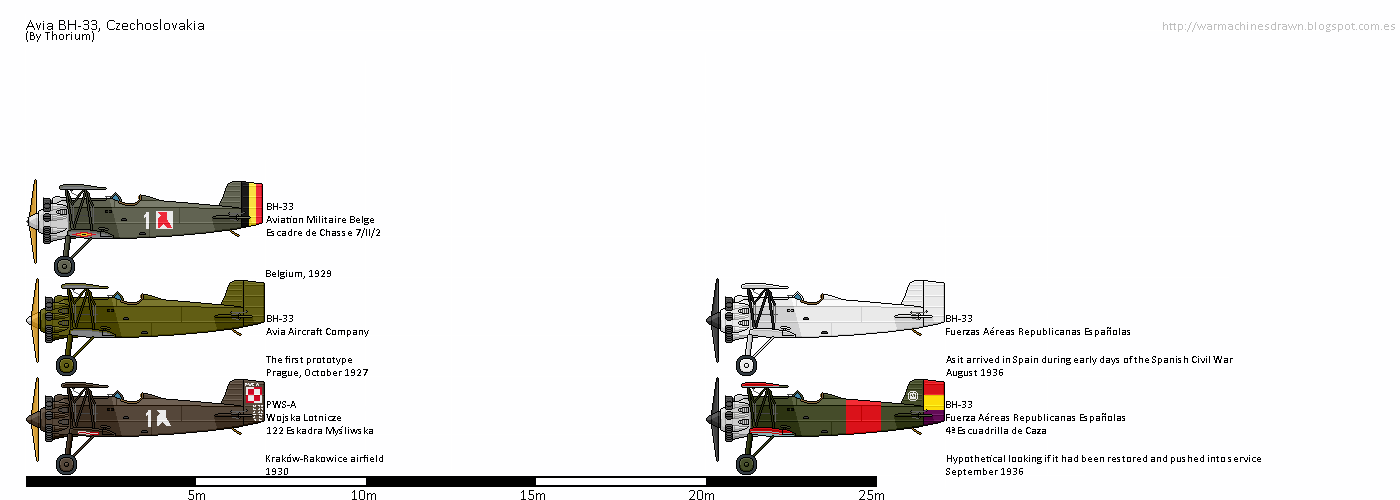
Avia BH-33

During 1926 Avia tested the Gnome-Rhône version of the Bristol Jupiter nine-cylinder radial air-cooled engine fitted to a BH-21 airframe, the BH-21J.

Trials were satisfactory and a new design was born, with the given name of Avia BH-33. It was the last fighter designed by Miroslav Hajn and Pavel Benes for Avia and was also the first Avia fighter to feature a fixed tail fin from the outset. Trials on the new design started in 1927 and were satisfactory enough for the Czechoslovak Army Air Corps, but not brilliant enough that they only ordered 5 airplanes. It was powered by a Walter-built Bristol Jupiter VI engine delivering 543hp at take-off and was armed with two Vickers 0.303in machine guns.

In Belgium, one Avia BH-33 powered by a Bristol Jupiter VII engine was one of the contenders for the Aéronautique Militaire fleet standaristation programme which was eventually won by the Fairey Firefly.
Regarding to Spain, apparently a single BH-33 painted entirely in white flew to Spain in the early days of the Spanish Civil War loosing it's machine-guns and synchronisation gear en route. It's unknown what happened to it, but we couldn't resist the impulse of thinking how it would've looked like if it had been repaired, repainted and push into service.
Poland adquired a manufacturing license in 1928 with PZL building 10 pre-production airplanes of this type and PWS building 50 of them as the PWS-A from 1930 onwards.


Sources:
1. https://en.wikipedia.org/wiki/Avia_BH-33
2. Salamander Books - The Complete Book of Fighters
3. http://bioold.science.ku.dk/drnash/model/spain/did.html
4. http://www.belgian-wings.be/Webpages/Navigator/Photos/MilltaryPics/interbellum/avia_bh33.htm

Tuesday, 12 July 2016

Avia BH-26

The Avia BH-26 was a two-seat fighter designed and built in Czechoslovakia in 1927.

It was a single-bay unstaggered biplane with equal-span wings with a fixed tail-skid undercarriage. An unusual feature for an Avia produced airplane was that it featured long-span ailerons balanced by a small auxiliary airfoil placed in the upper surface of the lower ailerons.

The design was typical of the World War I and the artermath years with the pilot and obersver sitting rear-to-rear in open cockpits, with the observer post, placed in the rear, being armed with two 0.303in Lewis machine guns placed in a Skoda-built ring. The airplane itself was powered by a 450hp Walter-built Bristol Jupiter IV radial engine and it had also another pair of 0.303in Vickers machine-guns placed in the front. Most probably it also had a small load capacity, but we haven't found any info about it. Just like other Avia designs, originally had not fixed fin, just a rudder, but it was changed when entered in service.


Sources:
1. https://en.wikipedia.org/wiki/Avia_BH-26
2. Salamander Books - The Complete Book of Fighters

Monday, 11 July 2016

Avia BH-23

The Avia BH-23 was a night fighter prototype which was a variant of the advanced BH-22 aerobatic trainer.

The BH-22 was developed in parallel to the BH-21 and was am unarmed lighter aerobatics version trainer of it. Thirty examples of the BH-22 were manufactured and, on one of them, the designers Pavel Benes and Miroslav Hajn, decided to install armament and searchlights in 1925.

Modifications were completed in 1926 and it was tested that same year, under the name of BH-22N. It was powered by a 180hp Hispano-Suiza 8Aa built by Skoda and it was armed with two 7,7mm machine guns.

Anyway, the Czechoslovak authorities weren't interested on the project and no production orders were placed.


Sources:
1. Salamander Books - The Complete Book of Fighters
2. https://en.wikipedia.org/wiki/Avia_BH-23

Sunday, 10 July 2016

Avia BH-21 - Czechoslovak users

The Avia BH-21 was built first in 1925 and was a single-seat biplane fighter that served with the Czechoslovak Army Air Force in the interwar period. It wasn't just a competent fighter but also a good racing airplane too.

It was designed by the same team composed by the engineers Pavel Benes and Miroslav Hajn who designed the BH-17, it's most direct predecessor.
The BH-21 and the BH-17 share some design features, in fact it could be said that the final BH-21 version was a heavily revised and modified BH-17. It's most welcomed feature was the improvement of the pilot's field of view. It was powered by a 300hp Hispano-Suiza 8fb which were built by Skoda under license and was armed with two 0.303in Vickers machine guns placed in the frontern upper part of the fuselage. It was put into production in 1925 and in one year 182 airplanes were produced, 137 of them were assigned to the Czechoslovak Army Air Force and the rest were either sold to Belgium or produced under license by the Belgian SABCA.
Two experimental variants were also built. The BH-21J, which was a regular BH-21 powered by a Bristol Jupiter engine which served as the predecessor for the BH-33 and the BH-21R which was a racing variant and was powered by a boosted Hispano-Suiza 8fb engine delivering 400hp of power.

It wasn't proven as it was retired just before the beginning of the World War II, however it served as a pivotal point for the BH-33 and BH-34 which much more advanced fighter types. The BH-21R earned some renown as it was the winner of several racing competitions in 1925.


Sources:
1. https://en.wikipedia.org/wiki/Avia_BH-21
2. Salamander Books - The Complete Book of Fighers

Friday, 8 July 2016

Avia BH-7

The Avia BH-7 was a Czechoslovak prototype fighter built in 1923. It was, more precisely a parasol wing-monoplane developed in parallel to the BH-6, which shared the fuselage and tail design.
Just like the BH-6, it crashed various times when tested, which caused it's abandonment as a fighter.
However, Avia decided to use the design as the basis for a racing airplane by shortening the wingspan 1.4m and fairing it directly into the fuselage dispensing it with cabane struts.
Both racing version and fighter version were renamed as BH-7A, the fighter and BH-7B, the racing variant.
When the racing airplane proved to not be more successful than the fighter, it was abandoned.


Sources:
1. https://en.wikipedia.org/wiki/Avia_BH-7
2. Salamander Books - The Complete Book of Fighters

Thursday, 7 July 2016

Avia BH-6/BH-8/BH-17

We're covering also various Czechosloval fighters which are variants of the same one.

The Avia BH-6 was a prototype Czechoslovak fighter built in 1923. It had wings of unequal span with the top wing being shorter than the lower one, something very unusual for the time. It was joined to the bottom one using an I type strut on both sides which sloped inwards from bottom to top. The top wing was attached to the fuselage by a single large pylon instead of a set of cabane struts.
It crashed early when it was being tested.

The Avia BH-8, on it's part, was another prototype, based also on the BH-6 and was essentialy an attempt to solve the problems that the test projects of that one showed. It was basically the same, with some minor alterations.
When tested, it showed some improvements from the previous BH-6, but as the next version, the BH-17, was ready by the time, the BH-6 development was abandoned.

Finally, the Avia BH-17 was another development of the same BH-6 which was built in 1924 and featured even more adjustments made to the original design. It shown even more good performance than the BH-8 and 24 airplanes were ordered by the Czechoslovak Air Force. However, once deployed, they proved to be seriously unreliable and were retired soon.


Sources:
1. https://en.wikipedia.org/wiki/Avia_BH-6
2. https://en.wikipedia.org/wiki/Avia_BH-8
3. https://en.wikipedia.org/wiki/Avia_BH-17
4. Salamander Books - The Complete Book of Fighters

Wednesday, 6 July 2016

Avia BH-3/BH-4/BH-19

We switch countries, Italy for Czechoslovakia, country where we will stay for quite some time.

Avia BH-3 was a Czechoslovak fighter airplane built in 1921, which was a direct descendant of the BH-1 sports plane.
It was a braced low-wing monoplane of conventional configuration and a tailskid undercarriage.
After favourable trials in June 1921, ten airplanes were ordered by the Czechoslovak Air Force and were delivered in 1923, under the military designation B.3. It proved to be temperamental in service and was shortly relegated to training duties, where it served until 1927.

The Avia BH-4 was a prototype fighter built also by the Czechoslovak Avia in 1922. It was a direct development of the BH-3 powered by a 220hp Hispano-Suiza 8Ba Vee-8 in order to improve the airplane's performance. In order to fit the new engine the airplane nose had to be considerably redesigned, and the fuselage and the undercarriage were reinforced. The performance was marginally better than the BH-3, so it wasn't worth it and it's development was abandoned.

The Avia BH-19 was another prototype built in Czechoslovakia in 1924. It also derived directly from the BH-3 and proved that the designers, Pavel Benes and Miroslav Hajn, believed that the monoplane configuration was the most suitable for a fighter aircraft (as it's obvious time proved them right). The initial test showed excellent performance but gave control problems and aileron flutter, however the Czechoslovak Army was interested and told them that they would order the airplane if those problems were solved.
However, the first prototype crashed when performing speed trials and the second one hadn't solved the problems of the first one, so, after that, the Czechoslovak Army asked Avia to cease the attempts to develop a monoplane fighter, at least during the 1920s.


Sources:
1. https://en.wikipedia.org/wiki/Avia_BH-3
2. https://en.wikipedia.org/wiki/Avia_BH-4
3.https://en.wikipedia.org/wiki/Avia_BH-19
4. Salamander Books - The Complete Book of Fighters

Friday, 29 January 2016

Aero A.20

We make this special entry in order to present you the evolution of the Aero A.18: The Aero A.20.

The Aero A.20 was developed in parallel with the A.18 in order to comply with a requeriment made by the Czech MNO (Ministerstvo Národny Obrany - Ministry of Defence) and get a contract.

It was powered by an Skoda-built 310hp Hispano-Suiza 8Fb engine. It was longer and heavier than the A.18 and also flew for the first time in 1923.

Regarding the strutcure of the fuselage it was identical to the A.18 and was also armed with a pair of synchronised 7,92mm Vickers Machine-Guns. In spite of its more powerful engine, it didn't perform well at the trials and was surpassed by the A.18, so the project was abandoned and it never went beyond the prototype stage.


Sources:
1.https://en.wikipedia.org/wiki/Aero_A.20
2. The Complete Book of Fighters

Aero A.18

Today we start this friday with the first successfully mass-produced Czechoslovak fighter, the Aero A.18.

Being an evolution of the Ae.04, the A.18 was a fighter designed also by Antonin Vlasák and Antonín Husník in order to fullfil an order coming from the Czechoslavk Army.

It was powered by the 185hp BMW IIIa engine that had already been employed in the previous Ae.04. and was armed by a pair of 7,92 (0,303) synchronized Vickers machine-guns.
It also retained the mixed construction of its predecessors but it featured a different upper wing and strut configuration.

The prototype flew for the first time in March 1923 and 20 airplanes were ordered in order to serve with the Czechoslovak Army Air Force over the other two candidates from Aero, the A.19 and the A.20 which, despite of what their names may suggest, they were developed in parallel to the A.18.

It was pretended for the A.18 stablish three national altitude records and two racing sub-variants were also made, the A.18B and the A.18C, in order to participate in the Czech Aero Club annual race which they won.


Sources:
1.https://en.wikipedia.org/wiki/Aero_A.18
2. The Complete book of Fighters

Thursday, 28 January 2016

Aero Ae.04

We keep going with the early Czechoslovak fighters and now it comes the turn for the Aero Ae.04.

The Aero Ae.04 was a Czechoslovak fighter of 1921. It was a development of the previous Ae.02 and it didn't attract any purchase order and it only could fly in prototype form.

After testing the Ae.02, Vlasák and Husník revised the basic design of the airplane in order to acommodate it to the requirements of the Czechoslovak army in order to fit it with the 185hp BMW IIIa six-cylinder engine because a license to produce that engine had been adquired.

It flew for the first time in 1921 and the prototype stablished a new national altitude record when it reached 6361m high. After such achievement, it was displayed at the 2nd international aircraft exhibition in Prague.

Even if it held most of the fuselage features of the Ae.02, the external fuel tank of that one was transfered back into the fuselage, in order to make it safer and initialy it flew with an automobile style radiator, however, after some development, it was changed into a chin-type radiator.

Only one prototype was made and the development continued towards the A.18.


Sources:
1. https://en.wikipedia.org/wiki/Aero_Ae_04
2. The complete book of fighters

Wednesday, 27 January 2016

Aero A.02

With this airplane, we include a new nation.

The Aero Ae.02 was the first fighter designed in Czechoslovakia, it was designed by Antonin Vlásak and Antonin Husnik and it was built by the Aero company.

It was an orthodox biplane design with I-type interplane struts and ailerons on the upper wing only.  It was made of mixed construction with fabric-covered wooden wings and a dural-frame fuselage.

It was powered by an V-type 220hp Hispano-Suiza HS 8Ba eight-cylinder engine with the peculiarity that the only fuel tank of the airplane was fitted between the main wheels of the undercarriage and that could be jettisoned by a quick-release mechanism. It was armed with a pair of 7,92mm Vickers Machine-guns.

It flew for the first time in 1920 and in 1921 ,piloted by Josef Novak, it won the silver club on the Czech aeroclub annual meeting. Even if the performance of the prototype was adequate for it's time, the Czechoslovak Army Air Force wasn't interested in buying it.


Sources: 
1. The complete book of fighters
2. https://en.wikipedia.org/wiki/Aero_Ae_02

Tuesday, 5 January 2016

Oeffag Va.253 - Foreign Users, first entry

And we keep going with the Albatros D.III variants. This time we are covering some of the foreign users of the Austro-Hungarian most advanced variant, the Oeffag Va.253.

Note: As the Polish air force 7th squadron used a lot of these airplanes, they'll have their own dedicated entry. The Polish airplanes represented here are those not belonging to that squadron.

Powered by a 225hp Austro-Daimler engine, the Va.253 was basically a license-built Albatros D.III featuring some changes which we will explain later.

The countries covered in this entry:

  • Austria: After the World War I, the newly created Austrian Republic was banned from having a military air force and therefore most of the former Austro-Hungarian airplanes were scrapped. However some were saved and were owned privately. 
  • Czechoslovakia: On 22nd November 1917 the Czech pilot Adolf Blaha, defected to Switzerland where he performed acrobatic shows for living until the Austro-Hungarian Empire collapsed. Then he flew back to Prague and became the first Czechoslovak pilot of the newly created Czechoslovak Army Air Force.
  • Poland: After the war the Polish army bought 38 Oeffag Va.253 and employed them in the Polish-Soviet war mainly in ground attack roles. The main user was the 7th squadron, but in this entry we are covering those which didn't serve on the 7th squadron.
  • Yugoslavia: The newly created State of Slovenes, Croats and Serbs, seized some leftover Austro-Hungarian airplanes and used them in the Austro-Slovene conflict lasting from November 1918 up to July 1919.


Tuesday, 27 October 2015

SPAD S.VII - First entry, foreign users vol. 1

We start this series of entries with another heavyweight of the Great War: The SPAD S.VII

The SPAD S.VII was the first of a successful saga of French biplane fighters. It was designed by Louis Béchereau and was produced by the Société Pour L'Aviation et ses Dérivés (SPAD) (Society for aviations and it's derivatives). It was renowned for being a sturdy and hard to destroy airplane with good climbing and diving characteristics. It was also good as a gun platform although apparently it was too heavy and less maneouvrable than the contemporaneous Nieuport fighters. Many famous WW1 aces like Guynemer, Baracca or Pentland flew it.

As it was widely used both in the Great war and in the aftermaths it suffered many small field modifications, being the most notorious one the inclusion of skis by the Russian DUX factory.

This entry covers the usage by the next countries:


  • Argentina: Bought two aircraft for evaluation purposes.
  • Belgium: Widely used by their national aviation corps (Aviation Militaire) during World War I and the post-war period. Most precisely it was used by the 5éme and 10éme escadrilles (5th and 10th squadrons).
  • Brazil: Used by their national military aviation service (Serviço de Aviação Militar) in 1920.
  • Chile: Another evaluation-only user. The colours are speculative as we couldn't find any photographic or visual evidence.
  • Czechoslovakia: One of the main post-war users. It constituted the backbone of the very early Czechoslovak Army Air Force (Československé Letectvo) and some of them were employed during the brief Polish-Czechoslovak war of 1919.
  • Estonia: It's been said that some captured ex-Russian airplanes were among the first airplanes that formed the Estonian aviation regiment in the aftermath of the Great War. Just like Chile we couldn't find any supporting evidence and therefore the colours are speculative
  • Finland: Finland used DUX-built airplanes in both versions, with skis and without them. However they didn't see action during the Finnish civil war of 1918, as far as we know.
  • Imperial Germany: Germany captured various airplanes during 1917, mostly from the French SPA 31 unit and SPA 65. Most of the SPA 31 retained the unit insignia when flying with their new German-owners.