Showing posts with label South Africa 2000-2009. Show all posts

Monday, 14 August 2017

Aermacchi MB-326, South African Users

South African obtained a production license for the MB-326M that was named Atlas Impala Mk.I in 1964 and the production started two years later, in 1966. The South African Air Force bought 40 Italian airplanes and 125 of them were locally built by the Atlas Aircraft Corporation. They were used both in the trainer and light attack role.
Seven further airplanes of MB-326K light attack model plus another 15 of them and 78 more were locally built by the Atlas Aircraft Company as the Atlas Impala Mk.II in 1974.
They were used in the South African war against the Angolan and Cuban troops in the border war. During the course of that war only one of them was shot down by an Angolan SA-7.
They had many advantages as they could operate from primitive airfields in order to strike swiftly during the 1970s and most of the 1980s when most of the Impalas were replaced by the Dassault Mirage III and Blackburn Buccaneers in order to perform the ground attack role.
The Impala Mk.II was also used as interceptor when in 1985 one of them shot down various Mil Mi-8 and Mil Mi-24 helicopters cutting off Angolan supply lines.


Sources:
1. https://en.wikipedia.org/wiki/Aermacchi_MB-326#South_African_service
2. http://www.craiglotter.co.za/2015/05/13/military-aircraft-south-african-atlas-impala-macchi-mb-326/

Wednesday, 29 June 2016

Atlas Cheetah - South African Users, Part Two

Today we center ourselves on the operational history and variants of the Atlas Cheetah.

As we said earlier, the Cheetah was, basically, a vast development of the Dassault Mirage III, and the first of those airplanes to be converted was the Mirage IIIDZ no.845 which was bought by Atlas Aircraft Company in April 1983 and the modifications were finished on 16th July 1986, by the time that various Cheetah Ds were in active service with the South African 89. Combat Flying School based at AFB Pietersburg but it wasn't only until 1987 that the type was declared operational.
Later, the company bought some Mirage IIIEZ in order to convert them into Cheetah Es and entered service with the South African Air Force at AFB Louis Trichardt serving with the 5.Squadron. More precisely, 16 of each type were in service by 1991 when the production lines for the Cheetah E and D closed, by which time the Cheetah C were being converted and the first of them rolled out of the production lines on January 1993.
Every Cheetah C entered service with the 2. Squadron SAAF, which was also based at AFB Louis Trichardt.
None of the Cheetahs saw combat action in the Border war, so their performance was never tested against the MiG-23 and the Cheetah Es were used as interceptors with a minimum of two of them staying in permanent alert status until the Border War ended in 1989.
When the more modern Cheetah C entered into service, the Cheetah Es were withdrawn from the active service and the 5. Squadron SAAF was disbanded in 1992. Soon after, the 89. Combat Flying School was also disbanded and the Cheetah Ds were transferred to 2. Squadron SAAF, where they remained in active service until 2008.
However, two Cheetah Ds are still operated by Denel Aviation at the Overberg Test Flight and development center.

The variants of the Cheetah are:

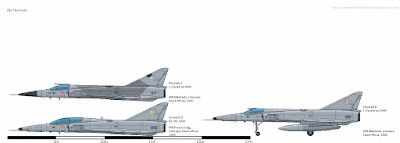
  • Cheetah D: The sole two-seater variant which was used mainly for training duties. It had also secondary attack capabilities as it could deliver some PGM. Some of them received an upgraded version of the Atar 9K50C-11 engine plus some upgrades in avionics systems.
  • Cheetah E: A variant developed as an interim fighter until the Cheetah C were available, as it was thought as an interceptor, it was armed mostly with air-to-air weaponry, mainly V3B and V3C missiles.
  • Cheetah C: The final development of the Cheetah, was the only fighter type serving with the South African Air Force until being replaced by the SAAB JAS39 Gripen in 2008. It was equipped with an improved pulse-doppler multi-mode radar (ELTA) and had also improved helmet and HUD systems. It featured also an anti-radiation shield wraped around the windshield a revised in-flight probe, an upgraded version of the Atar 9K50 engine and a new nose to fit the new radar. As the previous versions it could deliver precision-guided munitions, GPS-guided bombs and TV guided bombs plus various air-to-ground weapons and air-to-air missiles.


Sources:
1. https://en.wikipedia.org/wiki/Atlas_Cheetah
2. Salamander Books - The Complete Book of Fighters

Tuesday, 28 June 2016

Atlas Cheetah - South African Users, part one

As South Africa needed a modern fighter that could also act as a strike fighter in the 1980s, specially when their enemies in the border war, like Angola or Cuba counted with the newer Mig-23, and considering that South Africa was under an arms embargo by the United Nations due to the apartheid, made the upgrade of the already available material the only real choice for the South African Air Force.

As, they had a respectable amount of Dassault Mirage III and Mirage F.1, the Atlas Aviation company, using expertise gained from the aborted Israeli IAI Lavi fighter upgraded the main airframe of a Mirage III down to zero hours, fitted non-moving canards aft of the engine intakes, added two new wings store pylons at the wing roots, an aerial refuelling probe, new ejection seats, a new and more powerful engine (an upgraded SNECMA Atar 9k50C-11), a new main wing spar together with a new drooping leading edge and a dog-tooth incisition on each wing, modernized elevons controlled by a twin computer flight control system and strakes on the nose in order to improve the high angle of attack performance.
Just the aerodynamical improvements increased the performance of the aircraft by a respectable 15%, increased the angle of attack, reduced the minimum airspeed to 100kt and increased the maximum take-off weight by 700kg with the cost of a lost of a 5% in maximum level of speed and acceleration.

Additionaly a highly sophisticated avionics, radar, electronic warfare and self-protection suit was installed making the increase of the nose lengthness necessary. Missile and radar warning sensors were also installed as they were needed like electronic jammers, automatic chaff/flare dispensers, an integrated helmet mounted sight and oversized heads-up-display (HUD) an advanced pulse-doppler radar and sophisticated cockpit instrumentation.
It's suspected that Israel Aircraft Industries was involved at least initially and even some components were imported from Israel and even that some IAI Neshers were bought by South Africa for Cheetah trials and then absorbed into the existing fleet.

We are covering those conmemorative or special painted aircrafts, that were non combatant, leaving the combatant ones for the next post.


Sources:
1. https://en.wikipedia.org/wiki/Atlas_Cheetah
2. Salamander Books - The Complete Book of FIghters