Showing posts with label Mozambique 1980-1989. Show all posts

Tuesday, 27 August 2019

Mikoyan-Gurevich MiG-17F, part nine, African users, part three

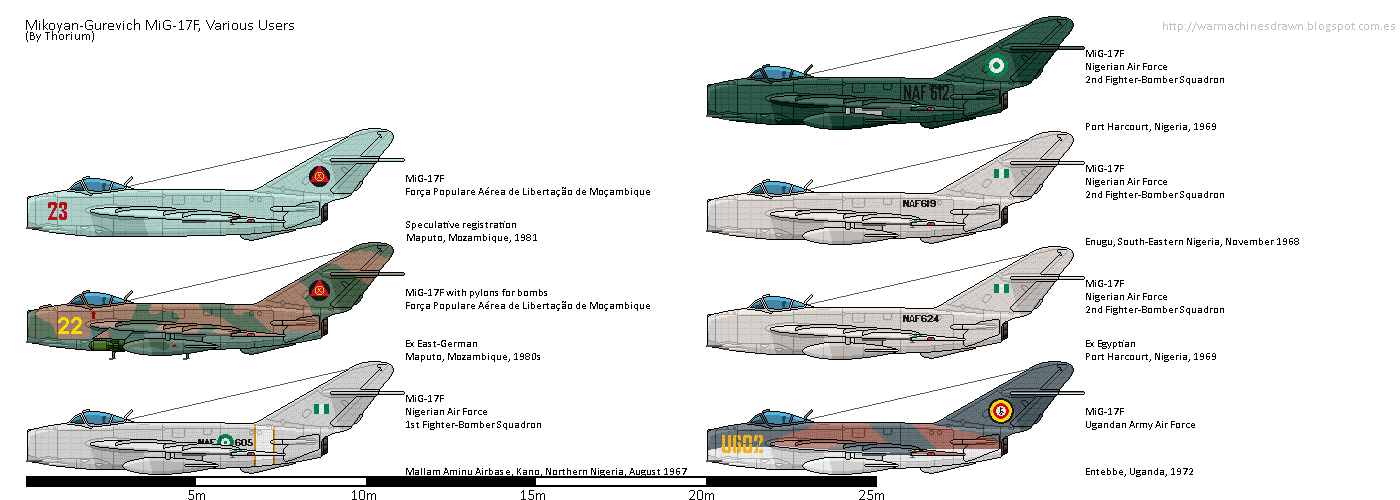
As we've said many times before, the MiG-17F was the fighter backbone of many African nations, among them the following ones:

  • Mozambique: Just like it happened with Angola, People's Liberation Air Force of Mozambique (PLAFM) was created in 1975 after Independence War and the subsequent Civil War. Twelve MiG-17Fs were supplied to the PLAFM most of them to perform ground support missions as they didn't have to keep the skies clear. Many of them were ex-East German which were already modified for fighter-bomber operations and had already underwing pylons for carry either bombs or air-to-ground rocket launchers.
    The fighter-bombers were delivered to the port of Beira in August 1981 with a detachment of East-German pilots and technicians to put the aircraft together and test-flight them. In fact, the first test flight took place in Beira on 9th September 1981 at the hands of an East German pilot. By October it was officially accepted into the PLAFM. There are reports about additional shipping of two 12-plane batches in 1983 and 1984 but they were never confirmed. During the whole duration of the Mozambican Civil War, the MiG-17F were flown by two fighter-bomber squadrons based at Maputo Air Base and it's known that all of them were inoperative by the early 1990s.
  • Nigeria: The MiG-17 first and the MiG-17F second, gave the Nigerian Air Force (NAF) combat capability after a Biafran attack on 13th August 1967 that damaged the already weakened NAF. After that attack, the USSR supplied the Nigerian Air Force with deliveries taken from Egyptian ports to Kano IAP. Initially just 8 MiG-17F were delivered. In July 1971 it was estimated that all of them were still active. They were taken out of service in 1975 following the delivery of the MiG-21 which replaced them. 
  • Uganda: From 1966 until 1972 around 12 MiG-17Fs were supplied to Uganda, whose Air Force (from now on Ugandan Army Air Force - UAAF) was strongly influenced by the Israeli Air Force back then, hence that atypical camouflage configuration. At least four of them were destroyed in the Entebbe Raid in 1977 and the last ones were flown during the Uganda-Tanzania War in 1978 and 1979. One of them was shot down by Tanzanian SA-7 on 11th October 1978 and the remaining ones (just two or three) captured and destroyed by Tanzanian troops in April 1979. 


Sources:
1. https://en.wikipedia.org/wiki/Mikoyan-Gurevich_MiG-17
2. https://en.wikipedia.org/wiki/Mozambique_Defence_Armed_Forces
3. https://en.wikipedia.org/wiki/Nigerian_Air_Force
4. https://en.wikipedia.org/wiki/History_of_Uganda_(1971–79)
5. https://en.wikipedia.org/wiki/Uganda–Tanzania_War
6. Salamander Books - The Complete Book of Fighters

Thursday, 11 July 2019

MIkoyan-Gurevich MiG-17, part three, various African & American users

The regular version of the MiG-17 was used by many African countries and saw action in many wars that took place in that continent. Among those users are:

  • Congo-Brazzaville: After achieving independence from France in the 1960s, in the 1970s they switched to the USSR for equipment. They were sold some MiG-17s and some MiG-15UTIs which were in service until the 1990s when they were replaced by MiG-21s.
  • Morocco: In 1961 the Royal Moroccan Air Force adquired 12 MiG-17s together with MiG-15UTI trainers and Il-28 bombers. The MiG-17s saw action two years later, in 1963 during the Sand War and later, during Yom-Kippur War, a squadron of Moroccan MiG-17s were deployed in Egypt with the Egyptian 69 Squadron. Every Moroccan MiG-17 was replaced by more modern types.
  • Mozambique: The People's Liberation Air Force of Mozambique was supplied with ex-East-German MiG-17s. They saw extensive action during Mozambican Civil War in the 1980s. The depicted one belonged to Adriano Bomba, a pilot who defected to South Africa on 8th July 1981. The South African Air Force tested the aircraft before returning it to its original owners. The MiG-17 was operated by two squadrons of the People's Liberarion Air Force of Mozambique which were based in Maputo. By the early 1990s they were totally inoperative as they lacked fuel and spare parts. When the Civil War ended, they were scrapped and replaced by more modern types.
  • Nigeria: The Nigerian Air Force received real aerial combat capability when the USSR supplied MiG-17s during the Nigerian Civil War from Egypt and a Polish merchant ship. They served during the Biafran conflict and were in active until 1975 when they were replaced by the MiG-21.
  • Somalia: Just before the outbreak of the Ogaden War (1977-1978) the Somalian Government bought some MiG-17s which most of them were destroyed shortly after the beginning of the war as they were whipped by the Cuban-backed Ethiopian Air Force. Some of them survived and were found derelict in 1992.
  • Cuba: The first MiG-17s arrived in Cuba in 1964 and were based in Santa Clara. They were active until the 1980s when they were replaced by the MiG-23. In 1964 two American F-8 Crusaders which were escorting a Lockheed P-3 Orion almost got into combat against two Cuban MiG-17 as the MiG-17s were impending the P-3 to do its job. The F-8's pilots asked for permission to fire, but didn't get it.
    It was also the aircraft on which the Cuban pilot Eduardo Guerra Jiménez defected to Florida. 


Sources:
1. https://en.wikipedia.org/wiki/People’s_Republic_of_Congo_Air_Force
2. https://en.wikipedia.org/wiki/Somali_Air_Force
3. https://en.wikipedia.org/wiki/Royal_Moroccan_Air_Force
4. https://en.wikipedia.org/wiki/Nigerian_Air_Force
5. https://en.wikipedia.org/wiki/Mozambique_Defence_Armed_Forces
6. http://www.urrib2000.narod.ru/EqMiG17.html (translated)

Saturday, 23 February 2019

Mikoyan-Gurevich MiG-15UTI, part four, African users

The MiG-15UTI served also in many African countries. Those are:

  • Angola: When the Angolan Air Force was established in 1975 it was equipped with Soviet equipment and trained by Cuban pilots. Among the material supplied by the Soviet bloc there was a batch of MiG-15UTI trainers that were used both for training pilots and recon missions against South African and UNITA forces in the context of the Angolan Civil War. The UTIs continue to serve nowadays, together with other trainers, with the Angolan 9th Training Squadron which is part of the 24th Training Regiment, based at Menongue Air Base.
  • Congo-Brazzaville: After achieving independence in the 1960s, and undergoing a revolution, in the 1970s the Congo-Brazzaville Air Force decided to switch to Soviet equipment. Among that new supplied aircrafts there were a number of MiG-15UTIs that served in the FAC (Force Aérienne Congolaise) and, during the late 1990s it's known that many of them, due to the Congolese Civil War, were in derelict condition.
  • Guinea-Bissau: After achieving independence, the air force was equipped (as initially they just had three North-American T-6Gs) with limited Soviet material, among them, two MiG-15UTIs. They served until 1991 when they were put in storage condition at the hangars of the Osvaldo Vieira International Airport due to the lack of funds.
  • Guinea-Conakry: After achieving independence, the air force was established with Soviet assistance in 1961. Just like Bissau, they got two MiG-15UTIs together with other Soviet aircrafts. They were most probably retired from service and/or scrapped in the 1980s when their air force underwent a small modernization process.
  • Madagascar: The Madagascar Air Force received a small number of UTIs when their air force was founded. Not much is known about their usage, but most probably they haven't been used a lot. As the information about these UTIs is rather scarce, the drawing should be taken as speculative.
  • Mali: During the mid 1960s the Soviets supplied a single MiG-15UTI to the newly founded Mali Air Force. It was used to train pilots in the usage of the MiG-17F which just had 5 of them. They served well until the 1990s when the air force was somewhat modernized.
  • Mozambique: Apparently, the Mozambican Air Force got some ex East-German UTIs shortly after their independence. They were used during the Mozambican Civil War during the 1980s and most of them were probably destroyed. 


Sources:
1. https://en.wikipedia.org/wiki/Mikoyan-Gurevich_MiG-15
2. https://en.wikipedia.org/wiki/Angolan_People%27s_Air_Force_And_Air_Defence_Force
3. https://en.wikipedia.org/wiki/National_Air_Force_of_Angola
4. https://en.wikipedia.org/wiki/People’s_Republic_of_Congo_Air_Force
5. https://en.wikipedia.org/wiki/Air_Force_of_the_Republic_of_Congo
6. https://en.wikipedia.org/wiki/Guinea-Bissau_Air_Force
7. https://en.wikipedia.org/wiki/Guinea_Air_Force
8. https://en.wikipedia.org/wiki/Malagasy_Air_Force
9. https://en.wikipedia.org/wiki/Military_of_Mali_Air_Force
10. https://en.wikipedia.org/wiki/Mozambique_Air_Force