Showing posts with label Canada 1950-1959. Show all posts

Tuesday, 29 November 2022

de Havilland Vampire. Part Five. Some American Users


The de Havilland Vampire is a British jet fighter aircraft designed, developed and produced by the de Havilland Aircraft Company. It was used by the Royal Air Force (RAF) but also by many other users, among them, the following ones:

  • Canada: In 1946 the Canadian Government ordered 150 Vampire F.Mk.3 fighter from de Havilland after changing an older plan where local production of the Vampire under license was planned. In fact, one Vampire F.1 was tested at the Winter Experimental Establishment in Edmonton, Alberta. 
    Eventually, the order was reduced to 85 machines, all of them drawn from RAF's production. They were delivered between September 1947 and February 1948 and Vampires equipped two frontline squadrons of the Royal Canadian Air Force (RCAF), Nos 410 and 421. No.410 operated the type from 1949 until 1951. No.421 was moved to Great Britain to carry out operational training alongside the RAF. 
    Six Royal Canadian Air Force Auxiliary squadron flew the type too, these were: Nos. 400, 401, 402, 411, 438 and 442 as did the Canadian Central Flying School and No.1 Operational Training Unit. 
    The Vampire was appreciated among Canadian pilots as it was easy to fly. Between November 1956 and June 1958 they were gradually withdrew from service as they were replaced by the Canadair Sabre. In 1960 fifteen Vampires F.Mk.3 were sold to the Mexican Air Force.
    Twenty-six machines, plus four 'spares' (machines intended to be used as a source for spare parts) were sold to an American company based in Wisconsin. This company sought to convert the Vampires into single-seat executive jet or fun flyers, however their project was cut short by sever restrictions set by the American Federal Aviation Administration.A Hollywood stunt pilot, Paul Mantz, is known to have operated two Vampires and one company, Airplanes Inc. of Wyoming, still had one operational machine in 1967.
  • Chile: On 22nd October 1953 five Vampire T.55 were ordered for the Chilean Air Force (CAF). The first three of which were shipped during January 1954 with the remaining two arriving between April and June. They were assembled and test flown at Cerrillos Air Base, in Santiago. These machines constituted the first jet aircraft of the CAF. They served as trainers. However, by 1962 they were all grounded, to be refurbished, one year later into ground attack planes. They lasted until 1971 when structural life restrictions grounded all the Vampires except for one.
    That year, the CAF ordered some Hawker Hunters, but they still had the need for a good basic jet trainer so they bought four ex-RAF T.11s and six ex-Fleet Air Arm T.22s. They were shipped to Chile in December 1972 and took part in the Beagle Crisis in 1974. By June 1977 some were withdrawn from active service with the remaining ones following on 31st December 1980. 


Sources:
1st Hall Park Books - Warpaint 27 - De Havilland Vampire
2nd https://en.wikipedia.org/wiki/De_Havilland_Vampire

Thursday, 24 September 2020

Fairey Firefly, Canadian users


The Fairey Firefly was a British carrier-borne fighter and anti-submarine aircraft that was developed during the Second World War. It served with the naval arms of various Commonwealth countries, among them, Canada, which is the subject of this post.
In May 1945, after the en of the war in Europe, and anticipating a major naval offensive against the Japanese mainland, the Canadian government accepted a British offer of loaning two Colossus-class aircraft carriers to the Royal Canadian Navy (RCN). In order to equip those carriers, it was necessary to procure naval fighters and, based upon the feedback of veteran pilots, Canada opted to acquire the Firefly over the other alternative that favoured the acquisition of American fighters.
As an interim measure, the Fireflies were acquired from the Royal Navy while more advanced purpose-built aircraft were being constructed. Therefore, between 1946 and 1954 the RCN employed a total of 64 (65 according to wikipedia). Initially they were based at HMCS Dartmouth, Nova Scotia, and they served aboard HMCS Warrior and HMCS Magnificent aircraft carriers operated by the No.825 and 826 squadrons of the RCN. The Firefly AS Mk.V (AS stands for anti-submarine) was ordered in 1949 to meet a NATO role for the RCN in anti-submarine warfare. Those AS.Mk V operated in this role until late 1950s when they were replaced by Grumman Avenger AS.Mk.3. 
Canadian Fireflies were sold to various countries during the 1950s like Ethiopia, Denmark and the Netherlands. Some older FR.I variants were used briefly for training purposes.


Sources:
1. https://en.wikipedia.org/wiki/Fairey_Firefly
2. https://www.warplane.com/aircraft/collection/details.aspx?aircraftId=18
3. Salamander Books - The Complete Book of Fighters

Wednesday, 3 May 2017

McDonnell F2H-3 Canadian users

As the Royal Canadian Navy wanted to replace their obsolete Hawker Sea Furies with Banshees back in 1951 but due to economical reasons the purchase wasn't approved until the production of the Banshee had been shut down in 1953 forcing Canada to adquire second-hand Banshees that were delivered from 1955 to 1958 and flew from the carrier HMCS Bonaventure or as NORAD interceptors.
Initially it had good reputation among the Canadian pilots. However it suffered various problems as one of them was lost after an inflight structural failure of the folding wing mechanism and another one had a brake failure when landing on the carrier, rolling off from it, falling into the ocean and, unfortunately, drowning its pilot.
As the main focus of the Royal Canadian Navy switched to anti-submarine warfare, the Banshees were left ashore and they retired without replacement in 1962 being the only jet-powered carrier-based fighters that served with the RCN.


Sources:
1. https://en.wikipedia.org/wiki/McDonnell_F2H_Banshee#Royal_Canadian_Navy
2. Salamander Books - The Complete Book of Fighters

Thursday, 22 December 2016

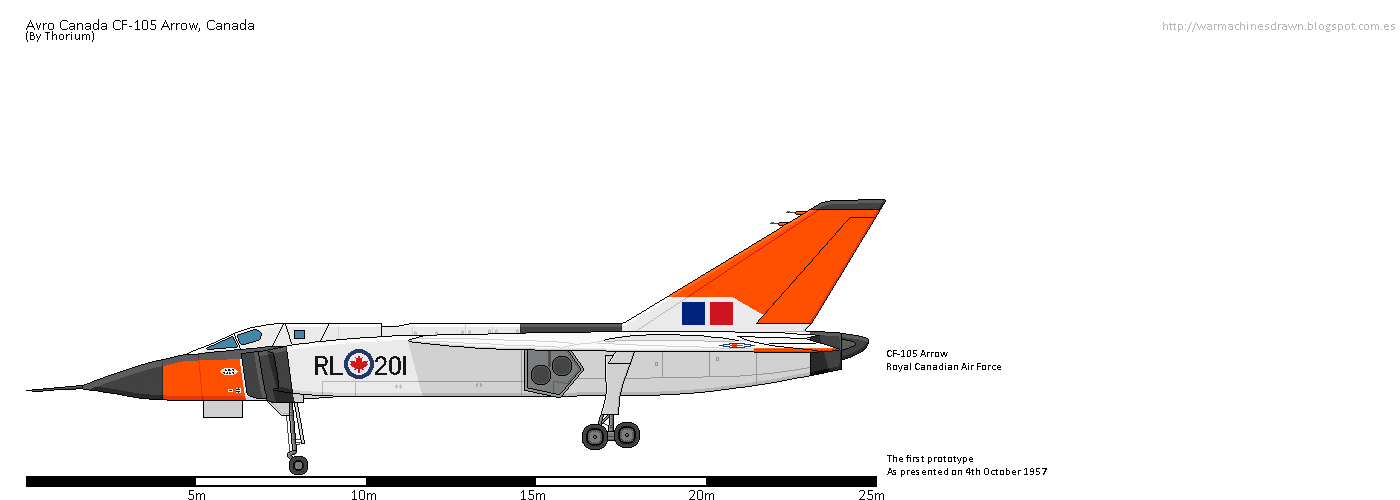
Avro Canada CF-105 Arrow

Now it's time to write about a true flying legend.
The Avro Canada CF-105 Arrow was conceived back in 1952 to a requirement from 1952 made by the Royal Canadian Air Force, the CF-105  was a two-seat tandem all-weather interceptor of which 37 airplanes were ordered.
Of those 37, the first five of them were known as the Mk.1 and were powered by two Pratt & Whitney J75-P-3 turbojet engines delivering each of them 5670kgp of power which could raise up to 8392kgp after applying the afterburner at maximum power.
The sixth and consecutive airplanes, would've been the Mk.2 series which were expected to be powered by two Orenda PS-13 Iroquis turbojet engines delivering each of them 8732kgp of power and 11794kgp whe afterburning.
The Mk.2 series were to be armed with eight AIM-4 Falcon, three AIM-7 Sparrow or some unespecified number of Canadair Velvet Globe Anti-Air Missiles placed internally in a bay that would deploy when needed.
The first Mk.1 prototype was flown on 25th March 1958 and the other four in 1st August, 22nd September and 27th October, the very same day that the Soviet Sputnik satellite was successfuly launched, so it overshadowed the presentation of this airplane. The fifth one flew on 11th January 1959.
The third prototype achieved the speed of mach 1.5 and mach 1.98 speed was achieved when, on 20th February 1959 the programme was cancelled due to various political reasons. By then, the first airplane of the Mk.2 series was almost complete, and was about to join the testing flights followed by further four that weren't so completed. Urban legends claim that one of those prototypes wasn't destroyed and it's lying inside some hangar, rusting somewhere.


Sources:
1. https://en.wikipedia.org/wiki/Avro_Canada_CF-105_Arrow
2. Salamander Books - The Complete Book of Fighters

Tuesday, 20 December 2016

Avro Canada CF-100 Mk.5 Canuck - Canadian users

Now it's time for the last post about the CF-100 Canuck.
The Mk.5 was the last variant of the CF-100 Canuck. It featured a longer wingspan in order to increase it's operational ceiling. They were powered either by Orenda 11 or Orenda 14 delivering similar thrust of power. It's special because it was armed only with rockets and had, therefore, the gun pack and machine-gun sights removed.
A total of 281 were built and 49 Mk.4B were upgraded to the Mk.5 standard and it was the first massively produced Canadian jet fighter.
It served with many Royal Canadian Air Force Squadrons, with four of them being deployed in Europe from 1956 to 1962 under the nimble bat program, which consisted on replacing the Canadair Sabre with some Canucks in order to provide some squadrons with an all-weather fighter against the Soviets.
When the Canuck was already outdated, some of them were retrofitted with some electronic counter-measures to serve in that role. It featured some radar jammers in the gun pack and chaff dispensers in the underwing pylons. It was followed by another communications-jamming version and remained in active role until 1981, however we couldn't find relevant graphical references of these versions, so they remain undrawn.


Sources:
1. https://en.wikipedia.org/wiki/Avro_Canada_CF-100_Canuck
2. http://www.airvectors.net/avcf100.html
3. Salamander Books - The Complete Book of FIghters

Monday, 12 December 2016

Avro Canada CF-100 Canuck Mk.4

The CF-100 Mk.4 was the first variant of the Canuck armed with rockets. It made it's maiden flight as a modified version of an Mk.2 on 11th October 1952. When tested, it outrunned the Canadair Sabre but it wasn't as agile as this one. It even managed to reach mach 1 in a dive on 4th December of that same year.
The prototype was used also to test a belly rocket pack mounted behind the guns with 48 FFAR rockets, but it caused several buffeting after being extended and therefore was discarded.
That prototype was lost on 23rd August 1954 during an accident where the pilot successfully ejected but the navigator, unfortunately couldn't.

The first production version of the Mk.4 appeared in September 1953 and it featured a modified cockpit with a one-piece canopy and an internal modification to make it easier for the navigator to eject after the pilot had ejected.
It was powered by two Orenda 9 engines delivering each of them 2950kgp of thrust, which required modified nacelles. Regarding avionics, it was equipped with the Hughes MG-2 fire control system and an AN/APG-40 radar in the nose, copying that way the Northrop F-89D Scorpion.
On the wingtips there was a provision for 29 Mighty Mouse rockets which could be swapped by wingtips tanks, which we have chosen to draw.
The early production of this variant lacked an autopilot, but it's not clear if it was fitted later on or not and some of them had a production tail bumper but most of them were removed, specially in the late production variants.
The Mk.4 was the true first satisfactory production variant, so when this one rolled out, the production orders for the Mk.3 were called off. Totally 137 Mk.4 were built and when an uprated Orenda 11 engine appeared, it became the standard for the Mk.4 which were designated as Mk.4B and those powered by the Orenda 9, were retroactively called Mk.4A. Only two Mk.4A were converted to Mk.4B configuration.


Sources:
1. https://en.wikipedia.org/wiki/Avro_Canada_CF-100_Canuck
2. http://www.airvectors.net/avcf100.html
3. Salamander Books - The Complete Book of Fighters

Saturday, 10 December 2016

Avro Canada CF-100 Canuck Mk.3

The Avro Canada CF-100 Mk.3 was the first production version. It featured the APG-33 nose radar, an US built Hughes E-1 fire control system, and was armed with eight 0.50in Browning M3 machine guns placed in a belly tray that could be dropped out in order to increase speed.
Some experimental variants were also made, like one with four 20mm cannons instead of the 0,50in machine guns, but it was discarded as it was very problematic.
It seems that it could be equipped with some air-to-ground bombs, with a load of up to four 450kg bombs, in order to perform the rather unlikely for this airplane, ground attack role.
It's interesting to mention that an Mk.3 was fitted with four Canadair Velvet Globe missiles on underwing pylons, in order to test them, however the Velvet Globe missile program was cancelled in 1956 and that missile never entered service.
In September 1950 the Royal Canadian Air Force oredered 124 Mk.3s with the first one of them entering service in 1953.


Sources:
1. https://en.wikipedia.org/wiki/Avro_Canada_CF-100_Canuck
2. http://www.airvectors.net/avcf100.html
3. Salamander Books - The Complete Book of Fighters

Thursday, 8 December 2016

Avro Canada CF-100 Mk.2

The Avro Canada CF-100 Canuck was a pre-production version of the regular Canuck. Only five of them were made as they intended to be test aircrafts.
They were also powered by the Orenda 2 engine that also powered the two prototypes and one of them was fitted with dual controls in order to make it a trainer aircraft. It was labelled as the Mk.2T.

Apparently, nowadays at least one of them is conserved as a gatekeeper at the CFB St.Jean in the Canadian province of Quebec.


Sources:
1. https://en.wikipedia.org/wiki/Avro_Canada_CF-100_Canuck
2. Salamander Books - The Complete Book of Fighters

Tuesday, 6 December 2016

Avro Canada CF-100 Canuck Mk.1

The Avro Canada CF-100 Canuck's origins can be traced back to the very late 1940s as the Royal Canadian Air Force (RCAF) needed an interceptor capable of patrolling the inmense areas of Canada's north operating in all-weather conditions.
The proposed two-seat fighter was designed around two powerful engines, an advanced radar and fire control system placed in it's nose making it that way able to fly under every weather 24/7.

Back in October 1946 a designed labelled as XC-100 was presented to the RCAF by the chief engineer Edgar Atkin who passed his design to John Frost, in order to redesign the design together with Jim Chamberlin, Avro's main Aerodynamacist.
The first prototype ,named CF-100 Canuck Mk.1, made it's maiden flight on 19th January 1950 with Gloster's chief test pilot Squadron Leader Bill Waterton at the controls. It was powered by two Rolls-Royce Avon engines delivering 2950Kgp of thrust each.

A second prototype was made, also belonging to the Mk.1 series, and was also powered by the same engine.


Sources:
1. https://en.wikipedia.org/wiki/Avro_Canada_CF-100_Canuck
2. Salamander Books - The Complete Book of Fighters