Showing posts with label Poland (fic). Show all posts

Tuesday, 28 January 2025

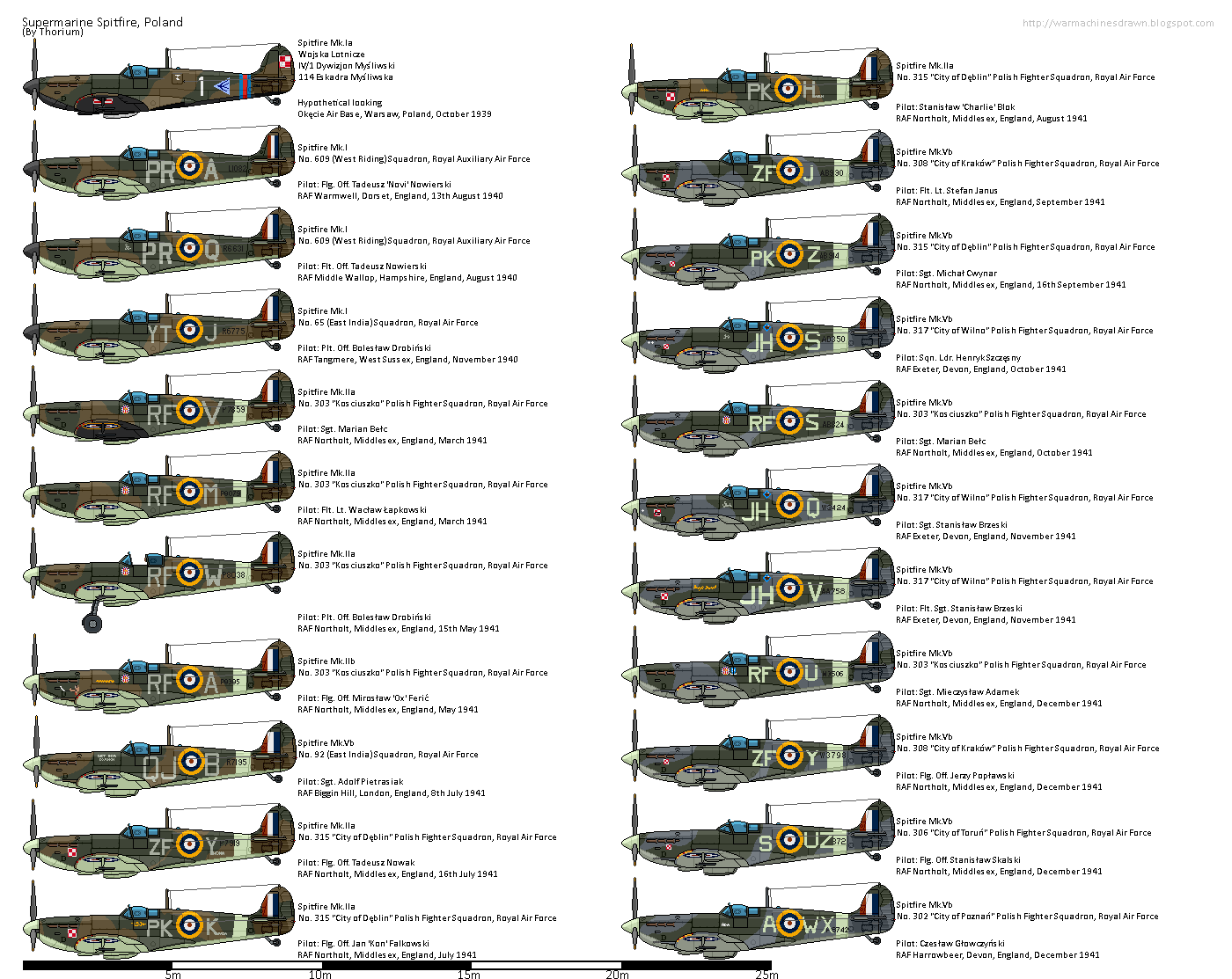
Supermarine Spitfire. European Users, part thirteen. Polish Spitfire users, part one.


In 1939 Poland bough one Spitfire Mk. I, registered as L1066, which was shipped to Poland but eventually, it did not reach its destination and ended up in Turkey. We, however, decided to draw it under the colours of Wojska Lotnicze as a sort of what-if.
During the war a total of nine Polish squadrons were equipped with the Spitfire. Of those, seven squadrons fought in Western Europe and two in both North Africa and Italy. Of these two ones one of them was a recon-fighter squadron. 
There were of course Polish pilots, outside official Polish squadrons, who served with other Royal Air Force's (RAF) squadrons, like Flg. Off. Tadeusz Nowierski, or Boleslaw Dobrínski, among many others.

Anyway, some of those Polish squadrons were:

  • No. 303 'Kosciuszko' Polish Fighter Squadron: Probably the most famous Polish Fighter Squadron. It was officially created on 22nd July 1940 with Polish airmen who escaped from France and had high experience in aviation matters. Thanks to that high experience level, the squadron became operational in early August 1940 and, during the most intense parts of the Battle of Britain, the squadron remained at RAF Northolt, only rebasing north in October, during the last stages of the Battle of Britain. During this period the squadron flew the Hawker Hurricane.
    This unit returned to Northolt in January 1941, where it was re-equipped with the Supermarine Spitfire and conducted offensive fighter sweeps over occupied France, sweeps that were kept for the following years, operating from various bases like Merseyside, Lincolnshire or Northern Ireland. 
    In April 1944 the squadron was assigned to 2nd Tactical Air Force (2nd TAF) to take part in Operation Overlord (the Allied invasion of mainland Europe - Normandy Landings) and, after that date and unlike most of the units belonging to 2nd TAF, it remained in England, operating from East Anglia and flying bomber escort missions and armed reconnaissance sweeps over the Netherlands. 
    In April 1945 the squadron was re-equipped with the Mustang Mk. IV (North American P-51D). 
    From January 1941 until April 1945 this squadron flew many variants of the Spitfire such as the Mk. I, Mk. IIa and b, Mk. V and Mk. IX.
  • No. 308 'City of Kraków' Polish Fighter Squadron: This squadron, formed on 9th September 1940, received the Spitfire in April 1941. In June it was assigned to bomber escort and fighter sweeps over France. This lasted until December when the squadron was rebased to Lancashire to rest. In April 1942 the squadron resumed offensive operations until April 1943 when the squadron was rebased to Yorkshire until September when it joined the 2nd TAF and converted to the fighter-bomber role, flying offensive missions over France. The squadron was rebased to Normandy in August 1944 and followed Allied advances east, being rebased to Belgium in October. 
    On 1st January 1945 the squadron's base was attacked by the Luftwaffe as part of Operation Bodenplatte, but the Poles lost only 2 aircraft on the air and 18 on the ground which were easily replaced. 
    This unit served with the occupation forces in Germany after the end of the war in Europe and flew many marks of the Spitfire, such as the Mk. I, Mk. IIa and b, Mk. V, Mk. IX and Mk. XVI.
  • No. 315 'City of Deblin' Polish Fighter Squadron: This unit was formed at Acklington on 21st January 1941 and was equipped with the Hawker Hurricane. In July it was rebased to Northolt where it transitioned to the Spitfire and was employed to perform fighter sweeps over occupied France. This role was kept until early 1942 when the squadron was moved to Lancashire and was given a five month break. 
    In September 1942 the squadron returned to Northolt to retake the offensive sweeps again. This second stage lasted until June 1943 when it was rebased to the north and in November 1943 it was assigned to 2nd TAF. 
    Once with the 2nd TAF, the squadron began to convert to the Mustang Mk. III (North American P-51B/C). 
    They employed various marks of the Spitfires such as the Mk. IIa, Mk. Vb and c and the Mk. IX.


Sources: 
1st AJ Press- Monografie Lotnicze 40 - Supermarine Spitfire 3 (translated)
2nd  http://www.historyofwar.org/air/units/RAF/303_wwII.html
3rd http://www.historyofwar.org/air/units/RAF/315_wwII.html
4th http://www.historyofwar.org/air/units/RAF/308_wwII.html

Thursday, 23 March 2023

Lazarov Laz-7M

 
In the previous post we wrote about the Lazarov Laz-7, however, we didn't mention that, albeit a successful aircraft (relatively speaking) it was prone to various accidents caused by a nimble crankshaft in the Walter-Minor 6-III engine.
In order to cope with that issue the Bulgarian People's Army Air Force (BPAAF), which by the time of these events had already fallen under Soviet influence, ordered the replacement of the  Walter engine with a Soviet-made M-11FR, as they were, theoretically, equally powerful, more reliable and, furthermore, they had constant-speed propeller.
Although the engineers of DSF-Lovech (manufacturers of the Lazarov) were reluctant at first, they were forced to comply with the command of a higher authority, so some engineers got permission (among them prof. Lazarov) to go to Bozhurishte airfield, where, among many others, some Soviet Yakovlev Yak-12 were stationed, to study its propulsion system. 
With that knowledge gathered, a single Laz-7 (numbered as 68) was delivered to the aircraft factory at Lovech, where the Walter engine was replaced by the M-11FR in the Laz-7. 
In this configuration, that Laz-7 was test flown by test pilot Popganchev, with unsatisfactory results as the M-11FR engine, coupled with the light fuselage of the airplane, lost force really quick. 
After this failure, the BPAAF ordered the creation of a complete new aircraft, powered by the M-11FR engine and the features of the Laz-7. For this, they were given a very short deadline; by 1952 that aircraft had to be already being mass produced (all these events took place in 1951). So engineers had no time to make a scale model nor test it in the wind tunnel.
This time, design was tasked to eng. Kiril Karlov who took the same layout of the Laz-7, installed the Soviet engine and made some alterations to the wings to make them lighter. Some further changes were also made, to the point that Karlov asked permission to name this design as ZAK-1, petition which was rejected, as the design was directly based on the Laz-7, so the designation of Laz-7M (the letter standing for "modernized") was given instead.
The first test flight of the Laz-7M, with its characteristic star-shaped nose (similar to that of the Yakovlev Yak-18) took place on 16th June 1952 with satisfactory results. This was the first of a total of 102 flight tests which took place until the next month. In July the prototype was passed on to the Bulgarian 2nd Night Light Bomber Aviation Division, stationed at the town of Stara Zagoda, to undergo military trials.
In that unit it was used both as a day and night trainer but also as a ground attack trainer, as it had the same armament the Laz-7 had. However, in order to make it lighter, most of the times it flew unarmed, as it was easier to fly. 
A total of 150 Laz-7Ms were manufactured by DFS-Lovech and were employed mainly by the BPAAF's School, the BPAAF and some flight clubs until the early 1960s.
Apparently the Polish People's Republic considered ordering 100 machines, but they opted for the Yakovlev Yak-18 instead. Egypt also was one possible customer, as they considered ordering 50 Laz-7Ms in the mid-1950s. We have included hypothetical profiles for both countries.
Some few aircraft also flew with the DOSO (a civilian volunteer organization for the protection of the Bulgarian aerial space).


Sources:
1st http://www.airwar.ru/enc/other/laz7m.html (translated)

Thursday, 31 December 2020

Morane-Saulnier Ms.406, foreign users, part two

 
The Morane-Saulnier Ms.406 was a French fighter aircraft designed, developed and manufactured by Morane-Saulnier from 1938 onwards. With more than 1.000 aircraft having been manufactured, it was France's most manufactured fighter of the time and it was exported to many countries, or it was going to be exported:
  • Belgium: The Ms.406 had attracted considerable foreign attention during the late 1930s and was showing signs of commercial promise. In fact, during 1937, when the prototype was shown at the Brussels Aeronautical Exhibition, negotiations were underway to undertake the licensed production of the type by Belgian aircraft manufacturer Avions Fairey for both the Belgian and French Air Forces. Those negotiations, however, came to nothing. Anyway, we decided to draw a hypothetical Belgian variant of the fighter.
  • Independent State of Croatia: In July 1943 the Luftwaffe sold 36 Ms.406 to the Air Force of the Independent State of Croatia. Those machines were acquired to increase combat effectiveness against the increasing Allied air raids over the Balkans. They were assigned to the 21st, 22nd and 23rd Jato (Squadrons) of the 11th Group of the Croat Air Force. Ten more machines were incorporated in December 1943. Most of them were either destroyed or captured during late stages of the war.
  • Poland: The Polish Air Force ordered 160 aircraft in September 1939. An initial batch of 30 machines was already shipped via the Mediterranean, the Black Sea and Romania, but as Poland fell, they were diverted to Turkey. We've drawn an hypothetical version of the Ms.406 serving with the Polish Air Force in 1939.
  • Turkey: The initial batch of 30 fighters originally planned for Poland was diverted to Istanbul, and later to Yesïlkoy (Turkey) where they were assembled, under the supervision of French technicians and put into service with the Turkish Undersecretariat of Military Aviation (the forerunner of the Turkish Air Force). They were followed by 45 additional machines in March 1940, just before the fall of France. They were assigned to the 43rd and 48th Companies of the 11th Battalion of the 4th Regiment, based at Kütahya. 
    In 1943 the Ms.406 was already been withdrawn from the active duty as a fighter and they were used as advanced trainers in the Flying School at Eskisehir. In 1945 they were definitely retired from service.
  • Yugoslavia & Yugoslav partisans: The Royal Yugoslav Air Force, ordered 25 fighters, however, the fall of France prevented their delivery. That's not excuse for us to draw an hypothetical-looking version in Yugoslav colours. 
    Anyway, during the closing stages of the War, in 1945, Yugoslav partisans managed to capture some of them. They were not used by the subsequent SFR Yugoslav Air Force so they were either destroyed, scrapped or withdrawn from use early after the end of the War.


Sources:
1. https://en.wikipedia.org/wiki/Morane-Saulnier_M.S.406
2. https://world-war-2.wikia.org/wiki/Morane-Saulnier_M.S.406#Croatia
3. http://www.tayyareci.com/digerucaklar/turkiye/1923ve50/ms406.asp
4. Salamander Books - The Complete Book of Fighters


Tuesday, 3 March 2020

Fairey Battle, part three

The Fairey Battle was a British single-engine light bomber designed and manufactured by Fairey Aviation Company. By the end 1940 the type was withdrawn from front-line service and was relegated to training overseas. The overseas user we're covering today are:

  • New Zealand: For some unknown reason, two Battles ended up in New Zealand. One of them, registered as P6673 arrived in July 1941 from Canada and was numbered as "Instructional Air-Frame Number 42". The other one, registered as K9177 was sent in November 1941, arrived in February 1942 and was numbered as "Instructional Air-Frame Number 59". However, according to other sources, it was sent on 22nd November 1942 to the Royal New Zealand Air Force (RNZAF) and remained there as an instructional air-frame until May 1943 when it was shipped to the Royal Australian Air Force (RAAF) and sent to the ANA (Australia National Airways) Flying School to be used, after being repaired, as a mascot. However it was decided to use it for spare parts. We couldn't find any graphical evidence, so the drawing should be considered as speculative.
  • Southern Rhodesia: As Southern Rhodesia was part of the Empire Air Training Scheme, they received 25 Battles which were sent to the newly created No.24 Combined Air Observers School which was formed in Moffat, Southern Rhodesia. The school was designated as "No.24 Bombing and Gunnery School" in May 1943. Its main equipment was the Battle Target Tug, with 25 of them listed as active in 1944. In the unit's annual report it was stated, "Other than the extreme age of these machines, calling for constant repairs and replacements, very little trouble has been experienced on the type". The last 12 of Southern Rhodesia's Battles were written off in August 1945. As we couldn't find any photo, the drawing should be considered as speculative.
    Concurrently, the No.266 (Rhodesia) Squadron, was formed in late October 1939 at RAF Sutton Bridge, Lincolnshire, and were equipped with the Fairey Battle for a brief period of time, until January 1940 when they were re-equipped with the Fairey Battle.
  • Denmark: According to some sources, a licensed-production line was already set-up in Denmark to manufacture the Fairey Battle but none of them was completed before the German Invasion in April 1940. Interestingly enough, in the same factory where the Battle was going to be manufactured, it was expected to produce the Fokker G.I too. 
  • Finland: During the Winter War, in late November 1939, the Finnish Government asked to the British Government for aircraft. Therefore, 20 ex-RAF Battles were released for delivery to Finland and were expected to arrive between January and March 1940. However, with the end of the hostilities, none were delivered and the aircraft were sent to the RAF.
  • Poland: In June 1939 a Polish Military Mission to London was formed under the command of General Ludomil Rayski. After long negotiations, it was agreed that one Spitfire, 10 Hurricanes and 100 Battles would be supplied to the Polish Air Force in a scheduled delivery.
    In fact, a first batch of 30 Battle was intended to be shipped to Danzig (Gdansk), but some archives state that it was one Spitfire and 25 that were loaded. On 18th September 1939 a merchant ship departed from Liverpool's harbour escorted by the Polish Destroyer ORP Blyskawica, arriving the two of the to Gibraltar two days later, as the cargo was expected to be unloaded in Constanta, Romania and delivered to Poland by land. However, Romania had declared that it was throwing in its lot in with the Germans and paralysed the transit of weapons all across its territory. Therefore the ship was ordered to sail to Istanbul, when the fall of Poland was unavoidable. They were offered to Turkey instead.
    At the same time, it seems that when Germany invaded Poland, the UK's Chief of Air Staff offered the immediate release of 20 Battles to be flown to France to be collected by Polish pilots. The proposal was refused on the grounds that deliveries of such small war material would make no difference in the outcome of the battle.


Sources:
1. https://en.wikipedia.org/wiki/Fairey_Battle
2. http://www.rathbonemuseum.com/DENMARK/DKPhotos/DKPhotos.html
3. http://www.adf-serials.com.au/2a22k.htm
4. https://www.bombercommandmuseumarchives.ca/canadaairwar/canadaairwar1940.pdf
5. https://en.wikipedia.org/wiki/No._266_Squadron_RAF
6. Aeroplane Database June 2016 - Fairey Battle