Showing posts with label Belgium 1919-1929. Show all posts

Tuesday, 14 March 2023

Breguet 14, part four. European Users, part one.

 
The Breguet 14 was a French biplane bomber of the First World War which was also employed as a reconnaissance plane. 
With more than 8.000 machines manufactured between March 1917 and 1926, it was exported all around the globe and saw usage with various countries and factions, among them, the following ones:
  • Belgium: Belgium acquired 31 or 35  (sources vary about the exact number) Breguet 14 A.2 before the end of World War I, and 12 or 15 after the war.
    The type entered service with the Belgian Aviation Militaire (Army Aviation) in 1918 serving both with Nos 2 and 3 squadrons based at Les Moëres (De Moeren) airfield, in West Flanders province. The Breguets replaced the Sopwith 1 ½ Strutters the squadrons were equipped with. Nos. 4 5 6 and 7 Squadrons also employed the type, in some cases, operating together with the SPAD S.XI. No.5 Squadron was based at Houtem airfield, in West Fladers too. 
    Every Breguet 14 delivered during the war was powered by either the Italian Fiat A-12 or A-12bis engine, but some of those delivered after the war, were powered by the Renault 12F engine (distinguishable by its unique exhaust pipe).
    After the war, the A.2 also equipped some squadrons of the Flying School Group and, by 1923, the A.2 was already withdrawn from operational squadrons, with the exception of some few machines which were employed as communications aircraft until 1928. 

  • Czechoslovakia: The newly created Czechoslovak Army Air Force acquired 10 Breguet 14A.2 in 1919. They were assigned to the Letecká setnina 4 (4th Air Company), based at Cheb, western Bohermia,  and then, after reorganization, they were inherited by the Letecká rota 8 (8th Air Company), based at Nitra, Bratislava. In 1923 they were assigned to Prozorovaci rota 3 based at Olomouc, Moravia and the Hlavni Letecke Dilny, 81 Bombardobaci Letka, based at Prague-Kbely airport.

  • Denmark: Denmark obtained four unarmed Br.14A.2s for civilian usage with the Ministeriet for Offentlige Arbejder (Ministry of Public Works) between 1921 and 1922. They were used for training commercial pilots until April 1927 when they were sold for scrap.


Sources:
1st https://en.wikipedia.org/wiki/Bréguet_14
2nd Flying Machines Press -  French Aircraft of the First World War
3rd https://www.armedconflicts.com/4th-Air-Company-t73424
4th https://www.valka.cz/topic/view/43381/Letecka-rota-8-1920-1924
5th http://www.milfly.dk/pdf/islander.pdf (translated)

Friday, 21 April 2017

Martinsyde F.4 Buzzard - Part one

The Martinsyde F.4 Buzzard was a powerful and fast biplane fighter that was developed for the Royal Air Force, but as the World War I ended, its mass production was cancelled. No more than 400 of them were produced and most of them were exported.
After the Great War, Belgium bought at least two of them to equip their Aviation Militaire (Military Aviation). They tested it at the Evere airfield but it was rejected for service.
The airplane was among of the few that founded the Bolivian Cuerpo de Aviación (Bolivian Aviation Corps) as nine of them served there from 1925 until 1929 when they were replaced by more modern types, most probably the Curtiss Hawk IA.
With its native users, only 57 of them were put into service with the Royal Air Force, but they weren't put into operational use. In the inmediate postwar, two of them were used as high speed transports during the Paris Peace Conference in 1919 and some others served in the Central Flying School. As the post-war RAF didn't want the type, it never served as a fighter.
The Finnish Ilmavoimat (Finnish Air Corps) bought a single airplane for testing purposes in April 1923 with 14 more of them being purchased in 1927. They initally served in the Maalentsoskadeer Ut until 1929 and since they served as trainers in the Kauhava School of Aviation until 1939. Nowadays, the Aviation Museum of Central Finland has the only remaining one in exhibition.


Sources:
1. http://www.belgian-wings.be/Webpages/Navigator/Belgian_Aviation_History/BAFAircraft/Bafallaircraft_1919_1945.htm
2. http://www.aeroflight.co.uk/waf/americas/bolivia/Bolivia-af-CMA.htm
3. https://en.wikipedia.org/wiki/Martinsyde_Buzzard
4. https://fi.wikipedia.org/wiki/Martinsyde_F.4_Buzzard (translated)

Monday, 17 October 2016

Avro 504K - European Users, Part One

As the Avro 504K was one of the most produced World War I airplanes, it was widely used by many European countries, we're covering them with this post.


  • Belgium: First presented to the Belgian authorities in 1920 at the airfield of Evere, it convinced the Belgian observers who ordered six of them which were delivered from April 1921 onwards. The third and final delivery was made in late 1921 making fifty machines delivered from British sources. In 1924 the Belgian company SABCA built some some additional licensed machines. They were used in the flying schools of Asch and Wevelgem as well as in the liaison role serving with different squadrons and groups. They were replaced in 1929 by the Avro 504N which was a much refined version of the 504K.
  • Denmark: Danske Luftfartselskab company, the Danish Airline Company bought some Avro 504K in the United Kingdom on 1919 but, as they never used them, they were sold to the Royal Danish Army who adquired two additional airplanes which were used until 1931 when they were replaced by the Avro 504N. The Royal Danish Navy, bought six of them in 1920 which were also replaced by the 504N in 1931.
  • Finland: The Finnish government bought one 504K for evaluation (which is nowadays preserved at the Tikkakoski air base's museum) in as late as 1926. It was extenisvely used until November 1930 when it was written off.
  • Estonia: The Estonian government bought seven airplanes in order to equip their training squadrons in 1921. They weren't manufactured by Avro itself but by one of their delegated companies, Grahame-White. They were replaced by the Avro 504R on 1928.
  • Germany: The Germans managed to capture some Avro 504K during the World War I. Not very much is known about the fate of these airplanes beyond some pics of the era.
  • Greece: Greece got some small number of Avro 504K airplanes after the World War I which were used to train pilots at their school of Dekeleia during the Turkish independence war. It's known that some of them were also destined to the Turkish city of Izmir. They were replaced in 1925 by the Avro 504N.


Sources:
1. http://www.belgian-wings.be/webpages/navigator/Photos/MilltaryPics/interbellum/Avro%20504K/Avro%20504K%20Frontpage.html
2. http://www.natureandtech.com/?cat=121
3. http://www.avro504.org/ActualAircraft.html
4. http://greek-war-equipment.blogspot.com.es/2010/10/1920-1936-avro-504.html
5. https://en.wikipedia.org/wiki/Avro_504

Wednesday, 13 July 2016

Avia BH-33

During 1926 Avia tested the Gnome-Rhône version of the Bristol Jupiter nine-cylinder radial air-cooled engine fitted to a BH-21 airframe, the BH-21J.

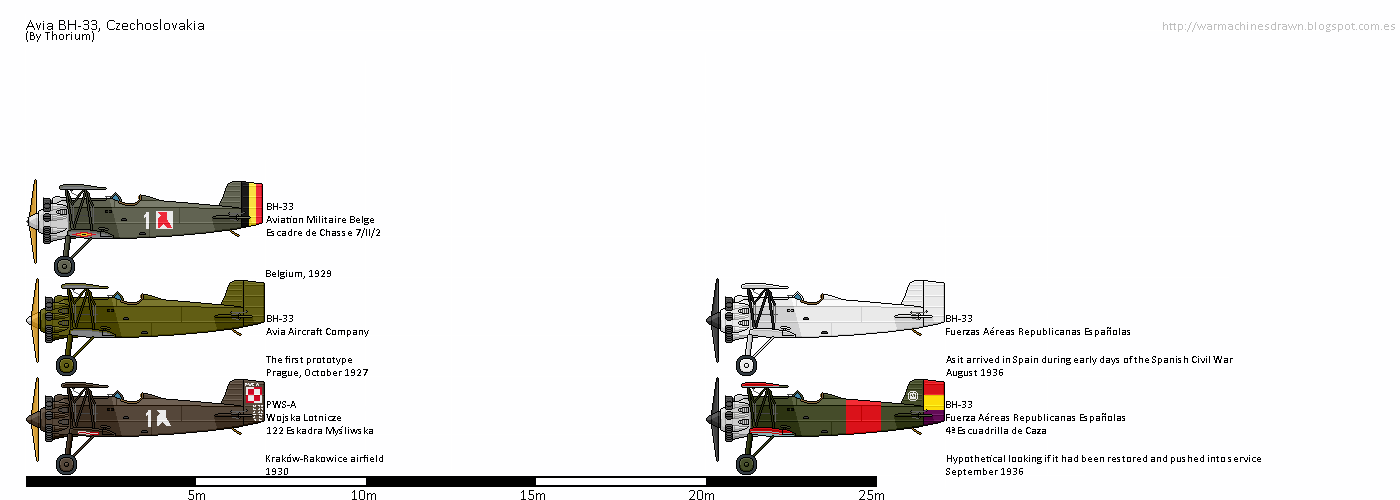
Trials were satisfactory and a new design was born, with the given name of Avia BH-33. It was the last fighter designed by Miroslav Hajn and Pavel Benes for Avia and was also the first Avia fighter to feature a fixed tail fin from the outset. Trials on the new design started in 1927 and were satisfactory enough for the Czechoslovak Army Air Corps, but not brilliant enough that they only ordered 5 airplanes. It was powered by a Walter-built Bristol Jupiter VI engine delivering 543hp at take-off and was armed with two Vickers 0.303in machine guns.

In Belgium, one Avia BH-33 powered by a Bristol Jupiter VII engine was one of the contenders for the Aéronautique Militaire fleet standaristation programme which was eventually won by the Fairey Firefly.
Regarding to Spain, apparently a single BH-33 painted entirely in white flew to Spain in the early days of the Spanish Civil War loosing it's machine-guns and synchronisation gear en route. It's unknown what happened to it, but we couldn't resist the impulse of thinking how it would've looked like if it had been repaired, repainted and push into service.
Poland adquired a manufacturing license in 1928 with PZL building 10 pre-production airplanes of this type and PWS building 50 of them as the PWS-A from 1930 onwards.


Sources:
1. https://en.wikipedia.org/wiki/Avia_BH-33
2. Salamander Books - The Complete Book of Fighters
3. http://bioold.science.ku.dk/drnash/model/spain/did.html
4. http://www.belgian-wings.be/Webpages/Navigator/Photos/MilltaryPics/interbellum/avia_bh33.htm

Saturday, 9 July 2016

Avia BH-21 - Belgian Users

Today it's the day to post about the Belgian users of this Czechoslovak fighter.

As the Belgian Aeronautique Militaire was greatly reinforced after the World War I, it was equipped with a mix amount of airplanes, ranging from British and French airplanes and even German ones, like the Fokker D.VII as war plunder. That situation created what today we would call a logistical nightmare as every type of aircraft had different engines, fuel types, spare parts... and so on.
That situation made obvious that a standarisation of their fighter fleet was needed which eventually would be completed in 1931 when they adquired the Fairey Firefly.

As, back in the mid 1920s when the standarisation/modernisation question was considered, the Nieuport-Delage NiD.29, a French fighter that entered service in 1918 was considered only as a minor improvements over their World War I counterparts, plus it was very hard to maneouver and weak.
In the meantime, in Czechoslovakia, the Avia Aviation Company, which was founded back in 1919 caught the attention of the Belgian authorities and achieved world prestige when their airplanes won various competitions all across Europe with their simple yet strong designs.
As the Avia BH-21 flew for the first time on January 1925 near Prague, by 1926 the Belgian authorities showed their interest for it. In order to evaluate them, the Belgian Defence Ministry bought one of them together with a French Dewoitine D.19 and a 420hp Bristol Jupiter powered Dewoitine D.9. Unlike later's standards, there wasn't a competing fly-off and the airplanes were delivered to the squadrons for them to evaluate.
As it was powered by the Hispano-Suiza engine that powered the NiD.29, spare parts weren't a problem and the BH-21 showed a good acrobatic performance so it was favoured by the Belgian Authorities. An order for 44 BH-21 was placed soon, five airplanes were to be constructed by Avia in Czechoslovakia and the 39 of them would be built in Belgium under license by the SABCA (Sociétés Anonyme Belge de Constructions Aéronautique - Belgian Aeronautical constructions Anonymous Society) company.
The first BH-21 arrived in Belgium on 1927 and the first Belgian built BH-21 rolled out from the factory on 14th September 1927. They served with the first group of the second regiment (I/2Aé) with base at Schaffen, close to the Belgian city of Diest.
Although the BH-21 was meant to replace the NiD.29, it served alongside with it both at Schaffen and Nivelles air bases until the early 1930s.
When the Fairey Firefly arrived on Belgium, both the NiD.29 and the BH-21 were gradually replaced and some BH-21 were transferred to the Belgian pilot school in Wevelgem where they served until 1934.
So, apparently, the bottom line is that it was intended to serve as an interim fighter between the obsolete NiD.29 and the Fairey Firefly in order to keep the SABCA's production lines active.


Sources:
1. http://www.belgian-wings.be/Webpages/Navigator/Photos/MilltaryPics/interbellum/Avia%20BH21/Avia%20BH21%20Frontpage.html
2. Salamander Books - The Complete Book of Fighters
3. https://en.wikipedia.org/wiki/Avia_BH-21

Wednesday, 9 March 2016

Ansaldo A.1 Balilla - European users

We keep going with this Italian fighter, this time we cover its' European users, excluding the Polish and Italian users because those two will have their own posts.

The Ansaldo A.1 Balilla was sold to many European countries, the ones covered in this post are:

  • Belgium: According to the Belgian Military Aviation archives, one Ansaldo A.1 was in service, with the code "1". Apparently it was in service from some 1920 until 1924 when it was written-off. Some sources claim that one Balilla was displayed in Brussels in order to sale it, but no orders were forthcoming. In anyway it's remarkable to point out that in order to make the return trip of that machine to Paris, it was fitted with a British compass taken from a Belgian airplane. As we couldn't find graphical evidence, the drawing is speculative.
  • Greece: Eight Balillas were bought by Turkey in order to use them in their independence war against various European users, among them, Greece. In 1923 a Greek cruiser ship seized an Italian cargo ship bound for Turkey loaded with those airplanes which were retained by the Greeks. However, lacking an appropriate training and maintenance manuals they were never operative. They were used as trainers operating from Tatoi airfield, in Athens.
  • Latvia: On August 1922 the Ansaldo operatives which were in Warsaw, selling armament to Poland, concluded a contract with Latvia. The contract stipulated four SVA.10 and A.1 with previssions for more. Those airplanes were to be flight-tested in Riga by Ansaldo crews and, on August 21st the Polish government wrote a letter supporting the qualities of those airplanes. In the end, Latvia bought 13 Balillas, but unfortunately, that success claimed the life of the Tenente Mainardi who spun in at Riga-Spilve airfield when performing low-level acrobatics at a festival held in 1924. The Latvian Balillas were used by a fighter squadron first and by a flying school later.
  • USSR: The White Russian army bought some Balillas in order to equip some of their fighter squadrons in 1920 but they weren't delivered until 1922 when 18 airplanes arrived by ship via Odessa which was already under Bolshevik control, and were assigned to the Independent Navy Fighter Sections (IAO, later known as OMIAO) at Novy Petergof (2nd IAO) and Odessa (1st IAO) which were organized in the traditional Russian system of six operational aircrafts and two in reserve. The last two Balillas were used by the Moscow School for Advanced Pilots until 1925. It's also known that the 1st IAO used the Balillas from 1923 to 1925 and some accidents were, unfortunately, suffered by various pilots. Even if the data about those accidents are scant, it's known that the No.2 crashed on 7th July 1924 while piloted by Akulinichev and the No. 3 crashed on 26th May 1924 killing its' pilot, SF Paenkov. The type continued in service until 1927 with the 2nd IAO when it was retired from active service.  


Sources:
1. https://en.wikipedia.org/wiki/Ansaldo_A.1_Balilla
2. Salamander Books - The Complete Book of Fighters
3. Windsock Datafile 88 - Ansaldo A.1 Balilla

Friday, 15 January 2016

A.C.A.Z. C.2

Today we go beyond the First World War and we bring you this rare native Belgian airplane.

The A.C.A.Z. C.2 was the prototype for a Belgian two-seater fighter. It was manufactured by the Ateliers de Construction Aeronautique de Zeebruge (A.C.A.Z.).

It was completely built in duraluminium and was considered very advanced for the year it flew for the first time in 1926. It was powered by a 450hp Hispano-Suiza 12Ha 12-cylinder liquid-cooled engine. An interesting feature of this airplane was the interchangeability of the four main wings panels. The pilot and the observer/rear gunner were seated in tandem and the airplane was armed by a single forward-firing Vickers machine gun and twin lewis machine-guns were installed in the observer post in a flexible mount.
It also featured some space to be fitted with cameras in order to perform reconnaissance missions.

Only one prototype was built and, due to the fact that no production order was placed by the Belgian Aeronautique Militare, it was considered a failure. That's why the prototype was modified and given a new registration in order to register it as a small passenger airplane that could accommodate at least one pilot and two substitutes in order to fly from Belgium to the Belgian Congo. The pilots chosen for that expedition were the famous World War I ace Edmond Thieffry plus two companions, Joseph Lang and Philippe Quersin, but due to a failure they never made it past the souther Belgian town of Philippeville, close to the French border because they had to perform a forced landing due to a failure.

The sole prototype crashed on 25th January 1933 and was written off.