Showing posts with label Poland 1940-1945. Show all posts

Tuesday, 22 July 2025

Bristol Beaufighter, part eleven. The Beau in Polish hands.


To write about the Beaufighter working with Poland, means to write about the history of No. 307 Polish Night Fighter Squadron, as it was the only Polish Squadron of the Royal Air Force (RAF) which employed the Beau.
In spring 1941 the No. 307 Polish Night Fighter Squadron was rebased to RAF Clyst Honiton, Exeter, in south-west England. Initially they were equipped with the Boulton-Paul Defiant turret fighter and, in spite of some early success, the squadron's staff complained about the Defiant, as it was clearly obsolete and it could not cope with the increasing pace of the war. 
Squadron Commander, Captain Antonowicz requested officially more modern equipment, so in August 1941 his petition for Beaufighters was accepted. However, as Antonowicz did not know the Beaufighter well, he applied for the Beau Mk. IIF from the Group Headquarters, which he thought it was better than the Mk. I. 
As that unfortunate decision could not be reversed, two weeks later the Beaus Mk. IIF began to land at RAF Clyst Honiton airfield. 
Flying this type, the squadron began to suffer a number of losses to aerial accidents, with Cpt. Antonowicz falling victim to one of them. The increasing number of accidents, arrived to the ears of the Commander of Polish Fighter Aviation in Great Britain, Col. Stefan Pawlikowski,  who stated that "a good pilot can fly even on a barn door", meaning that the causes for the accidents should be attributed to the pilots for not having enough control on the aircraft, and not to any design flaw. 
It was not until May 1942 when the unpopular Mk. IIF, nicknamed as the "Flying Coffins" by the Polish pilots, were replaced by the much better Mk. VIF, on which Polish crews could face the enemy. 
Of the Polish forces serving with the RAF, only No. 307 squadron employed the Beau from 14th August 1941 to 24th December 1942, when most of the Beaus were replaced by the De Havilland Mosquito NF. Mk. II, except for the Beaufighters Mk. VIF, which served until January 1945. During the period of service, the Polish Beaus scored 15 enemy aircraft, with two additional possible ones, damaged 7 and lost, mainly to accidents in the Mk. II, nine aircraft.


Sources:
1st https://en.wikipedia.org/wiki/No._307_Polish_Night_Fighter_Squadron
2nd https://www.historyofwar.org/air/units/RAF/307_wwII.html
3rd https://pl.wikipedia.org/wiki/Dywizjon_307 (translated)
4th TBiU 67 - Beaufighter (translated)


Tuesday, 18 February 2025

Supermarine Spitfire. European Users, part sixteen. Polish Spitfire users, part four.

 
As we have written in earlier posts, eight Polish Fighter squadrons served with the Royal Air Force (RAF), composed of seven fighter squadrons operating on Great Britain and north-western European Theatre of operations, plus one reconnaissance squadron operating in Italy and one short-lived squadron operating in Tunisia, were equipped at some points of their careers with Spitfires. 
After the end of the war, due to political decisions made by the Allies, the Polish Air Forces in France and Great Britain did not return to Polish soil and were disbanded in the United Kingdom. 
In late 1945 just three Spitfires were sent to Poland, from Polish Air Force in Exile's stocks, as a gift from the RAF. One of them, whose pilot got lost on his way to Warsaw, was sent back to the British Occupation Zone in Germany. The other remaining two were taken to the Polish Army Museum, from where they were taken and destroyed in 1947 during the Stalinist period. 
It is worth mentioning the last Polish ace to fly the Spitfire, Miroslaw Wojciechowski, who joined the RAF post war and, after undergoing a refresher course on Spitfires Mk. XVIs, he was assigned to No. 2 Squadron in Germany to fly the PR. XIX. From December 1949 to February 1951 he flew his PR. XIX (PM627 OI-X) more than 30 times until the PR. XIXs were replaced by the jet-powered Gloster Meteor FR.9.


Sources:
1st AJ Press - Monografie Lotnicze 40 - Supermarine Spitfire 3 (translated)
2nd Osprey Publishing - Aircraft of the Aces 127 - Polish Spitfire Aces

Thursday, 13 February 2025

Supermarine Spitfire. European Users, part fifteen. Polish Spitfire users, part three.

 
Some more Royal Air Force's (RAF) Polish squadrons and units were the following:
  • No. 302 'City of Poznan' Polish Fighter Squadron: This unit transitioned from the Hawker Hurricane to the Spitfire Mk. V in late 1941 while stationed in south-west England. Their mission was changed from providing aerial cover to convoys in the Irish Sea to fighter sweeps over France, which is the role they played for the most part of 1942. 
    In February 1943 the squadron was rebased north to provide aerial defence to Yorkshire and Lincolnshire. In June 1943 the squadron was assigned to the 2nd Tactical Air Force (2nd TAF) and the fighter sweeps over mainland Europe were resumed. In April 1944 the squadron was converted to the fighter-bomber role and in August 1944 they were moved to France, where they took part in the Battle of Normandy, providing close air support. In October they were rebased to Belgium, from where they performed offensive sweeps over Germany. 
    Just as it happened to other Polish squadrons, their base was attacked by the Luftwaffe on Operation Bodenplatte and, in April 1945 they were operating from Germany until the end of the war. They operated the Spitfires Mk. V, Mk. IX and Mk. XVI.
  • Polish Fighting Team: This unit, nicknamed as 'Skalki's Circus', was formed at RAF Northolt in February 1943 and they were embarked for Tunisia later that month. 
    The team was initially attached to No. 145 Squadron and, equipped with the Spitfires Mk. Vc/Trop and Mk. IX operated from various airfields in western Libya and Tunisia providing very effective aerial cover and ground support throughout the whole Tunisian campaign and making themselves a name. 
    The Polish Fighting Team (PFT) had just one casualty, one pilot who was shot down and taken POW. 
    After the end of the Tunisian campaign, the PFT was disbanded and their pilots moved on to another units of the RAF, mostly Nos. 601 (where Skalki -founder of the PFT- became its CO), 43 and 152 which operated through the Italian campaign. 


Sources:
1st http://www.historyofwar.org/air/units/RAF/302_wwII.html
2nd https://en.wikipedia.org/wiki/Polish_Fighting_Team
3rd https://military-history.fandom.com/wiki/Polish_Fighting_Team

Tuesday, 4 February 2025

Supermarine Spitfire. European Users, part fourteen. Polish Spitfire users, part two.

 
Some more Polish squadrons equipped with the Supermarine Spitfire were:
  • No. 306 'City of Torun' Polish Fighter Squadron: This squadron transitioned from the Hawker Hurricane to the Spitfire Mk. II in July 1941, while present at Northolt, where they were conducting offensive sweeps over France. In October 1941 they were moved to Merseyside, to stay on the defensive and, in December they were moved again to south west England, this time equipped with the Mk. V. Based at south-west England, they kept on sweeps over France until March 1943, with a small rest in May-June 1942. As written, in March 1943 they were moved north to Yorkshire. This squadron was equipped with both the Mk. V and the Mk. IX until they were all replaced by the North American Mustang III (P-51 B/C) in March 1944. 
  • No. 316 'City of Warsaw' Polish Fighter Squadron: This unit transitioned from the Hurricane to the Spitfire during a period that lasted from October 1941 until July 1942 when they were fully equipped with the Mk. V. That same month, they were moved to Yorkshire, where it remained until March 1943 when the unit returned to southern England to resume the fighter patrols over France. This period lasted until September, when the squadron was pulled back to defensive duties and then, in April 1944 the Spitfires were replaced with the Mustang Mk. III. 
  • No. 317 'City of Wilno' Polish Fighter Squadron: This squadron, formed in late February 1941 and initially equipped with the Hawker Hurricane, was re-equipped with the Spitfire Mk. V in October 1941. Operating from the south-west of England, they conducted many offensive sweeps over France and, in April 1942 they joined other Polish squadrons at Northolt, where it remained until September when they were re-based to North Yorkshire to stand there during the winter of 1942-1943. In April 1943 the squadron was moved to Suffolk to resume the offensive sweeps over France. It was there where the unit became part of the 2nd TAF and operated over Normandy in June 1944. In August 1944 the squadron was re-based to Normandy, following the Allies' advance east. In October they were moved to Belgium, where they kept conducting offensive sweeps over Germany and, on 1st January 1945 its base was attacked in Operation Bodenplatte (the last great offensive of the Luftwaffe).
    In April 1945 they were operating from bases in Germany, where they stayed until the end of the war. They were part of the occupation forces in Germany until disbanded on 18th December 1946.
It is also interesting to point out that  the first test pilots of the Spitfire F.XII (the first of the Griffon-powered variant) were Henryk Pietrzak and Wladislaw Potocki, both Polish aces. They were assigned to test the very much improved version of the Spitfire from November 1942 to February 1943. 


Sources:
1st http://www.historyofwar.org/air/units/RAF/306_wwII.html
2nd http://www.historyofwar.org/air/units/RAF/316_wwII.html
3rd http://www.historyofwar.org/air/units/RAF/317_wwII.html

Tuesday, 28 January 2025

Supermarine Spitfire. European Users, part thirteen. Polish Spitfire users, part one.


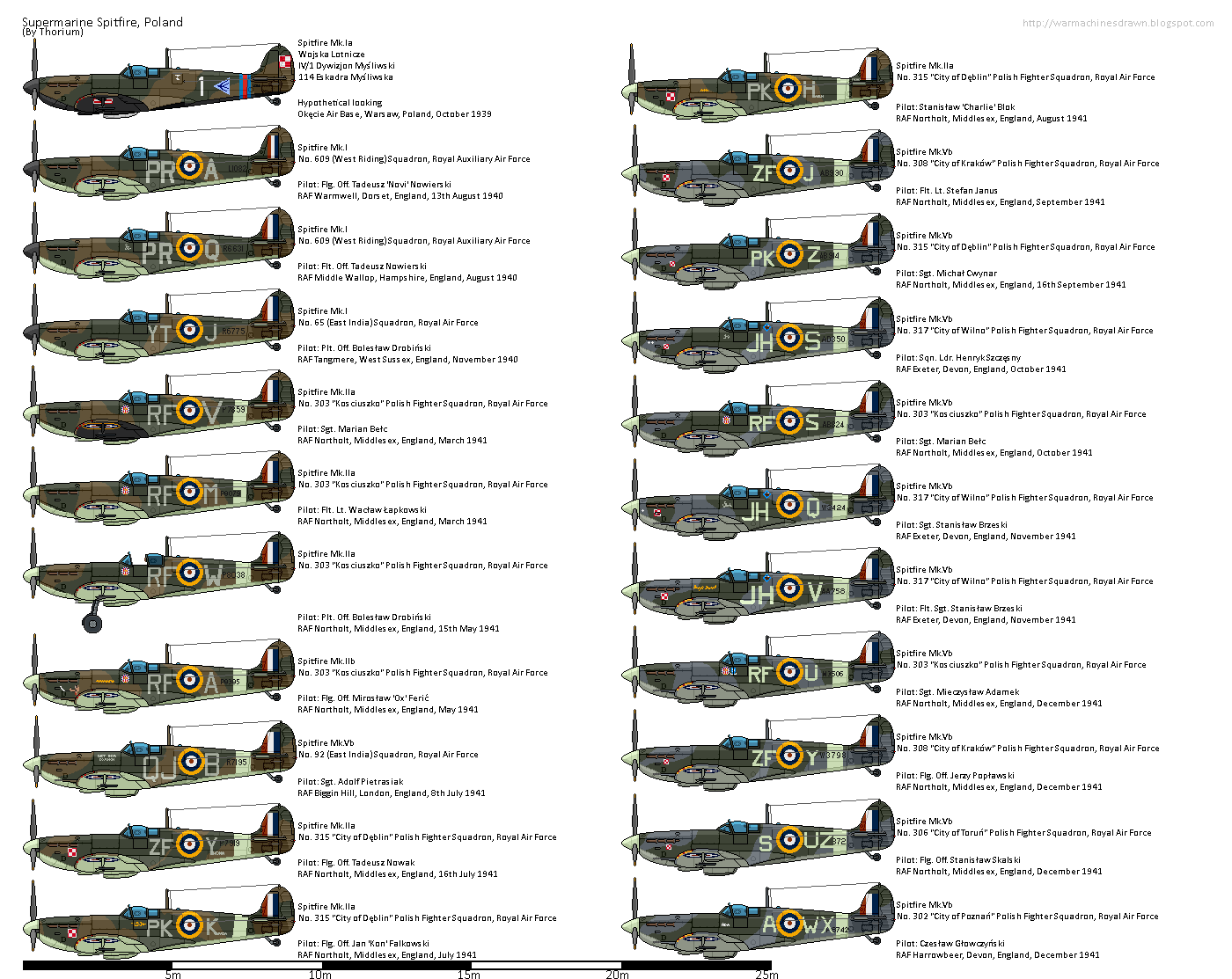
In 1939 Poland bough one Spitfire Mk. I, registered as L1066, which was shipped to Poland but eventually, it did not reach its destination and ended up in Turkey. We, however, decided to draw it under the colours of Wojska Lotnicze as a sort of what-if.
During the war a total of nine Polish squadrons were equipped with the Spitfire. Of those, seven squadrons fought in Western Europe and two in both North Africa and Italy. Of these two ones one of them was a recon-fighter squadron. 
There were of course Polish pilots, outside official Polish squadrons, who served with other Royal Air Force's (RAF) squadrons, like Flg. Off. Tadeusz Nowierski, or Boleslaw Dobrínski, among many others.

Anyway, some of those Polish squadrons were:

  • No. 303 'Kosciuszko' Polish Fighter Squadron: Probably the most famous Polish Fighter Squadron. It was officially created on 22nd July 1940 with Polish airmen who escaped from France and had high experience in aviation matters. Thanks to that high experience level, the squadron became operational in early August 1940 and, during the most intense parts of the Battle of Britain, the squadron remained at RAF Northolt, only rebasing north in October, during the last stages of the Battle of Britain. During this period the squadron flew the Hawker Hurricane.
    This unit returned to Northolt in January 1941, where it was re-equipped with the Supermarine Spitfire and conducted offensive fighter sweeps over occupied France, sweeps that were kept for the following years, operating from various bases like Merseyside, Lincolnshire or Northern Ireland. 
    In April 1944 the squadron was assigned to 2nd Tactical Air Force (2nd TAF) to take part in Operation Overlord (the Allied invasion of mainland Europe - Normandy Landings) and, after that date and unlike most of the units belonging to 2nd TAF, it remained in England, operating from East Anglia and flying bomber escort missions and armed reconnaissance sweeps over the Netherlands. 
    In April 1945 the squadron was re-equipped with the Mustang Mk. IV (North American P-51D). 
    From January 1941 until April 1945 this squadron flew many variants of the Spitfire such as the Mk. I, Mk. IIa and b, Mk. V and Mk. IX.
  • No. 308 'City of Kraków' Polish Fighter Squadron: This squadron, formed on 9th September 1940, received the Spitfire in April 1941. In June it was assigned to bomber escort and fighter sweeps over France. This lasted until December when the squadron was rebased to Lancashire to rest. In April 1942 the squadron resumed offensive operations until April 1943 when the squadron was rebased to Yorkshire until September when it joined the 2nd TAF and converted to the fighter-bomber role, flying offensive missions over France. The squadron was rebased to Normandy in August 1944 and followed Allied advances east, being rebased to Belgium in October. 
    On 1st January 1945 the squadron's base was attacked by the Luftwaffe as part of Operation Bodenplatte, but the Poles lost only 2 aircraft on the air and 18 on the ground which were easily replaced. 
    This unit served with the occupation forces in Germany after the end of the war in Europe and flew many marks of the Spitfire, such as the Mk. I, Mk. IIa and b, Mk. V, Mk. IX and Mk. XVI.
  • No. 315 'City of Deblin' Polish Fighter Squadron: This unit was formed at Acklington on 21st January 1941 and was equipped with the Hawker Hurricane. In July it was rebased to Northolt where it transitioned to the Spitfire and was employed to perform fighter sweeps over occupied France. This role was kept until early 1942 when the squadron was moved to Lancashire and was given a five month break. 
    In September 1942 the squadron returned to Northolt to retake the offensive sweeps again. This second stage lasted until June 1943 when it was rebased to the north and in November 1943 it was assigned to 2nd TAF. 
    Once with the 2nd TAF, the squadron began to convert to the Mustang Mk. III (North American P-51B/C). 
    They employed various marks of the Spitfires such as the Mk. IIa, Mk. Vb and c and the Mk. IX.


Sources: 
1st AJ Press- Monografie Lotnicze 40 - Supermarine Spitfire 3 (translated)
2nd  http://www.historyofwar.org/air/units/RAF/303_wwII.html
3rd http://www.historyofwar.org/air/units/RAF/315_wwII.html
4th http://www.historyofwar.org/air/units/RAF/308_wwII.html

Thursday, 25 August 2022

Miles M.14 Magister. Part five. British users


The Miles M.14 Magister is a British two-seat basic trainer which was developed during the 1930s to the specification T.40/36.
After the success of the M.2 Hawk elementary trainer, Miles decided to produce a variant of the M.2 to satisfy the Air Ministry's specification T.40/36. 
The type submitted was very similar to the M.2. The main difference between the M.2 and the M.14 being the cockpit, which was enlarged in the M.14 and had various new features to meet military training requirements. The prototype flew for the first time on 20th March 1937 at the hands of Frederick G. Miles, and, during the following month, it received the nickname of Magister. During early flights the aircraft showed a tendency to spin. This was, however, fixed with many alterations, among them, elevating the tailplane by 6 in (15 cm), the fitting of anti-spin strakes and the adoption of a taller rudder. These changes worked so well that the Magister became the first aircraft to receive permission from the Air Ministry to perform aerobatics. 
The Magister is mainly made out of wood, the fuselage consisting of a spruce structure covered in plywood. Both wings and tail section were made out of similar materials. It is equipped with split flaps, and was the first Royal Air Force's (RAF) trainer to be equipped with them. It has also a fixed undercarriage covered in aerodynamical spats and equipped with Bendix drum brakes, in order to reduce landing distance. It is powered by a single De Havilland Gipsy Major I engine which yields 130 hp of power. 
After having won the contest of the Air Ministry, it was ordered into mass production, which began in October 1937 and continued until 1941, with 1.023 machines being manufactured by Miles. 
Initial production orders were supplied to flying clubs through the Straight Corporation, as well as many overseas private customers. At the outbreak of World War 2 more than 700 Magisters were in service with the RAF Elementary Flying Training Schools, among them the Central Flying School. 
During June 1940 as part of the British anti-invasion preparations around 15 Magisters were fitted with small bomb racks to be used as very light bombers. However, they were never used in this role. 
The Magister was also used as an experiment carried out in 1941 to include an auxiliary towed rear wing, which could carry either additional ammo or fuel. This was done to increase the range of British medium bombers at the time. The experiment was, however, a failure.
After the war, many were sold to private owners, and were known as the Hawk Trainer III. In these private hands the Magister enjoyed a reputation of being a fast racer. 


Sources:
1. https://en.wikipedia.org/wiki/Miles_Magister
2. Scale Aircraft Modelling - October 1997 - Miles Military Trainers
3. Putnam & Co. - Miles aircraft since 1925 

Tuesday, 29 March 2022

Bristol Blenheim, part four. More foreign users

 
The Bristol Blenheim was a British light bomber designed and manufactured by Bristol Aeroplane Company. It was used during the first half of the Second World War by the Royal Air Force (RAF), but by many foreign users too:
  • Poland: Reportedly, No.307 (Polish) Night Fighter Squadron operated two Blenheims. One of the Mk.I variant and another of the Mk.IV variant. 
    Furthermore, one Blenheim ad-hoc converted into VIP transport was used as the personal transport of General Wladislaw Anders, commander of 2nd Polish Corps. As we couldn't find pics of these Blenheims, the drawings should be considered as speculative.
  • Portugal: In order to honor their ancient alliance, ensure their neutrality and use their bases in the Azores Islands, the Portuguese Government was provided with various British aircraft. Among them was a bath of 12 Blenheim Mk.IVf in September 1943. These were assigned to Esquadrilha B (Squadron B) of the Aviaçao Naval (Naval Aviation - Portuguese Naval Air Arm) which made for its first land-based unit. They were serialled B-1 to B-12 and were based at Portela de Sacavem, in Lisbon.
    The Aeronáutica Militar (Military Aeronautics) received ten Mk.IV which were assigned to Esquadrilha ZE (Squadron ZE) based at the town of Ota and commandeered by Captain Joao Jose Ribeiro Ferreira, who died on 30th August 1944 when his Blenheim crashed. 
    Three additional Mk.Vs were supplemented later. These Mk.Vs flew also with the Aviaçao Naval, though it's not clear if these were the same that had previously belonged to the Aeronáutica Militar. Anyway, the Blenheims remained in service with Portugal until 1948.
  • Romania: The Romanian Government was among the first customers of the Blenheim Mk.I. They received a batch of 34 Blenheim Mk.I between May and November 1939 to equip their bombing and long range reconnaissance squadrons Nos.1,2,3 and 4 of the Fortele Aeriene Regale ale Romaniei (FARR - Royal Romanian Air Force). When Romania joined the Axis in November 1940, spare parts for British-supplied aircraft became a problem, which was somehow eased with the inclusion of three ex-Yugoslavian Blenheim Mk.I and spares in September 1941. 
    The Romanian Blenheims saw action during the Barbarossa Campaign, from 21st June 1941 onwards. During the initial opening stages of that campaign, four Blenheim were lost to Soviet anti-air fire. The Blenheims were used in support of Romanian ground troops during the siege of Odessa in 1941. However, logistic problems for the British-supplied aircraft were being felt this early on in the campaign and in late 1941 the FARR was largely withdrawn to rest. By early 1942, only 13 Blenheim were in active, number which was increased, thanks to the work of FARR's mechanics, to 27 later that year.
    Escadrila 1's (Squadron 1) Blenheims flew recce missions supporting Axis troops in their assault on Stalingrad. This squadron lost four Blenheim during that campaign and then they withdrew to Ciocarlia, in Romania, where they flew their Blenheim covering the northern areas of the Black Sea. The Blenheims in this squadron remained in active until 23rd August 1944, though, by that date they had only six serviceable machines, and one of them was shot down by friendly fire near Ploesti and other was captured by the advancing Soviet forces.
    When Romania switched sides in late August 1944, the three remaining Blenheims were employed for reconnaissance duties. However, they were in such poor condition that they were assigned to transport duties and, eventually, they were withdrawn from active service after an eventful career with the FARR.


Sources:
1. https://en.wikipedia.org/wiki/List_of_Bristol_Blenheim_operators#Poland
2. Hall Park Books - Warpaint 26 - Bristol Blenheim
3. Osprey Publishing - Combat Aircraft 5 - Blenheim Squadrons of World War 2

Tuesday, 30 November 2021

Caudron C.440 Goéland, Foreign Users Part Two

 
The Caudron C.440 Goéland (French word for "Seagull") was a French six-seat twin-engined utility aircraft of the 1930s that saw service with many foreign users:
  • Poland: The Caudron C.445 was used by the Polish Air Force in France in 1940 as a bomber pilot and navigator trainer. They were employed in the flying schools of Lyon-Bron, Clermont-Ferrand, Istres, Corbas, Rennes and St. Cyr. From 13th May 1940 until the end of the Battle of France, the Franco-Polish Goélands were used as utility and transport airplanes to transport both men and materiel to and from frontlines. Later, during the French retreat, they were employed to evacuate Polish transport personnel. In fact, on 23rd June two Goélands evacuated a group of 16 Polish pilots from Perpignan to Oran, in Algeria. 
    At the end of the war, one C.445A-T that was built in France during the German occupation, was captured by the Poles at the city of Dziwnów, in a very bad condition though. In spite of initial interests by the Polish Air Force for the plane, it was transferred to civilian aviation, where PZL-Mielec rebuilt it and used it for transport duties and company business trips. Oddly enough, the production license and technical documentation for the PZL-Mielec Lim-1 (the Polish MiG-15 license-built in Poland) was transported in this airplane. It was used by PZL from 22nd August 1947 until 12th September 1955.
  • Slovak Republic: Twelve C.445M (military variant of the regular C.445) were ordered by the Slovenské Vzdusné Zbrane (Slovak Air Force) in 1942 (although, according to other sources they were transferred by the Luftwaffe from captured machines). They were employed in the trainer and transport role, and their ultimate fate is unknown.
  • Spain: After the outbreak of the Spanish Civil War, the Republican Spanish Líneas Aéreas Postales Españolas (Spanish Postal Airlines - LAPE) acquired three ex-French Goéland machines. They were employed in various aerial routes inside the Republican territory during the Spanish Civil War. All three of them were either destroyed or captured by the Nationalists. After the war, in May 1940 some fleeing machines crash-landed in Spain and their crew and machines were interned.
  • Yugoslavia: The Yugoslavian National Airline Aeroput, bought two C.449 monoplanes in 1937 and 1938 as part of their modernization programme in order to cover more aerial routes. One of them was damaged beyond repair in 1939 and the other one was pressed into service with the Royal Yugoslav Air Force in 1941 when Germany invaded and was subsequently captured by them in April 1941.


Sources:
1. https://en.wikipedia.org/wiki/Caudron_C.440_Goéland
2. http://www.samolotypolskie.pl/samoloty/638/126/Caudron-C-445-Goeland (translated)
3. https://en.wikipedia.org/wiki/Aeroput
4. http://equinoxe.dk/SCWaircraft/did.html
5. http://incidentessgm.blogspot.com/2013/11/caudron-c-445.html (translated)
6. http://www.airhistory.org.uk/gy/reg_YU-.html
7. http://www.airhistory.org.uk/gy/reg_EC-.html

Tuesday, 12 January 2021

Morane-Saulnier Ms.406, Franco-Polish users

 
The Morane-Saulnier Ms.406 was the most manufactured French fighter of the World War 2. 
The Ms.406 was very manoeuvrable and could withstand high amounts of damage, potentially giving possible advantage against German fighters. However, overall, the Ms.406 was totally outclassed by the Bf.109E. Efforts to replace the type with a more capable type, like the Dewoitine D.520, the Curtiss H75 or even the improved Ms.410, failed to take place before the end of the Phoney War, on 10th May 1940, when Germany invaded. On the eve of the invasion, a total of 10 Groupés were equipped with the Ms.406, together with another amount of defensive units which were equipped with either the Ms.406 or the Bloch MB.152. 
During the combat that followed that date, the Allied forces suffered a high attrition rate and couldn't keep with the level of damage sustained. Of the Ms.406 that faced the Germans, heavy losses were reported. One hundred and fifty aircraft were lost in action while a further 200-300 fighters were recorded to have been lost to other causes. The quick advance of the German army led to repeated retreats and abandonment of bases, rendering most of the repairing efforts chaotic and, in many times, forcing the crews to destroy their own fighters on the ground to prevent them from being captured. The Armée de l'Air's tactic of employing small group of fighters against larger German formations, proved to be mostly ineffective and, often, very expensive.
In combat against enemy fighters, the Ms.406 showed mixed results. While there are recordings showing some lucky victories against the much superior Bf.109E, it was generally outclassed by it. On this topic, the story of the Groupe de Chasse III/7 (fighter squadron III/7) was very typical. On 15th May 1940 nine Ms.406 encountered 12 Bf.109 over Meziéres. The Germans stayed some few thousands of feet above the French and dived down in pairs to attack, with a single firing pass, before climbing back and repeating the manoeuvre. Three Ms.406 spinned down in flames and only one French pilot could bail out, seriously wounded. A fourth Morane, full of bullets, crash-landed at Soissons and was wrecked. A fifth pilot, was wounded in the head by splinters, forcing him to land. 
On 21st May seventeen Morane of the same unit, intercepted 50 Dornier Do.17 bombers escorted by other 50 Bf.109. Before the Morane could get in range to open fire, the Bf.109 jumped on then and shot down four Moranes almost at once. Two more resulted badly damaged and couldn't be repaired. The French pilots claimed two Bf.109 shot down. 
The Ms.406 holds the distinction of being the most ineffective French fighter to served during the Battle of France, probably because of its low firepower. On 24th June, one day before the armistice, a Ms.406 flown by Sous Lt. Marchelidon, of the G.C. 1/2 scored the Armée de l'Air's last kill in the conflict. 
The type was also used by the Polish Air Force in exile. It was the main fighter of the Groupe de Chasse I/145 'Varsovie', together with the Caudron C.714 (which was used mainly for training purposes) and the Bloch MB.152. This squadron was put into reserve at Mions, after the Lyon-Bron airport was struck twice by enemy air raids, on 10th May. However, two days later, as the Armée de l'Air needed every Ms.406 available, the squadron was re-equipped with the Caudron C.714, almost completely. However, some Polish pilots, achieved the ace status while flying the Ms.406.


Sources:
1. https://en.wikipedia.org/wiki/Morane-Saulnier_M.S.406
2. https://en.wikipedia.org/wiki/Polish_Air_Forces_in_France_and_Great_Britain
3. https://en.wikipedia.org/wiki/I/145_Polish_Fighter_Squadron
4. Salamander Books - The Complete Book of Fighters

Tuesday, 9 June 2020

Airspeed AS.10 Oxford, part five, various European Users

The Airspeed AS.10 Oxford was a British twin-engined multi-purpose aircraft which was designed and developed by Airspeed Ltd. With more than 8.500 exemplars manufactured, it saw service with many countries all around the globe. Among them, the following ones:

  • Norway: From 1947 until 1953, when they written off, the Royal Norwegian Air Force had a total of 22 Oxfords serving in three squadrons (Nos. 333, 334 and 335). Four aircraft were sold between 1951 to 1953 to the Norwegian airline Wideroe which employed the aircraft for photo-surveying Norwegian territories in a commission for the Norwegian Geographical Society. Eventually only three of them were sold with the fourth one not being registered as sold and was hold by the Royal Norwegian Air Force for spare parts. The aircraft were taken out of service in 1960 and were used at Fornebu, Oslo, as target practice.
  • Poland: At least one unit of the Polish Air Force in exile had some Oxfords in their rows. Among them there was the No.16 (Polish) Flying Training School which from July 1941 until December 1946 employed them as trainers at RAF Newton, in Nottinghamshire.
  • Portugal: Both Portuguese Army and Navy received six Oxfords in 1943 as part of the Operation Oatmeal (thanks to which the Allied set up bases in the Azores islands). When the Portuguese Air Force was formed in 1952, there were still four of them in active service. 
  • Sweden: The Swedish charter airline Transair Sweden AB had three Airspeed Oxford in 1950 as part of their fleet. They were used with the aim of flying newspapers from Stockholm to other parts of Sweden. They served until September 1955 and December 1959.
  • Yugoslavia: Five Oxford were obtained from Norway, via H.A. Berg, under the mutual Defence Aid Programme in 1951. They were used by an unknown unit based at Pancevo as twin-engined trainers for the De Havilland Mosquito crews. They were withdrawn from service in 1958.


Sources:
1. https://en.wikipedia.org/wiki/Airspeed_Oxford#Operators
2. https://www.wikiwand.com/no/Airspeed_Oxford (translated)
3. https://codenames.info/operation/oatmeal/
4. https://en.wikipedia.org/wiki/Transair_Sweden
5. http://transairsweden.com/aircraft/airspeed/
6. https://discovery.nationalarchives.gov.uk/details/r/C7160847?descriptiontype=Full&ref=AIR+29/570
7. https://en.wikipedia.org/wiki/RAF_Newton
8. http://www.aeroflight.co.uk/waf/yugo/af2/types/trainers.htm

To know more about the Oxford in Norway:
1. https://flyblader.com/onewebmedia/Nr%2012%20Oxford.pdf (in Norwegian)

Saturday, 7 March 2020

Fairey Battle, part five

The Fairey Battle was a single-engine monoplane light bomber that was powered by a Rolls-Royce Merlin engine. During production it was fitted with various versions of the Merlin engine, like the Merlin I, II, III (which was the most numerous variant) and V, but every bomber variant was called Battle Mk.I. The Battle featured a relatively clean design with a slim oval-shaped fuselage manufactured in two sections. Forward section, in front of the cockpit, relied mainly upon a steel tubular structure to maintain the weight of the engine. The rear section was made of a metal monocoque structure with hoop frames and z-section stringers, which was built on jigs. It was a very innovative design for Fairey as it was the company's first low-wing monoplane and the first light-alloy stressed-skin aircraft produced by them.
The wing used a two-part construction, with the central section being integral part of the fuselage. Internal wing structure relied upon steel spars which varied in dimensions towards the wing tips. The ailerons elevators and rudder were entirely metal-framed with fabric coverings and the split trailing-edge was entirely made out of metal.
The typical crew of the Battle was three, pilot, observer/navigator and radio operator/rear gunner, all of them accommodated in the forward canopy. Pilot and observer were seated in a tandem position, with the pilot controlling the single forward-firing Browning 0.303 in mounted in the starboard wing. The gunner/radio operator was in the rear controlling the manually-operated Vickers 0.303 in K machine gun. The observer acted also as the bomb aimer and, for this function, he was placed beneath the pilot's seat, as sighting was made in the prone position through a sliding panel in the floor of the fuselage.
It had a standard payload of 1.000 lb (453 kg) of bombs (similar to the earlier variants of the Bristol Blenheim). The standard payload was of four 250 lb (113 kg) carried in cells contained in the internal space of the wings. The maximum bomb-load was 1.500 lb (680 kg) with two additional 250 lb or 500 lb (227 kg) bombs carried on underwing racks. The bombs were mounted on hydraulic jacks and were released via trap doors during a dive attack.
The Battle was a robust aircraft easy to fly even for inexperienced pilots. The pilot enjoyed good external visibility and the cockpit was considered roomy and confortable for the time. However, the tasks of simultaneously deploying the flaps and the retractable undercarriage, were considered as a notable complication.
By the time it entered service in 1937, it had already become obsolete thanks to the quick advances in aircraft technology. It's defensive and offensive armament was considered too weak, and it lacked other defensive items of the time like armoured cockpit and self-sealing tanks. Ironically, it was well armoured of the standards of 1940, but only against small-arms fire on the ground.
In June 1937 No.63 Squadron was the first one to receive the Battle, being it the first operational aircraft to be powered by the mighty Merlin engine. By May 1939 a total of 17 squadrons were equipped with the Fairey Battle, with many of them being assigned to non-mobilising training roles or reserve squadrons.
By the start of the World War II, the Battle was already obsolete but it remained as the front-line main Royal Air Force's (RAF) dive bomber due to the lack of a better replacement.On as early as 3rd September 1939 (some sources claim it was the 2nd, although that day the United Kingdom was not still at war with Germany) ten Battle squadrons were deployed to airfields in France as part of the RAF Advanced Air Striking Force, which was independent of the British Expeditionary Force. They were spread out just after having arrived as it was intended that the Battles would, in the event of German commencement of bombing attacks, launch retaliatory attacks in the Ruhr valley region taking advantage their closer range in French airfields.
Initial missions were to perform aerial reconnaissance over the Siegfried Line at day, resulting in occasional skirmished and losses. On 20th September 1939 a German Messerschmitt Bf.109 was shot down near Aachen, Germany, being that the first RAF's aerial victory of the war.
However, the Battle was seriously outclassed by Luftwaffe's fighters resulting in high losses for the period of late 1939. During the winter of 1939-1940 it was decided to re-estructure the Advanced Air Striking Force, so some Battle squadrons returned to the United Kingdom and were replaced by Bristol Blenheim-equipped squadrons. During this time the activities of Advanced Air Striking Force were limited to training activities.
When the Battle of France begun in May 1940, the Battles were called to perform unescorted low-level tactical attacks against the advancing German army. These kind of attacks resulted very dangerous as the Battles were easy targets for both the Luftwaffe and ground anti-aircraft guns with very little impact on the German ground forces.
During the Battle of France, most of the Battle's attacks were aimed towards bridges and other infrastructures resulting their bomb-load insufficient most of the time for destroying the bridges. It was decided therefore to restrict Battle's operations to night-time raids only resulting in much fewer losses.
On 15th June 1940 the last remaining aircraft of the Advanced Air Striking Force returned home with almost 200 Battles having been lost in six weeks, 99 of them lost between 10 and 16 May. After the Battle of France, the RAF continued to rely on the Battle for a short period of time on the light bomber role. The No.1 Group was reformed with the inclusion of four new Polish squadrons equipped with the type and continued to be deployed for anti-shipping operations in the Channel ports for Operation Sealion. The last combat sortie of the Battle was performed by No.301 (Polish) squadron on the night of 15/16th October when they attacked Boulogne and No.12 and 142 Squadrons attacked Calais. Shortly after, No.1 Group's bombing squadrons were re-equipped with Vickers Wellington bombers. However, in 1941, three squadrons, No.88 and No.226, based in Northern Ireland and No.98 in Iceland were still equipped with the Battle for coastal patrol duties.
As the Battle was found to be largely inadequate for the bomber role, most of them were refitted as trainers or target tugs, some of them with a second cockpit added, others with a turret on the back for gunner training and other with tug-towing equipment. They served on this role with many RAF's schools until the end of the war in 1945.
Some others were used as engine test-beds for various engines such as the Rolls-Royce Exe, Fairey Prince, Napier Dagger and Napier Sabre both in the United Kingdom and the United States of America. Curiously enough a single Battle was re-fitted with the Fairey Monarch engine, driving two three-bladed contra-rotating propellers and large ventral radiator. After 86 hours of extensive testing it was shipped in December 1941 to the USA in order to continue the testing at Wright Field, Liberty County, in Georgia.


Sources:
1. https://en.wikipedia.org/wiki/Fairey_Battle
2. https://en.wikipedia.org/wiki/Polish_Air_Forces_in_France_and_Great_Britain
3. https://www.valka.cz/Fairey-Battle-Mk-I-t1349
4. https://www.valka.cz/Fairey-Battle-Mk-II-t17039
5. https://www.valka.cz/Fairey-Battle-Mk-III-t61598
6. https://www.valka.cz/Fairey-Battle-TT-t104197
7. https://www.warhistoryonline.com/instant-articles/fairey-battle.html

Friday, 10 November 2017

Avro Lancaster Mk.I - Polish Users

As many of you know, the Polish Air Force continued to fight under the colours of many of the air forces of the world, among them the Royal Air Force. The Polish Air Forces in the Great Britain were organized in various fighter, bomber, support and other roles. One of those was dedicated to strategical bombing and was equipped with the Avro Lancaster Mk.I.

  • No.300 (Polish) 'Land of Masovia' Squadron: This squadron received the Avro Lancaster Mk.I on 5th March 1944 based at RAF Faldingworth, in Lincolnshire, replacing that way the Vickers Wellington they had been flying since 1940. Since then they took part in many famous raids against Germany, like the raids against V-weapons sites, operations supporting Operation Overlord, Rhine crossing, the Battle of the Ruhr and the aerial Battle of Berlin. Their last raid was on 8th May 1945 against Hitler's residence in Berchtesgaden. They retained the Avro Lancaster until 2nd January 1947 when the squadron was disbanded. 


Sources:
1. https://en.wikipedia.org/wiki/Avro_Lancaster
2. https://en.wikipedia.org/wiki/Polish_Air_Forces_in_France_and_Great_Britain
3. https://en.wikipedia.org/wiki/No._300_Polish_Bomber_Squadron
4. Signal Squadron - Aircraft In action 52 - Lancaster in Action

Monday, 18 September 2017

Amiot 143, various foreign users

A little bit later than usual but now it's the turn for the foreign users of this French medium bomber as France wasn't the only one to employ it.
The Air Force of the Independent State of Croatia apparently received one of them and used it, probably, for training purposes. However as we couldn't find any graphical evidence, the drawing should be considered as speculative.
The Vichy French Air Force got some of the bombers that weren't destroyed after the French armistice, and gathered them in Istres, southern France in order to use them as transports to send them to take part in the Syria-Lebanon campaign, which is why they created the G.T. I/15 meaning Groupe de Transport or Transport Group on 14th July 1941 and became the G.T. III/15 in October of that same year. However, as the Syria-Lebanon campaign finished just in July 1941, they were never sent to Syria and were based in the French North Africa, mainly in Algeria and Morocco where most of them were destroyed during Operation Torch with some of them, belonging to the G.T. I/36 (a reformed G.T. III/15) being used during the Tunisian Campaign in January 1943. Anyway, all of them were scrapped in early 1944.
The Polish Air Force in France, employed some Amiot 143M as bomber trainers, mainly in the bomber flying school of Lyon-Bron and Caen. During the last days of the French Campaign in June 1940 they were used to evacuate personnel to Southern France.
Regarding the Spanish Republican Air Force, there were several reports of them being used in the early days of the Spanish Civil War, but they seem to be erroneus, as there aren't any significal evidence of the airplane flying in that conflict. We couldn't however let the oportunity pass and painted one of them with the colours of the FARE (Fuerzas Aéreas Republicanas Españolas - Spanish Republican Air Forces) to see how it could have looked like.


Sources:
1. https://en.wikipedia.org/wiki/Amiot_143
2. https://fr.wikipedia.org/wiki/Amiot_143 (translated)
3. Signal Squadron - Aircraft In action -  French Bombers of World War II in Action
4. http://bioold.science.ku.dk/drnash/model/spain/didnt.html

Monday, 3 April 2017

25pdr SP, tracked, Sexton

Today we bring you another tracked land vehicle. The 25pdr tracked Sexton was a self-propelled artillery vehicle from the World War 2 that was based on the Canadian built versions of the M3 Lee and M4 Sherman tanks, which were built in Canada under the name of Ram and Grizzly.
When the production of the Sherman expanded and the supply of tanks wasn't no more a problem, it was decided, in 1943 to switch the Canadian production lines to manufacture the Sexton in order to provide the British and Commonwealth forces with a mobile artillery based on the QF 25pdr howitzer.
It was used by the British and Canadian forces during the Second World War and with South Africa and the Polish Forces in the west. After the war, some Sextons, together with some Grizzlies, were sold to Portugal where they served until the 1980s.
There were three versions of them, Sexton I, which was based on the Ram tank hull and only 125 of them were produced, Sexton II, which was based on the chasis of the Grizzly (M4A1 Sherman) and added boxes to the rear deck in order to carry batteries and an auxiliary generator to charge them and, finally, the Sexton GPO (Gun Position Officer) which was an unarmed command version.


Sources:
1. https://en.wikipedia.org/wiki/Sexton_(artillery)
2. Salamander Books - The Illustrated Encyclopedia of the World's tanks and AFV