Showing posts with label Belgium 1914-1918. Show all posts

Tuesday, 7 October 2025

Nieuport 11. Part one. The 'Bébé' in Belgium


The Nieuport 11 was a French sesquiplane fighter aircraft from the World War I, while the Nieuport 16 was an improved variant, powered by a more powerful Le Rhône engine.
It received good reputation and was exported to various countries around the world, among them, Belgium.
In contemporary sources it's referred as 'Nieuport XI C.1' (or 'Nieuport XVI C.1) where the letter 'C' stands for 'Chasseur', meaning 'Hunter' in French.
It's commonly believed that approximately 12 Nieuport 11 C.1 were sent to serve with the Belgian Aviation Militaire (Belgian Military Aviation) on 5th January 1916 and were followed by two additional Nieuport 16 in September 1916. 
Both Nieuport 11 and 16 were employed by the Belgian Military Aviation's fighter squadrons, Nº1 (Chardon) and Nº5 (Comet), and were even employed by some famous aviation pioneers like Jean Olieslager or Egide Roobaert (who was among the first to have used the Le Prieur rockets -the very first air-to-air rockets), until they were replaced in frontline service by either the better Nieuport 17 or the Hanriot HD.1. 
The remaining Nieuports 11 or 16 were used for pilot training purposes at the Belgian schools of Étampes (France), Juvisy-sur-Orge (France) and after the war, at Asch (Netherlands). 
The last Nieuport 11 or 16 was withdrawn from Belgian inventory in the early 1920s.


Sources:
1st https://www.belgian-wings.be/nieuport-11-c1-16-c1
2nd en.wikipedia.org/wiki/Nieuport_11
3rd https://en.wikipedia.org/wiki/Nieuport_16
4th Aeronaut Books - The Belgian Air Service in the First World War

Tuesday, 14 March 2023

Breguet 14, part four. European Users, part one.

 
The Breguet 14 was a French biplane bomber of the First World War which was also employed as a reconnaissance plane. 
With more than 8.000 machines manufactured between March 1917 and 1926, it was exported all around the globe and saw usage with various countries and factions, among them, the following ones:
  • Belgium: Belgium acquired 31 or 35  (sources vary about the exact number) Breguet 14 A.2 before the end of World War I, and 12 or 15 after the war.
    The type entered service with the Belgian Aviation Militaire (Army Aviation) in 1918 serving both with Nos 2 and 3 squadrons based at Les Moëres (De Moeren) airfield, in West Flanders province. The Breguets replaced the Sopwith 1 ½ Strutters the squadrons were equipped with. Nos. 4 5 6 and 7 Squadrons also employed the type, in some cases, operating together with the SPAD S.XI. No.5 Squadron was based at Houtem airfield, in West Fladers too. 
    Every Breguet 14 delivered during the war was powered by either the Italian Fiat A-12 or A-12bis engine, but some of those delivered after the war, were powered by the Renault 12F engine (distinguishable by its unique exhaust pipe).
    After the war, the A.2 also equipped some squadrons of the Flying School Group and, by 1923, the A.2 was already withdrawn from operational squadrons, with the exception of some few machines which were employed as communications aircraft until 1928. 

  • Czechoslovakia: The newly created Czechoslovak Army Air Force acquired 10 Breguet 14A.2 in 1919. They were assigned to the Letecká setnina 4 (4th Air Company), based at Cheb, western Bohermia,  and then, after reorganization, they were inherited by the Letecká rota 8 (8th Air Company), based at Nitra, Bratislava. In 1923 they were assigned to Prozorovaci rota 3 based at Olomouc, Moravia and the Hlavni Letecke Dilny, 81 Bombardobaci Letka, based at Prague-Kbely airport.

  • Denmark: Denmark obtained four unarmed Br.14A.2s for civilian usage with the Ministeriet for Offentlige Arbejder (Ministry of Public Works) between 1921 and 1922. They were used for training commercial pilots until April 1927 when they were sold for scrap.


Sources:
1st https://en.wikipedia.org/wiki/Bréguet_14
2nd Flying Machines Press -  French Aircraft of the First World War
3rd https://www.armedconflicts.com/4th-Air-Company-t73424
4th https://www.valka.cz/topic/view/43381/Letecka-rota-8-1920-1924
5th http://www.milfly.dk/pdf/islander.pdf (translated)

Tuesday, 22 February 2022

Morane-Saulnier H, part one

 
The Morane-Saulnier Type H was a single-seat development of the previous Type G. It had a shorter fuselage and wingspan and was powered by a Le Rhône engine rated at 80 hp. It flew for the first time in 1913 and shortly later around 26 machines were ordered by the Aéronautique Militaire (French Army's Aeronautical Corps) which gave the denomination of MoS.1. 
A version powered by a de-rated 45 hp Anzani engine was also converted from previous machines, which were used as trainers. 
There are reports about some other versions powered by 50-hp or 60-hp Gnome engines with an enlarged wing which were designated as "Army Type 12", which were used as trainers.
It was employed by various users:
  • Belgium: At least one Type H was used by the Belgian Aviation Militaire (Military Aviation) during World War I in 1915. 
  • United Kingdom: The Royal Flying Corps (RFC) acquired many Type Hs as part of an order placed in 1915 for 12 Type G and Hs. These airplanes arrived in April 1915 and were assigned to Nos. 1, 2, 4, 10 and 11 Reserve Aeroplane Squadrons. They were used as trainers. A second order for 24 additional machines was placed with Grahame-White Aviation Company, in Hampshire, as this company produced the type under license in 1915. They received serial numbers 5693 to 5716 and most of them served with training units, but others served with Nos.7, 15 and 60 Squadrons of the RFC.
  • France: Most of the Type Hs served with the Escadrille (Squadron) MS.31 which was formed shortly after the beginning of the war, on 24 September 1914. According to French documentation, at the time of its formation, this Escadrille had three single-seat Morane-Saulniers with 60-hp engines, plus two additional ones in reserve. The unit was intended to be used as an "Escadrille Artillerie" (Artillery Squadron) and was formed at Dijon-Longvic airfield, in the Côte-d'Or department, under command of Capitaine (Captain) Yence who had four pilots at his command. 
    Two days later the Escadrille was moved to Toul, in Meurthe-et-Moselle department, closer to the frontlines, where it was assigned to 1ere Armée (1st Army). It's not known if they Type Hs were used in combat, but by 6th November 1914 they were already been replaced by the Type L and the Type Hs had been sent to training units. 
    Two Type Hs were sent to C.R.P. (Camp Retranché de Paris - Paris Entrenched Camp- a series of fortifications built around the French Capital with garrison units assigned there) and armed with carbines. At least one of those had a special mount for the gun and may had also deflector plates on the propeller to allow bullets be fired through the propeller's arc. It may also had been modified with a modified cowling, spinner and undercarriage. 
    Some Anzani-powered machines were also used by some flying schools of the Aeronautique Militaire.


Sources:
1. Flying Machines Press - French Aircraft of the First World War
2. https://en.wikipedia.org/wiki/Morane-Saulnier_H
3. https://www.belgian-wings.be/aircraft-1909-1918

Tuesday, 1 February 2022

Morane-Saulnier Type AI

 
The Morane-Saulnier AI was a French parasol-wing fighter which was developed during World War I. 
In 1916 Morane-Saulnier designed the Type P two-seater reconnaissance parasol-wing aircraft, but it wasn't successful, so they moved on to design new types of fighters. Namely the Type AF biplane fighter and the parasol-wing AI which was itself a refinement of the Type N fighter with the intention of replacing both the Nieuport 17 and the SPAD S.VII. 
The AI was mainly of conventional construction. The fuselage had a circular cross section built around a wooden framework, the flat wing was swept back with a section in the middle cut to improve pilot's field of view. It was hold by parallel lift struts which ran from the base of the forward section of the fuselage to two thirds the way along the wing and braced with a pair of compression struts. Strength tests on the wings showed that this arrangement should've been safe. 
It was powered by a single Gnome Monosoupape 9N radial engine which yielded 150 hp of power and drove a two-bladed propeller.
The first prototype, which flew for the first time in 1917, was armed with a single Vickers 0.303 in machine gun placed on the nose and was given the official designation of Morane-Saulnier MoS.27 by the French Aéronautique Militaire (Military Aeronautics - the forerunner of the Armée de l'Air). It was tested at Villacoublay, in Seinte-et-Oise department, on 7th and 9th August 1917 manned by Eugene Gilbert. Further trials made in September, judged the aircraft as very maneuverable, with excellent control response and an excellent field of view for the pilot.
Work on a second version, the MoS. 29 was underway in September. This version differed from the MoS.27 in having two machine guns and had a slightly larger tail surface, but, otherwise, it was similar to the MoS.27. 
The Type AI was ordered into mass production and a total of 1.210 machines, mostly of the MoS.29 variant, were produced. It entered service in early 1918 and it served with the following three Escadrilles (Squadrons) of the Aéronautique Militaire; N.156 (which became M.S.P. 156 in February 1918), N.161 (which became M.S.P. 161) and N.158 (which became M.S.P. 158). 
The MoS.29 proved to be popular among its pilots who praised its speed and maneuverability, however, in service conditions, the wing proved to be very weak. In fact, some aircraft were lost when their wing either came off or folded in mid-air killing their pilots. The reason was never investigated, it was probably related to wing flutter or a similar phenomenon unknown in those years. By mid-May the Type AI was relegated from frontline service. 
Morane-Saulnier then answered by converting the MoS.27/29 into an advanced trainer by removing guns ,reducing fuel capacity and introducing extra wing bracings. This trainer variant received the denomination of MoS.30 and was made in two sub-variants, the standard MoS.30, powered by a single Le Rhône 9Jb engine, which delivered a power of 135 hp and the MoS.30bis powered by a de-rated Le Rhône 9Jby engine rated at 90-95 hp of power. 
The Royal Flying Corps (RFC) was shown the MoS.29, to check their interest on the type on 12th August 1917, but Hugh Trenchard, chief of the RFC rejected it. The MoS.30 was, however exported as trainers to various countries:
  • Belgium: During the last stages of the World War I three machines were sold to the Belgian Aviation Militaire, which assigned them to the 9e Escadrille (9th Squadron). 
  • Czechoslovakia: The newly created Czechoslovak Army Air Force, had one MoS.30 in service in 1919. As we couldn't find graphical information, the drawing should be considered as speculative.
  • Japan: The Imperial Japanese Army Air Service evaluated a single MoS.30 in 1922. Just like the previous user in this post, the drawing should be considered as speculative.
  • Poland: A total of 21 MoS.30 were exported to Poland between 1920 and 1922. They served as advanced trainers in various flying schools all around Poland until 1925 when they were replaced by more modern types like the MoS.35.
  • Switzerland: The Swiss Fliegertruppe (Swiss Army Aerial Corp) operated one MoS.30 in 1919.
  • USSR: A total of four MoS.30 were evaluated and used for test and trials by the Workers and Peasants' Red Air Fleet (the forerunner of the Soviet Air Force)
  • USA: Fifty-one MoS.30 were purchased by the American Expeditionary Force in France and were employed at their training base at Issoudun, at the department of Indre. After the war they re-sold to other countries. We couldn't however find graphical evidence. However, we think they wouldn't differ too much from the French MoS.29, so we decided to leave them out.


Sources:
1. http://www.historyofwar.org/articles/weapons_morane_saulnier_Type_AI.html
2. https://en.wikipedia.org/wiki/Morane-Saulnier_AI
3. http://bequickorbedead.com/article_detail/french-trainings-morane-saulnier-ms-30e1/ (translated)
4. https://www.valka.cz/Morane-Saulnier-AI-t51372 (translated)

Saturday, 14 October 2017

Morane-Saulnier L - Various European users

We keep on going with the various users of the Morane-Saulnier Type L and today we cover its European and Turkish users except for French, British and Russian ones which will have their own post.

  • Belgium: The Belgian Aviation Militaire adquired some Morane-Saulnier L prior to the World War I together with the Morane-Saulnier Type G. The type L was employed in the scout role during the early days of the World War I and was outdated and quickly replaced. As we couldn't find graphical evidence of the type L in Belgian service, the colours should be considered as speculative.
  • Czechoslovakia: Apparently, the Czechoslovak state had at least one Type L in service, however any further information is unknown and the drawing must be considered as speculative.
  • Finland: This country had also some Type L that adquired together with the modified licensed Swedish version Thulin D. Apparently it served its role as scout/trainer in the early Finnish Army Corps of Aviation.
  • Holland: Apparently at least one airplane served with the Dutch Aviation corps. However, as we couldn't find any further information, the drawing is speculative.
  • Poland: Somehow, the early Polish Air Force got a Type L that was probably used as a trainer during its early days. As we couldn't find further info the drawing should be considered as speculative.
  • Romania: Prior to World War I the Romanian Army bought a Type L and it served as scout during the war. As there isn't graphical evidence to support the claim, the drawing should be considered as speculative.
  • Ottoman Empire: The Ottoman Aviation Commission bought a Type L before the war and it was used in the early war. It was widely liked and later they bought the German Pfalz copy.
  • West Ukrainian People's Republic (ZUNR): Apparently some ex-Russian built Type L served with the ZUNR during their convoluted existance.


Sources:
1. https://en.wikipedia.org/wiki/Morane-Saulnier_L
2. Salamander Books - The Complete Book of Fighters

Friday, 22 April 2016

Sopwith Pup - Foreign Users

Note: This post is just a re-arrangement of our first one, the Sopwith Pup in order to cope with the new national -and historical tags - As the drawings aren't new, we haven't announced it through twitter.

The users contained in this post are:


  • Australia: The Sopwith Pup equipped the Australian No.5, No.6 and No.8 Training Squadrons and they also equipped the No.1 Flying training School RAAF in the post-war years.
  • Belgium: It seems that the Belgian 5éme Escadrille de Chasse employed at least one Sopwith Pup during the World War I.
  • Greece: During the First World War some Pups were used by the Hellenic Army Air Service.
  • Netherlands: Apparently Netherlands used some airplanes that had crashed inside their borders during the First World War.
  • Japan: The Imperial Japanese Air Force used the Pup, both with the army and the navy, where it's known that some of them served aboard the Yamashiro Battleship.
  • Romania: Apparently some Pups served with Romania during the First World War.
  • Russian Empire: It seems that some Pups were sold to the Imperial Russian air corps.
  • Russian SFSR: When the revolution started, with the subsequent civil war, the Bolsheviks employed some captured ex-white Pups.
  • USA: It's claimed that the US Navy used some Pups.

Tuesday, 22 December 2015

Hanriot HD.1 - Belgian users

We continue with the Belgian users of this airplane which was manufactured in France but saw little to none use under French command.

The Belgians took the bulk of the earliest production of this airplane in 1916 and realized that they had to manage with those unwanted airplane models rejected by their allies. Under Belgian hands it proved to be highly successful and it remained as the standard Belgian fighter until the end of the war.

The most successful Belgian HD.1 pilot was Willy Coppens who fitted his airplane with an experimental 11mm Vickers Machine gun to perform better at ballon busting duties, something where he excelled. In fact most of his victories were ballons and most of them were taken down while piloting a HD.1.

Also,  regarding the 9th squadron, we could only find one of them not flown by Willy Coppens.


Saturday, 5 December 2015

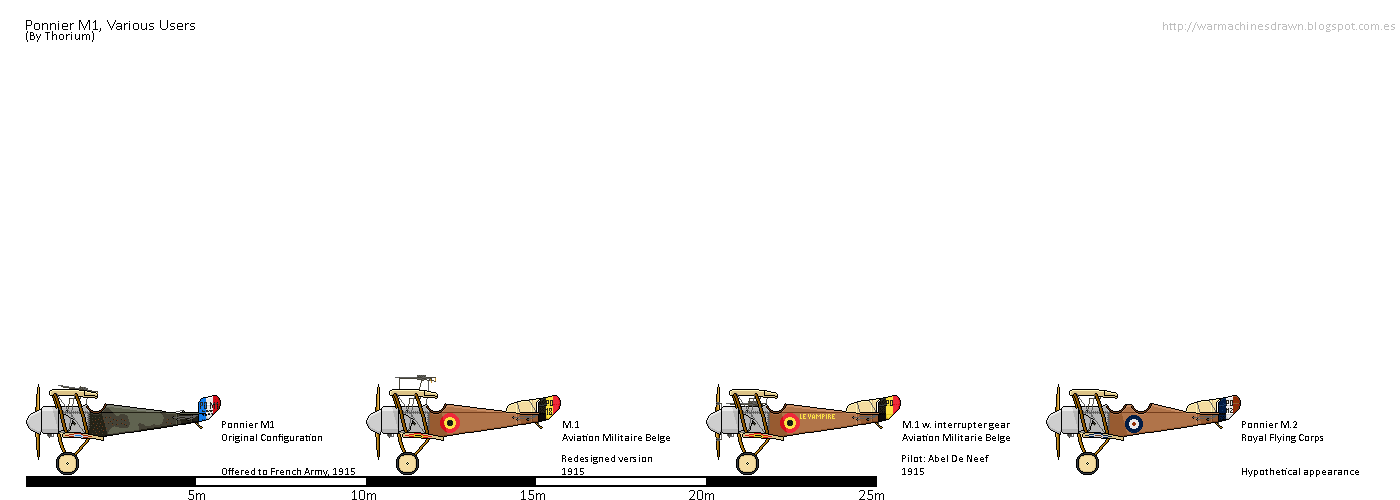
Ponnier M.1

We give the RAF Se.5 some resting and, instead, we switch to a somewhat not very known French airplane that wasn't employed by the French Aeronautique Militaire, but by the Belgian Aviation Militaire.

Avions Ponnier had been trying to win a pre-war contract with their 1913 Ponnier L, but they couldn't win. In 1914, just after the beginning of the war, they tried again, this time with an airplane designed by Emile Dupont, the same one that one year later would design the, much more efficient Hanriot HD.1.

It was powered by a single 80hp le Rhône 9c engine and featured a very large domed spinner which left a very small gap for cooling between it and the engine enclosure. In every version it was armed only with a single lewis machine gun, which changed positions depending on the variant. The most interesting variant was the one flown by the Belgian ace Abel De Neef which featured an interrupter gear in order to shoot the machine gun through the propellers in a way similar to the Morane-Saulnier N.

All things considered, it wasn't a good airplane. Some contemporary fighters like the Nieuport 11 had much better performance. It was also deemed unusable by the Belgian ace Willy Coppens and therefore only 20 of them were manufactured. The only operator was the Belgian Aviation Militaire and, given the great superiority of other enemy fighters, they were only employed in night ground-attack missions without any great success.

It's also claimed that a second two-seater trainer version was planned and even offered to the Royal Flying Corps but never materialized.


Tuesday, 27 October 2015

SPAD S.VII - First entry, foreign users vol. 1

We start this series of entries with another heavyweight of the Great War: The SPAD S.VII

The SPAD S.VII was the first of a successful saga of French biplane fighters. It was designed by Louis Béchereau and was produced by the Société Pour L'Aviation et ses Dérivés (SPAD) (Society for aviations and it's derivatives). It was renowned for being a sturdy and hard to destroy airplane with good climbing and diving characteristics. It was also good as a gun platform although apparently it was too heavy and less maneouvrable than the contemporaneous Nieuport fighters. Many famous WW1 aces like Guynemer, Baracca or Pentland flew it.

As it was widely used both in the Great war and in the aftermaths it suffered many small field modifications, being the most notorious one the inclusion of skis by the Russian DUX factory.

This entry covers the usage by the next countries:


  • Argentina: Bought two aircraft for evaluation purposes.
  • Belgium: Widely used by their national aviation corps (Aviation Militaire) during World War I and the post-war period. Most precisely it was used by the 5éme and 10éme escadrilles (5th and 10th squadrons).
  • Brazil: Used by their national military aviation service (Serviço de Aviação Militar) in 1920.
  • Chile: Another evaluation-only user. The colours are speculative as we couldn't find any photographic or visual evidence.
  • Czechoslovakia: One of the main post-war users. It constituted the backbone of the very early Czechoslovak Army Air Force (Československé Letectvo) and some of them were employed during the brief Polish-Czechoslovak war of 1919.
  • Estonia: It's been said that some captured ex-Russian airplanes were among the first airplanes that formed the Estonian aviation regiment in the aftermath of the Great War. Just like Chile we couldn't find any supporting evidence and therefore the colours are speculative
  • Finland: Finland used DUX-built airplanes in both versions, with skis and without them. However they didn't see action during the Finnish civil war of 1918, as far as we know.
  • Imperial Germany: Germany captured various airplanes during 1917, mostly from the French SPA 31 unit and SPA 65. Most of the SPA 31 retained the unit insignia when flying with their new German-owners.