The Avro Canada CF-105 Arrow was tried to be sold to various foreign countries, among them United Kingdom and the United States of America, however, their national aviation industry was considered as a national interest and they rarely purchased foreign designs.
Anyway, from 1955 onwards, the UK showed some interest on the Arrow for their F.155 program which was expected to enter into service in 1962, however as time passed and it was obvious that the Arrow wouldn't be completed for that year, they focused their attention on interceptor fighters that would be ready for the end of the 1950s. Initially a thin-wing version of the Gloster Javelin was considered together with the short-range interceptor Saunders-Roe SR.177.
During April 1956 the UK's air council recommended the purchase of 144 arrows as an interim for the thin-winged Javelin which would be powered by two Bristol Olympus 7R, two Rolls-Royce Conway Stage 4 or two De Havilland Gyron. The interest became so real that even it was studied the set-up of a production line for the Arrow in the UK, however the 1957 Defence white paper cancelled almost all British manned fighter aircrafts in development back then. In January 1959 UK definitely declined the offer and they offer to sale Canada the English Electric Lightning. We have taken some liberties to imagine an improved Mk.3 version.
Regarding France, they showed interest in the Iroquis engine, in order to fit them in their Dassault Mirage IV bomber, together with another types of engines like the Bristol Olympus. However due to media speculations about the jeopardy of the Arrow being cancelled, the French government cancelled the negotiations in October 1958 and chose their native Snecma Altar. They only showed interest in the Arrow's engine, not in the interceptor as a whole, however we chosen to consider to show the Arrow in French colours for the sake of seeing it under more international colours, because... why not?
The USA, during 1954 had already a supersonic interceptor programme underway, which would eventually lead to the Convair F-106 Delta Dart (which had some similarities with the Arrow). Some of their designs were already better than the Arrow, like the Republic XF-103 or the North American XF-108 however, both of those aircrafts were cancelled as it was obvious that the Soviets were concentrating their efforts on the ICBMs and not in their strategic bombers. This assumption was taken as one of the justifications for the cancellation of the Arrow. In 1958 Avro Canada president promised the USAF a free supply of fire control system and missiles if they allowed the usage of Edwards AFB for free.
Sources:
1. https://en.wikipedia.org/wiki/Avro_Canada_CF-105_Arrow#Foreign_interest
A blog dedicated to draw historical, ahistorical and fictional warplanes and other military vehicles in 1/34 scale. Disclaimer: We just draw for the fun of doing it. If you want you can display the drawings of this blog in your website or forum as long as you credit the source. To properly view the drawings, click on them.
Showing posts with label Avro Canada CF-105 Arrow. Show all posts
Wednesday, 28 December 2016
Monday, 26 December 2016
Avro Canada CF-105 Arrow - Fictional Canadian users
As it's widely known, the CF-105 Arrow was cancelled due to some various reasons.
However, given the characteristics of the airplane, it's very susceptible to a lot of what-ifs.
So, this is the first post, out of two, where we cover various lookings of this interceptor that was ahead of it's time. Each of them is armed with one of the possible missile configurations,either the AIM-4A Falcon, the cancelled Canadair Velvet Glove or the AIM-7 Sparrow II. The Arrow was expected to have so much compatibility with American missiles because it was expected to be sold to the USA and the United Kingdom.
Finally, we decided to take some creative steps and we drawn an anti-ship version carrying one of the first purely air-to-sea missiles, the Nord SS.12/AS.12.
They're all are drawn with the weapons bay deployed in order to show their weaponry.
Sources:
1. https://en.wikipedia.org/wiki/Avro_Canada_CF-105_Arrow
However, given the characteristics of the airplane, it's very susceptible to a lot of what-ifs.
So, this is the first post, out of two, where we cover various lookings of this interceptor that was ahead of it's time. Each of them is armed with one of the possible missile configurations,either the AIM-4A Falcon, the cancelled Canadair Velvet Glove or the AIM-7 Sparrow II. The Arrow was expected to have so much compatibility with American missiles because it was expected to be sold to the USA and the United Kingdom.
Finally, we decided to take some creative steps and we drawn an anti-ship version carrying one of the first purely air-to-sea missiles, the Nord SS.12/AS.12.
They're all are drawn with the weapons bay deployed in order to show their weaponry.
Sources:
1. https://en.wikipedia.org/wiki/Avro_Canada_CF-105_Arrow
Thursday, 22 December 2016
Avro Canada CF-105 Arrow
Now it's time to write about a true flying legend.
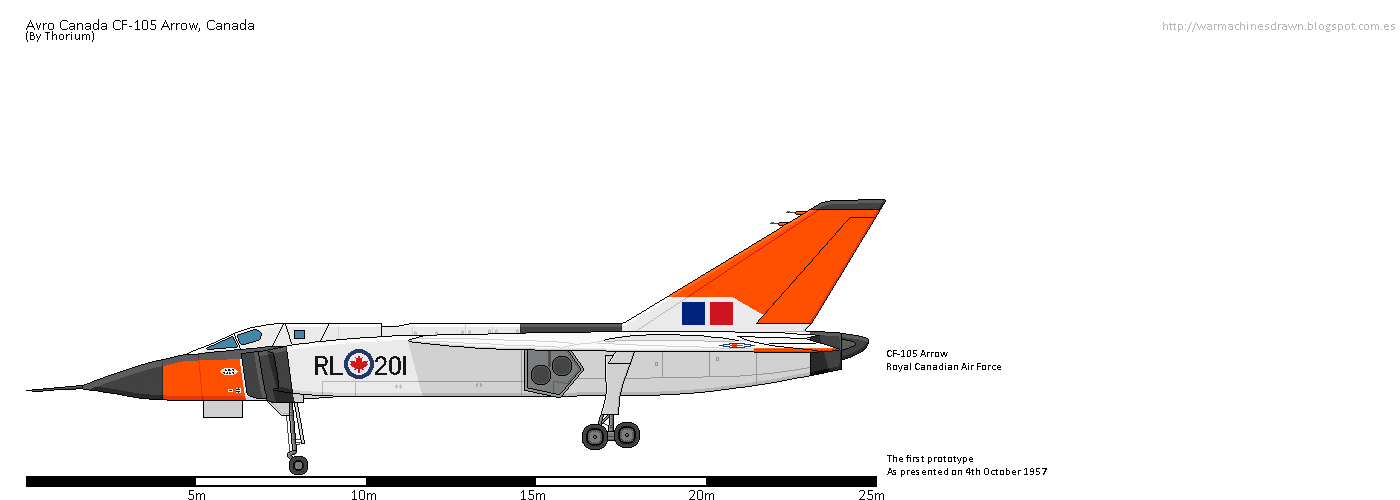
The Avro Canada CF-105 Arrow was conceived back in 1952 to a requirement from 1952 made by the Royal Canadian Air Force, the CF-105 was a two-seat tandem all-weather interceptor of which 37 airplanes were ordered.
Of those 37, the first five of them were known as the Mk.1 and were powered by two Pratt & Whitney J75-P-3 turbojet engines delivering each of them 5670kgp of power which could raise up to 8392kgp after applying the afterburner at maximum power.
The sixth and consecutive airplanes, would've been the Mk.2 series which were expected to be powered by two Orenda PS-13 Iroquis turbojet engines delivering each of them 8732kgp of power and 11794kgp whe afterburning.
The Mk.2 series were to be armed with eight AIM-4 Falcon, three AIM-7 Sparrow or some unespecified number of Canadair Velvet Globe Anti-Air Missiles placed internally in a bay that would deploy when needed.
The first Mk.1 prototype was flown on 25th March 1958 and the other four in 1st August, 22nd September and 27th October, the very same day that the Soviet Sputnik satellite was successfuly launched, so it overshadowed the presentation of this airplane. The fifth one flew on 11th January 1959.
The third prototype achieved the speed of mach 1.5 and mach 1.98 speed was achieved when, on 20th February 1959 the programme was cancelled due to various political reasons. By then, the first airplane of the Mk.2 series was almost complete, and was about to join the testing flights followed by further four that weren't so completed. Urban legends claim that one of those prototypes wasn't destroyed and it's lying inside some hangar, rusting somewhere.
Sources:
1. https://en.wikipedia.org/wiki/Avro_Canada_CF-105_Arrow
2. Salamander Books - The Complete Book of Fighters
The Avro Canada CF-105 Arrow was conceived back in 1952 to a requirement from 1952 made by the Royal Canadian Air Force, the CF-105 was a two-seat tandem all-weather interceptor of which 37 airplanes were ordered.
Of those 37, the first five of them were known as the Mk.1 and were powered by two Pratt & Whitney J75-P-3 turbojet engines delivering each of them 5670kgp of power which could raise up to 8392kgp after applying the afterburner at maximum power.
The sixth and consecutive airplanes, would've been the Mk.2 series which were expected to be powered by two Orenda PS-13 Iroquis turbojet engines delivering each of them 8732kgp of power and 11794kgp whe afterburning.
The Mk.2 series were to be armed with eight AIM-4 Falcon, three AIM-7 Sparrow or some unespecified number of Canadair Velvet Globe Anti-Air Missiles placed internally in a bay that would deploy when needed.
The first Mk.1 prototype was flown on 25th March 1958 and the other four in 1st August, 22nd September and 27th October, the very same day that the Soviet Sputnik satellite was successfuly launched, so it overshadowed the presentation of this airplane. The fifth one flew on 11th January 1959.
The third prototype achieved the speed of mach 1.5 and mach 1.98 speed was achieved when, on 20th February 1959 the programme was cancelled due to various political reasons. By then, the first airplane of the Mk.2 series was almost complete, and was about to join the testing flights followed by further four that weren't so completed. Urban legends claim that one of those prototypes wasn't destroyed and it's lying inside some hangar, rusting somewhere.
Sources:
1. https://en.wikipedia.org/wiki/Avro_Canada_CF-105_Arrow
2. Salamander Books - The Complete Book of Fighters
Subscribe to:
Posts (Atom)