Wednesday, 31 January 2018

Messerschmitt Bf.109G - Bulgarian users

From 1941 onwards, the Royal Bulgarian Air Force received many new German equipment, among them the famous Bf.109E, as they got 15 of them. Later in the war, as the American bombers which were on their way to bomb Ploesti, in Romania, had to cross Bulgarian soil, the Bf.109E proved to be outdated, so the decission of adquiring many of the new Bf.109G was taken.
A total of 145 Bf.109Gs were adquired and assigned to the various squadrons of the Royal Bulgarian Air Force.
They took part in the aerial defence of the country as the Allied raids intensified and was the fighter of choice for the top Bulgarian aces in history. Among them Stoyan Stoyanov which is depicted below and he flow that aircraft until being promoted to the command of 3.6 Orlyak (3.6 squadron) and after that it passed to his successor pouruchik Petar Manolev.
It was also the aircraft of podporuchik of S Marinopolski who painted the name of his girlfriend Helga under the cockpit and applied it to make it look like kill marks from a distance. Poruchik Ditmar Spisarevski managed to shot down an American B-24 Liberator on 20th December 1943 manning his Bf.109G-2 and, according to eyewitness he managed to shot down a second one by a ramming attack, although only the first one was officially recognized. The application of his individual number in yellow indicates that the aircraft belongs to the staff of the 3.6 orlyak.
The last batch of Bf.109Gs that Germany supplied to Bulgaria in mid-1944, included some late production Bf.109G-6s with the famous Galland hood.
Once Bulgaria switched sides in September 1944, the Bf.109Gs kept serving with the Bulgarian Air Force with the new pro-allied markings which they served with until the end of the war.
It seems that shortly after the war, in mid-to-late 1945 they were gradually replaced with the Soviet-made Yakovlev Yak-9.


Sources:
1. https://en.wikipedia.org/wiki/Messerschmitt_Bf_109_operational_history
2. http://www.lasegundaguerra.com/viewtopic.php?t=4091 (translated)
3. Osprey - Aircraft of the Aces 58 - Slovakian and Bulgarian Aces of World War 2 

Tuesday, 30 January 2018

Messerschmitt Bf.109G - Various users

On this post, we're going to write about various non native users of the Bf.109G.

  • Australia: It seems that personnel from the No.3 Squadron Royal Australian Air Force captured some Bf.109G-2/Trop in a Libyan airfield on 4th November 1942 that was operated by the 8./JG 77. German markings were overpainted with RAAF's ones and it was flown by Squadron chief officer Robert H.M. Gibbes. 
  • United Kingdom: Various examples were captured by the Royal Air Force. For instance, there was one Bf.109G-6 crashed on Thorney island, in West Sussex on 19th May 1944 in good conditions. It was repainted with Royal Air Force's colours and pushed into service with the famous "Rafwaffe", the No.1426 flight where it was tested. Some more Bf.109G-6 were captured and used by the RAF painted with ad-hoc colours like the one piloted by 1st Lt. H.L. Thorne which the main fuselage section was overpainted in coastal command colours.
  • Soviet Union: Many of them were captured during the course of the war in the eastern front since as early as 1942 which was when the earlier versions of the Bf.109G entered into service with the Luftwaffe. Some of the captured ones were overpainted in Soviet white winter colour almost entirely and used in the aerial battle of Stalingrad.  Another examples were used for evaluation purposes at the Moscow TsAGI institute. 
  • United States of America: Many Bf.109G-2 were found abandoned when Axis forces abandoned Tunisia and were captured by the USAAF troops, specially those from the 31st Fighter Group. They were used for testing purposes. There was one, a Bf.109G-6/Trop which was overpainted completely in black with ailerons, spinner and flaps in red and became the personal aircraft of Commander Robert "Bob" Baseler. It was used as a squadron hack serving with the 325th Fighter Group in 1943.


Sources:
1. https://en.wikipedia.org/wiki/Messerschmitt_Bf_109_operational_history
2. Salamander Books - The Complete Book of Fighters

Monday, 29 January 2018

CAC Ca-4 Woomera

Due to the incoming war, in early 1939 the Australian Government ordered large numbers of Bristol Beaufighters to be produced in railway workshops bypassing that way the local aircraft company, the Commonwealth Aircraft Corporation CAC.
CAC which was under the direction of Sir Lawrence Wackett began to work on his own design, hoping to outperform the Beaufighter serving both as a dive and torpedo bomber. In order to keep the weight low, Wacket dispensed with traditional self-sealing fuel tanks and opted to make wing cavities liquid-tight in order to serve as fuel storage. Initially, Australian Government wasn't interested in the design, however, in mid-1940, when Australia was cut-off from the supply of British-made components needed for the Beaufort, due to the need of maximization of British aircraft production during the Battle of Britain during mid 1940, the Australian Government ordered a prototype of the CAC design, even before the Royal Australian Air Force had expressed their opinion about the type.
The prototype flew for the first time on 19th September 1941. It was a low-wing, twin-engined, multi-role bomber with a crew of three. It was armed with four 0.303in machine-guns mounted in the nose and two remote-controlled twin machine-guns barbettes mounted at the rear of the engine nacelles. It could carry either 500lb (250Kg) bombs, 250lb (110Kg) or two torpedoes. In the case of the bombs, they were stored in a compartment placed in the nacelles.
It was originally powered by two Pratt & Whitney Twin Wasp R-1830-S3C3-G radial engines yielding each of them 1200hp of power. Unfortunately, the novel fuel tanks weren't reliable and on 15th January 1943 the CAC Ca-4 prototype was destroyed in a mid-air explosion, probably due to a fuel leak and killing two of the three crewmen near Kilmore, in Victoria. The wreckage was recovered and used for components.
Due to the Japanese entry into the World War II, the RAAF accepted the design even before it was tested and placed an order for 105 examples on 8th March 1942, however the loss of the first prototype the programme was delayed.


Sources:
1. https://en.wikipedia.org/wiki/CAC_Woomera
2. https://www.militaryfactory.com/aircraft/detail.asp?aircraft_id=848

Saturday, 27 January 2018

BAT F.K.22/23 Bantam

Friedrich Koolheven's first design for the British Aerial Transport Company (BAT) was the F.K.22 single-seat fighter. It was a two-bay wooden biplane and was planned to be powered by a 120hp A.B.C. Mosquito radial engine, but, as that engine failed, it was fitted with a 170hp A.B.C. Wasp I in the first and third aircraft, while the second aircraft was fitted with a 100hp Gnome Monosoupape rotary engine and was the first aircraft to fly at Martlesham Heath in January 1918.
Originally six of them were ordered as development aircraft but three of them were built as the F.K.23 Bantam I with the second prototype being renamed as Bantam II. The Bantam I had the same wooden structure but it was slightly smaller. Two more prototypes were built, followed by at least 9 development aircrafts. One of them was delivered to the Royal Aircraft Establishment on 26th July 1918. One more was delivered to Villacoublay, in France to be evaluated by the French Aéronautique Militaire and a further one more was delivered to the United States Army Air Corps at Wright field in 1922.
Given the unsatisfactory spin characteristics of the prototypes, the production Bantam had to be modified. However, due to continuous engine problems and the downsizing of the Royal Air Force after the World War I, made that no further orders for the Bantam to be placed. Koolhoven returned to the Netherlands after the war with one aircraft which was re-engined with a 200hp Armstrong-Siddeley Lynx radial engine and several examples were used as civil racing aircrafts.
As we couldn't find graphical evidence of most of these ones, the French, Dutch and American ones should be considered as speculatives.


Sources:
1. https://en.wikipedia.org/wiki/BAT_Bantam
2. Salamander Books - The Complete Book of Fighters

Friday, 26 January 2018

Morane-Saulnier AC

The Morane-Saulnier AC (AKA Morane-Saulnier MoS 23) was designed in 1916 as a variant of the type N via the never-built type U.
It differed from the previous Morane-Saulnier types in the fact that it had ailerons for lateral control instead of wing warping.This was because of the rigid wing bracings, with a wire braced truss of steel tubes supporting the wing from below. It appeared in autumn 1916 and was found to be aerodynamically clean.
It was powered with a single 110hp (82Kw) LeRhône 9J or 9Jb nine-cylinder air-cooled rotary engine and was armed with a single Vickers 0.303in machine gun placed in cowl on the nose.
The first flight of this type, is unrecorded, but it's supposed that it was in late summer 1916. As tests were successful and the aircraft was liked by the Aéronautique Militaire, thirty aircraft were ordered. In spite of the advanced design and good performance, it was considered to be inferior to the SPAD S.VII, which was already being produced and employed in combat,  and therefore it wasn't adopted for mass production. Two aircrafts were provided to the British Royal Flying Corps for evaluation but it was rejected as they already had better airplanes in their lines.
As we couldn't find any graphical evidence of the type serving with the RFC, the drawing should be considered as speculative.


Sources:
1. https://en.wikipedia.org/wiki/Morane-Saulnier_AC
2. Salamander Books - The Complete Book of Fighters

Thursday, 25 January 2018

Dornier-Zeppelin D.I

The Dornier-Zeppelin D.I was a single-seat all-metal stressed-skin monocoque cantilever-wing biplane fighter that was designed by Claude Dornier when he was working for Luftschiffbau Zeppelin, at Lindau, in Bavaria.
The Dornier-Zeppelin D.I was the first fighter to feature such all-metal monocoque and stressed skin, which made the fighter a true millestone for aviation. Even if production was cancelled before any production version could be completed, it was the first aircraft with such features to enter into production. In order to reduce risks of inflight fires, it featured an external fuel tank which, apparently, and according to some sources, could be jettisoned. It also had a thick-section cantilevered wings for improved aerodynamics. It was armed with two forward-firing Spandau machine-guns.
Seven prototypes were built in order to develop the type and it was never used operationally due to the end of the World War I. It was evaluated by Luftstreitkräfte pilots in May, June and October 1918. One of the German aces, Wilhelm Reinhard was killed on 3rd July 1918 after a structural failure when this aircraft was grounded to get structural improvements. Apparently there were reports of heavy aileron controls and poor climb performance at higher altittudes. In order to fix those flaws it was fitted with a more powerful 185hp BMW IIIa water-cooled 6-cylinder inline engine that boosted the climb rate to 5000m (16000ft) from 25 minutes to 13 minutes so, thanks to that achievement, a production order was placed for 50 aircraft to be released either in October or November 1918, however airframes for that production batch were roughly 50% completed when production was halted in early 1919. US Navy and US Army Air Service bought one prototype each in 1921, which were delivered in 1922 and were used for evaluation and novel construction methods. However, as we couldn't find graphical evidence of this aircraft in American colours, we didn't drawn it.


Sources:
1. https://en.wikipedia.org/wiki/Dornier-Zeppelin_D.I
2. Salamander Books - The Complete Book of Fighters

Wednesday, 24 January 2018

Macchi M.C.91

The Macchi M.C.91 was a project of a medium bomber loosely based on the American Martin B-10 that, at the time, was a revolutionary design as it was the first bomber in the world with a completely sealed canopy.
Unlike the Martin B-10 which was made entirely out of metal, this was going to be made completely out of wood. The engine imposed by the Italian Regia Aeronautica was the Piaggio P.IX RC.40 radial engine rated at 630hp each of them which was an Italian version of the British-built Bristol Jupiter with a two-speed compressor which was expected to rate the engine at that horsepower we wrote earlier.
As the power of the engines was expected to be really low, engineer Mario Castaldi would have to cope with a wooden structure as light as possible and make that structure as aerodynamic as possible which, apparently, this design was the most aerodynamic of all his designs for the project. However, in order to achieve that goal, the payload had to be reduced with the payload hanging partially from outside of the fuselage. Therefore the configuration of the defensive armament, which was going to be of two 7,7mm Breda-SAFAT in a turret in the nose, another two 12,7mm Breda-SAFAT in a dorsal turret plus another 12,7mm one placed in a ventral hatch, was really complicated, as the front gunner and the dorsal one, were extremelly bulky and broke the aerodynamics and, furthermore, the position of the front gunner broke pilot's vision making take-offs and landing harder than usual.
Those so many problems leaded to the cancellation of the project.


Sources:
1. http://italianaircraftwwii.blogspot.com.es/2015/03/macchi-mc.html
2. https://www.secretprojects.co.uk/forum/index.php/topic,12121.msg118179.html#msg118179
3. http://www.aereimilitari.org/forum/topic/15374-concorso-1934-un-bombardiere-per-la-regia/ (translated)

Tuesday, 23 January 2018

Kocherigin BSh-1

At the end of 1935, the USSR received information about the American light bomber and attack aircraft Vultee V-11. Under orders of the People's Commissar of Defence Kliment E. Voroshilov showed interest on the project in order to replace the outdated Soviet attack biplanes like the Polikarpov R-5Sh.
Therefore, the Vultee V-11 was included in the list of purchase licenses and, on 11th April 1935 negotiations with Vultee began.
Both Soviets and Vultee reached an agreement and four Vultee V-11GB were sold to the USSR together with production blueprints adapted to the metric system. These weren't the standard type as they had a crew of three, one pilot, a rear-gunner and one navigator-bombardier.
It was powered by a single Shvetsov ASh-62 rated at 1000hp (746Kw) radial engine and was armed with four forward firing 7.92mm ShKas machine guns mounted in the wings with 3600 rounds in total. It could also carry up to 400Kg (881lb) of ordnance under the fuselage. As defensive armament, it had one 7.92mm Shkas at the end of the canopy and another one that was deployed on a hatch ventrally placed just behind the one at the of the canopy.
The first Kocherigin BSh-1 rolled out of the factory on 11th December 1936 and it was tested so it wasn't until mid 1937 that it entered into production. It was found however that the armour fitted for the ground attack role, reduced performance greatly and it was decided to stop production after only 31 aircraft were manufactured. As they proved to be not suitable for service in the VVS (Soviet Air Force) they were transferred to Aeroflot, which redesignated them as Kocherigin PS-43 and used them as high-speed transports until June 1941 when Germany invaded. Then they were transferred both to the VVS and PVO (Soviet Air Defence).
They served all-through World War 2 and, albeit serving in small numbers, they were present at the Battle of Stalingrad as they were the ones, together with outdated Polikarpov R-5, that delivered air mail to the sieged troops. However, casualties were heavy and by 1st June 1944 there were only 9 of them active and by the end of that year, 8 serving with the 1st Baltic Front and 2nd and 3rd Byelorussian fronts as par of the 3rd Communications Division air unit. By the beginning of 1945 as the lend-leased Douglas A-20 and B-25 were somewhat outdated, they were sent to the 3rd Communications Division to serve in the liaison role so the extremely worn-out and old PS-43 were written-off. By September there weren't any Kocherigin BSh-1 or PS-43 active inside the USSR.
Finally we decided that this aircraft would fit perfectly in an alternate history universe where the Whites won the Russian civil war, so we decided to paint one of them in Russian Aeronaval colours.


Sources:
1. https://en.wikipedia.org/wiki/Vultee_V-11
2. http://www.airwar.ru/enc/aww2/bsh1.html (translated)

Monday, 22 January 2018

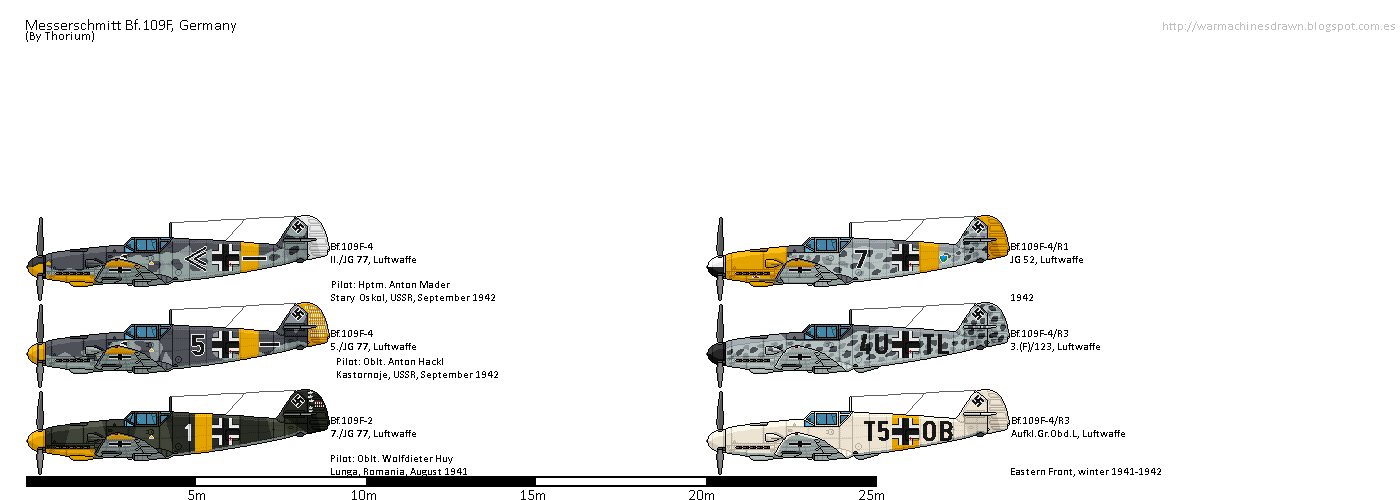
Messerschmitt Bf.109F, German Users - part seven

The DB 601E rated at 1332hp (993Kw or 1350Ps) was fitted to the F-3 and F-4 versions together with a VDM 9-12010 propeller which featured broader blades to improve high altittude performance. Initially, the DB601E was limited to 1184hp (883Kw or 1200Ps) but that limit was removed in February 1942. It ran on standard 87 octane B-4 aviation fuel, in spite of the increased performance, while the earlier DB601N required 100 octane C-3 fuel.
It's believed that just 15 aircrafts of the F-3 variant were produced, which it's believed that they served as the pre-production for the upcoming F-4. They were manufactured by Messerschmitt Regensburg between October 1940 and January 1941. Like the F-1, it was armed with one 20mm MG-FF/M firing through the propeller hub. plus two 7.92mm MG-17.
The F-4 introduced the new Mauser 20mm MG151/20 replacing the motorkanone, and firing it through the propeller hub. The first ones rolled out from the factory in June 1941 and they were produced exactly during one year, from May 1941 until May 1942 with a total of 1841 F-4 of every sub-variant built. Some of the late sub-variants featured two MG-151/20 cannons mounted under the wings in faired gondolas. They were designated F-4/R1 and 240 were built by WNF in the first quarter of 1942. This optional armament was standarized as a kit in the later G and K variants. Another high-altittude variant, the F-4/Z featuring a GM-1 boost was also manufactured with a production run of 544 in that first quarter of 1942 and they were extensively used. Erla factory, produced the tropicalized F-4/Trop variant, in the first half of 1942.
With the initial engine rating of 1184hp the maximum speed that the F-4 could achieve was 635km/h (394mph) at a rated altittude and when the engine was cleared to work at maximum power of 1332hp, the maximum speed increased to 659km/h (410mph) at 6200m high (20341ft).
There were also some reconnaissance variants, with cameras fitted under the fuselage aft of the cockpit, built in small numbers. They were designated F-4/R2 and F-4/R3 and just 41 of them were built. Five of the R2 sub-variant and 36 of the R3.


Sources:
1. https://en.wikipedia.org/wiki/Messerschmitt_Bf_109_variants#Bf_109F
2. Salamander Books - The Complete Book of Fighters
3. Osprey - Air Vanguard 23 - Messerschmitt Bf 109 E-F series
4. Signal Squadron - Aircraft In action  57 - Messerschmitt Bf-109 in Action Pt.2

Saturday, 20 January 2018

Messerschmitt Bf.109F, German Users - part six

The armament of the Bf.109F was modified and now consisted of two synchronized 7.92mm (0.312in) mounted above the engine plus one Motorkanone canon firing through the propeller hub. Opinions were mixed the new armament arrangement, Oberst. Adolf Galland criticised the new armament as being light and inadeuqate for the average pilot while Major Walther Oesau preferred to fly a Bf.109E and Oberst Werner Mölders saw the new arrangement as an improvement.
With the early tail unit problems fixed, the popular opinion among pilots was that the F variant was the one that could be handed the best. Mölders flew one of the first operational Bf.109F-1s over England in October 1940 with an excellent score of shooting down eight Hawker Hurricanes and four Supermarine Spitfires between 11th and 29th October 1940.
Given the shortage of the DB 601E engine, which wasn't available in enough numbers, the pre-production version, F-0 (which was the only one to feature a complete rectangular supercharger intake) and the first versions F-1 and F-2, were fitted with the 1159hp (864Kw 1175PS) DB 601N engine which drove a VDM 9-1127 propeller. The F-0 and F-1/F-2 versions differed only in the armament, as the F-1 was fitted with a 20mm MG FF/M Motorkanone firing through the propeller hub. F-1 served for the first time, as we said previously, in the late stages of the Battle of Britain, in October 1940 serving with the JG 51 manned by Werner Mölders. A total of 208 F-1s were manfuactured between August 1940 and February 1941 by Messerschmitt Regensburg and Wiener Neustädter Flugzeugwerke (WNF).
The F-2 variant replaced the MG FF by a 20mm Mauser MG 151 cannon and as that cannon became available, many of them were retrofitted with it in the field. Around 1230 F-2s were manufactured between October 1940 and August 1941 by AGO, Arado, Erla, Messerschmitt Regensburg and WNF. Initially there wasn't any tropicalized version, but many of them were converted on the field. There was also a projected high-altittude version of the F-2, called F-2/Z equipped with a GM-1 boost, but it was cancelled in favour of the F-4/Z.


Sources:
1. https://en.wikipedia.org/wiki/Messerschmitt_Bf_109_variants#Bf_109F
2. Salamander Books - The Complete Book of Fighters
3. Osprey - Air Vanguard 23 - Messerschmitt Bf 109 E-F series(1)
4. Signal Squadron - Aircraft In action  57 - Messerschmitt Bf-109 in Action Pt.2

Friday, 19 January 2018

Messerschmitt Bf.109F, German Users - part five

The whole wing was redesigned, being the most notorious change the quasi-elliptical wingtip shape and the reduction of the wing area to 16.05 square meters (172.76 square feets). Other features of the redesigned wings included new leading edge slats, which were shorter but had a slightly increased chord plus a new removable wingtip that changed the planview of the wings and increased the span slightly over that of the E series. Ailerons were also replaced with Frise-type ones. The 2R1 profile with a thickness-to-chord ratio of 14.2% at the root reducing to 11.35% at the last rib. Just like before, dihedral was 6.53º.
Wing radiators were shallower and set farther back on the wing. A new cooling system was also introduced which was automatically regulated by a thermostat with interconnected variable position inlet and outlet flaps that would balance the lowest drag possible with the most efficient cooling. A new radiator shallower but wider than the one of the E-model was developed. A boundary layer duct allowed a continuous airflow to pass through the airfoil above the radiator ducting and exit from the trailing edge of the upper split flap. Lower split flap was mechanically connected to the main flap while both the upper and forward ones were regulated via a thermostatic valve which automatically positioned the flaps for maximum cooling efectiveness. New "cutoff" valves were introduced in 1941 which allowed the pilot to shut down either wing raditor in the case of one was damaged, allowing that way the remaining coolant to be preserved and allow the damaged aircraft to return to its base. However, those valves were delivered to the frontlines as kits, the number of which, for not known reasons, was limited. Anyway, those valves were the standard ones for the next G and K variants.


Sources:
1. https://en.wikipedia.org/wiki/Messerschmitt_Bf_109_variants#Bf_109F
2. Salamander Books - The Complete Book of Fighters
3. Signal Squadron - Aircraft In action 57 - Messerschmitt Bf-109 in Action Pt.2
4. Osprey - Air Vanguard 23 - Messerschmitt Bf 109 E-F series(1)

Thursday, 18 January 2018

Morane-Saulnier V

The Morane-Saulnier V, AKA Morane-Saulnier M.S.22,  was a French fighter of the 1910s that was itself a variant of the Morane-Saulnier N, but powered by a 110hp Le Rhône engine instead of the original 80hp Le Rhône one. Thanks to its engine, it had an endurance of 3 hours.
As it was more developed, it required more work than the previous type N or the type I, which was developed in parallel to this one. In fact, it had bigger wingspan and had modified elevators with a bigger area. It had also bigger fuel tanks, which gave the fuselage a deeper front.
The first aircraft was presented on 16th May 1916 at No.1 Air Depot, near Guillaux, in France, although unarmed. Later, by 8th July, they were armed and with their engines fitted and were delivered to the Royal Flying Corps in that same month.
With the Royal Flying Corps, one of them served with the No.3 Squadron for a few days, but after that, only the No.60 Squadron was the only RFC unit to use the type, receiving at least 7 of the 12 delivered. Of those, three were written off as they crashed while landing and another one was destroyed in combat on 19th September 1916. It wasn't very popular among the pilots of the No.60 Squadron as the more powerful and heavier engine, made the aircraft harder to control . By early August, the squadron had to be withdrawn from the frontlines, in order to be fitted with new and better aircrafts. However, when the squadron received the Nieuport 16, some few Morane-Saulnier V, were still in active until they were definitely withdrawn from service on 11th October 1916.
This didn't end Morane-Saulnier N family, as the type V was the basis for the experimental type U version which eventually evolved into the type AC.
Some of them were also sold to the Imperial Russian Air Service in 1917, where they were kept into service until the revolutions of that same year when they were adquired by the Bolshevik Red Air Fleet and served, without known results, during the Russian Civil War.


Sources:
1. http://www.historyofwar.org/articles/weapons_morane_saulnier_Type_V.html
2. https://en.wikipedia.org/wiki/Morane-Saulnier_V
3. Salamander Books - The Complete Book of Fighters

Wednesday, 17 January 2018

Morane-Saulnier I

The Morane-Saulnier I, AKA Morane-Saulnier MS.6, was a French fighter of the 1910s. It was basically a modified version of the Morane-Saulnier N.
Following the advice of Lord Trenchard, the Royal Flying Corps placed an order for a more powerful Morane-Saulnier N, so the firm Morane-Saulnier answered by fitting a 110hp Le-Rhône engine to a type N, creating that way the type I, even if externally it was identical to the type N, with the only difference that it was armed with a 0.303in Vickers Machine Gun.
Initially the Royal Flying Corp's order was for just one aircraft, but later, in March 1916 it was extended to thirteen.
However, just four aircrafts were delivered to the RFC in July 1916, having it flown in March of that year in RFC trials. No further production was ordered as the more advanced version, the Morane-Saulnier V proved to be better and more promising. However, the type I remained with the RFC, at the frontlines until October 1916 when they were replaced and sold to Russia, where they served with the Imperial Russian Air Service until the end of the war.


Sources:
1. https://en.wikipedia.org/wiki/Morane-Saulnier_I
2. Salamander Books - The Complete Book of Fighters

Tuesday, 16 January 2018

Morane Saulnier-N

The Morane-Saulnier N, was a French monoplane fighter airplane from the First World War. It was designed in and manufactured by Morane-Saulnier, it entered into service in April 1915 with the French Aéronautique Militaire, who named it Morane-Saulnier MS.5C1.
Even if it was a clean and streamlined aircraft, it wasn't easy to fly due to a mixture of stiff lateral control caused by using wing warping instead of ailerons, sensitive pitch and yaw controls caused by using an all-flying tail, and very high landing speed for the period. It was armed with a single unsynchronised forward-firing 7.92mm Hotchkiss machine gun which used the defector wedges, first used in the Morane-Saulnier L to fire through the propeller arc. It was powered by a single 80hp (60Kw) Le Rhône 9C air-cooled rotary engine.
A large metal "casserolle" spinner was designed to make the aircraft more streamlined, but it was found that it overheated the engine, so many pilots removed it. In fact, in 1915, most of them were removed so overheating problems dissappeared with little loss in performance.
Forty-nine aircrafts were manufactured but they were already obsolete by the end of 1915 in the Western Front as the aircraft development ran very fast back then.
A version with a modified tail was introduced in very small numbers, the type Nm.
It served with the French Aéronautique Militaire at the hands of mighty pilots like Roland Garros. It's service was highly successful as they had an aicraft that could face the German Pfalz E.I. It  also served with some squadrons of the Royal Flying Corps, where it earned the nickname of "The Bullet" and was also manned by pilots of the 19th Squadron of the Imperial Russian Air Force, operating in Ukraine, where at least three of them served with the Ukranian Galician Army, of the West Ukrainian People's Republic during the years of the Russian Revolution and Russian civil war.


Sources:
1. https://en.wikipedia.org/wiki/Morane-Saulnier_N
2. http://www.historyofwar.org/articles/weapons_morane_saulnier_Type_N.html
3. Salamander Books - The Complete Book of Fighters

Monday, 15 January 2018

Messerschmitt Bf.109F - German users, part four

The tailwheel of the Bf.109E was also replaced with a semi-retractable one and the undercarriage legs were raked forward by six degrees to improve ground handling. When the first F-1s were put into service, a structural flaw was revealed causing the crash of some aircrafts as the wing surface wrinkled or fractured or by the tail structure failing. One of those accidents claimed the life of JG 2 'Richtofen' Commander Wilhelm Balthasar when he was attacked by a Spitfire during a test flight. When he performed an evasive maneouvre, wings broke away and the aircraft crashed killing Balthasar.
In order to deal with that serious problem, slightly thicker wings and reinforced spars were introduced. Some tests were also performed to see why the tail unit had failed.
It was found that at a certain engine settings a high-frequency oscilation in tailplane spar was overlapped by harmonic vibrations from the engine. So those two combined effects were enough to cause structural failure at the rear fuselage/fin attachment point. Initially, two external stiffening plates were screwed onto the fuselage on each side, and later, the enitre fuselage structure was reinforced.


Sources:
1. https://en.wikipedia.org/wiki/Messerschmitt_Bf_109_variants#Bf_109F
2. Salamander Books - The Complete Book of Fighters
3. Osprey - Air Vanguard 23 - Messerschmitt Bf 109 E-F series
4. Signal Squadron - Aircraft In action 57 - Messerschmitt Bf-109 in Action Pt.2

Saturday, 13 January 2018

Messerschmitt Bf.109F - German Users, part three

The canopy of the Messerschmitt Bf.109F stayed basically the same as the one of the E-4, although the handbook of the F, claimed that the forward lower triangular panel to starboard was to be replaced by a metal panel with a port for firing signal flares. The great majority of F-1 and F-2s subvariants kept the glazed pannels. An additional two-piece all-metal armour plate head was added, just like in the E-4, to the hinged portion of the canopy. However, some of them lacked the curved top section. It featured also an optional bullet-resistant windscreen. Fuel tank was self-sealing and in 1942 many F-2 were retrofitted with additional armour made from layered light-alloy plate just aft of the pilot and fuel tank. The fuselage aft of the canopy remained essentially unchanged in its externals.
Tail section was slightly modified as well. The rudder was slightly reduced and the symmetrical fin section changed to an airfoil shape, which produced a sideways lift force that swung the tail slightly to the left. That helped to increase the effectivness of the rudder, and made the need for application of right rudder on takeoff not so needed to counteract the effects of the torque effects from the engine and propeller. Bracing struts were also removed in the tail from the horizontal tailplanes, which were relocated slightly below and forward of their original positions.


Sources:
1. https://en.wikipedia.org/wiki/Messerschmitt_Bf_109_variants#Bf_109F
2. Salamander Books - The Complete Book of Fighters
3. Signal Squadron - Aircraft In action 57 - Messerschmitt Bf-109 in Action Pt.2
4. Osprey - Air Vanguard 23 - Messerschmitt Bf 109 E-F series(1)

Friday, 12 January 2018

Piaggio P.16

The Piaggio P.16 was an Italian heavy bomber that was designed by a team leaded by engineer Corradino D'Ascanio who designed a three-engined shoulder-wing monoplane made mostly out of metal with inverted gull-wings.
The wing was semi-elliptical and was mounted high on the fuselage. Landing gear was retractable and had a spatted, non-retractable tailwheel. It had a payload of 1000Kg (2205lb) and an armament of two fixed 7,62mm Breda-SAFAT machine guns placed in the leading edge of the wing and two defensive ones. One of them was placed in a dorsal retractable turret and another one in the rear fuselage mounted beneath the tail.
It was powered by three Piaggio Stella P.IX R.C.40 9 cylinder air-cooled radial piston engine rated at 700hp (520Kw) each of them which drove each of them a two-bladed wooden variable-pitch propeller, the first Italian aircraft to feature that. The bomb-aimer manned a compartment set behind the nose engine on the underside of the fuselage.
It was officially ordered on 4th July 1933, however construction had already started before that date. The only prototype beared the serial number of MM 226 and flew for the first time in November 1934 at Villanova d'Albenga Airport with test pilot Mario Gama at the controls. In February 1935 the bomber was evaluated by the Regia Aeronautica (Royal Italian Air Force) and in October of that same year it was presented to the public at the first Salone Internazionale Aeronautica (International Aviation Display) in Milan, where it attracted a lot of attention and interest.
Twelve machines were ordered by the Regia Aeronautica but the order was cancelled shortly after in favour of the more promising and conventional Piaggio P.32 bomber, designed in 1935. Even with just one P.16 built, it helped Piaggio to learn the skills required to build large all-metal aircrafts which eventually ended in the Piaggio P.108.


Sources:
1. https://en.wikipedia.org/wiki/Piaggio_P.16
2. https://it.wikipedia.org/wiki/Piaggio_P.16 (translated)
3. https://oldmachinepress.com/2015/11/29/piaggio-p-16-bomber/
4. La Bancarella Aeronautica - Ali d'Italia 15 - Piaggio P.108

Thursday, 11 January 2018

Messerschmitt Bf.109F - German Users, part two

In comparison with the previous versions, the Bf.109F introduced many aerodynamical improvements. Engine cowling was redesigned to be more smoother and more rounded, the enlarged propeller spinner, which was adapted from the Messerschmit Me.210, now blended smoothly into the new engine cowling. Underneath the cowling there was a revised, more streamlined oil cooler, radiator and fairing. A new ejector exhaust arrangement was incorporated and, on later aircrafts, a metal shield was fitted over the left hand banks to deflect exhaust fumes away from the supercharger air-intake. From the F-1 series onwards, a rounded "elbow"-shaped design protruding further into the airstream.
A new three-bladed, light alloy VDM propeller unit with a reduced diametor of 3m (9ft 8.5in) was used as the standard type. Pitch was controlled electronically and was regulated by a constant-speed unit, with a manual override provided just in case.
Thanks to the improved more aerodynamical airframe, more fuel-efficient engines and the improvement of the Luftwaffe's 300L drop tank, the range of the Bf.109F increased greatly to 1700Km (1060 milles), specially when compared to the 660Km (410 milles) of the previous Bf.109E on internal fuel only and with the E-7's provision for the 300L drop tank, a Bf.109E equipped with it, doubled the range to 1325Km (820 milles).


Sources:
1. https://en.wikipedia.org/wiki/Messerschmitt_Bf_109_variants#Bf_109F
2. Salamander Books - The Complete Book of Fighters
3. Osprey - Air Vanguard 23 - Messerschmitt Bf 109 E-F series(1)
4. Signal Squadron - Aircraft In action 57 - Messerschmitt Bf-109 in Action Pt.2

Wednesday, 10 January 2018

Marton X/V

The concept of a cantilever monoplane pusher-puller fighter with twin tail units on booms was retaken by Hungarian engineers at the end of 1942.
As the locally-built fighter, the Weiss WM-23 'Ezüst Nyíl' proved to be obsolete, the Royal Hungarian Air Force centered their attention on Martons' project.
Externally it resembled the original Fokker D.XXIII, the first fighter flying with such configuration, however it was shaped more aerodynamically. The prototype was built along 1943 and was powered by two Daimler-Benz DB.605 engines, one in pusher and another one in puller configuration yielding each of them 1475hp of power. Expected maximum speed was of, at least 580km/h (360,40mph) at some altittude that haven't been found.
It was going to be armed with two 20mm guns plus another two 12.7mm machine guns, the late ones placed in the nose over the engine and the first ones placed in the wings, however the prototype never had armament installed.
The sole prototype was destroyed in an US air raid on 13th April 1944, so the programme was abandoned and the Royal Hungarian Air Force decided that it was best to concentrate on the already adquired Messerschmitt Bf.109G and Messerschmitt Me.210.


Sources:
1. http://www.airwar.ru/enc/fww2/marton.html (translated)
2. https://de.wikipedia.org/wiki/Marton_X/V (translated)

Tuesday, 9 January 2018

Messerschmitt Bf.109F - German users, part one

The development of the Bf.109F had begun in 1939. After February 1940 a new engine, the DB 601E had been developed to be used in the Bf.109. Engineers of Messerschmitt took two Bf.109Es airframes and fitted the new engine in them. That way, the first two prototypes, dubbed V21 and V22, kept the trapeziform wing shape of the Bf.109E, but by "clipping" the tips, total wingspan was reduced by 61cm (2ft).
V22 became in fact the testbed for the pre-production version of the new DB601E engine. Smaller wings had detrimental effect on the handling so V23, a new prototype was fitted with new, semi-eliptical wingtips, which would become the standard wing planform of all Bf.109 versions. A fourth prototype was built, V24, flew with the clipped wings but with a modified "elbow"-shaped supercharger air-intake which was chosen for production, and a deeper oil cooler bath beneath the cowling. On every of these prototypes, fuselage was cleaned up and engine cowling was modified to improve aerodynamics.


Sources:
1. https://en.wikipedia.org/wiki/Messerschmitt_Bf_109_variants#Bf_109F
2. Signal Squadron - Aircraft In action 57 - Messerschmitt Bf-109 in Action Pt.2
3. Salamander Books - The Comple Book of Fighters

Monday, 8 January 2018

Messerschmitt Bf.109F - Hungarian users

Today's post isn't very long, but anyway, it's full of content!.
In October 1942 an agreement was reached by the Luftwaffe and the Royal Hungarian Air Force to partially re-arm them with the Bf.109F. The previous type of the Bf.109  So, subordinated to the JG 52 on the Eastern Front, the first Hungarian unit to convert to the Bf.109F-4 was the 1./1. vadászszázad (fighter squadron) and shortly after, zászlós (ensign) Lukács Otto flew the first combat sortie, on 15 October 1942.
They were used mainly in the fighter-bomber role, so most of them were of the F-4/B variant.
The first kill of an Hungarian Bf.109F didn't come until 16th December 1942 when fohädnagy (Lieutenant) György Bánlaky and hadnagy (Second Lieutenant) Imre Pánczél shot down four Ilyushin Il-2, which were the first victims of the Hungarian Bf.109Fs. Many other Hungarian units converted either to the Bf.109F and more advanced Bf.109G types during the course of 1943.


Sources:
1. https://en.wikipedia.org/wiki/Messerschmitt_Bf_109_operational_history#Combat_service_with_Hungary
2. Hikoki editions - Hungarian Eagles - The Hungarian Air Forces 1920-1945
3. Salamander Books - The Complete Book of Fighters

Saturday, 6 January 2018

Messerschmitt Bf.109F - Various foreign users

The Messerschmitt Bf.109F, a very improved version of the Bf.109E, was used by various countries.

  • United Kingdom: On 20th May 1942, a Bf.109F-4 belonging to 10 (Jabo)/JG 26 was shot down by anti-air fire and had to force land in Beachy Head, in East Sussex. It was piloted by Uffz. Oswaldom Fischerom who was taken prisoner. The aircraft was took to Royal Aircraft Establishment Research Centre located in Farnborough to be tested. After several testings, it was assigned to the famous No.1426 Flight RAF, commonly known as "Rafwaffe" whose mission was to show enemy aircrafts' weaknesses in order to be easily exploited. When the war was already over, on 31st January 1945, as it wasn't needed no more, the aircraft was transported to the Enemy Aircraft Flight of the Central Flying School located in Tangmere, West Sussex. In November of that same year it was stored at the 47th Maintenance Unit at Sealand, in Wales.
  • Spain: After the Spanish Civil War was over, the Francoist Government, in order to pay the debts they had with Germany, opted to buy some German aircrafts, which, as the German government was reluctant to sell due to the course of the war, they were sold at high prices. The Francoist government bought in 1943 fifteen second hand Bf.109F-2 and F-4 at an average price of 202000 Reichmarks per unit, plus other types of aircrafts like Junkers Ju.88, Junkers Ju.52, Heinkel He.111 and a production license for the Bf.109G plus loads of other equipment. The Bf.109Fs were delivered at the French airfield of Villacoublay on 17th May 1943 and two days later were based on Reus Air Base, in Catalonia, being part of 23er Regimiento de Caza (23rd Fighter Regiment). They served until well passed the war, when, in 1952, the theoretical replacement started to be manufactured, the Hispano HA-1109 Buchón. 
  • Italy: On as late as 23rd May 1943 the Italian 150º Gruppo Autonomo (150th Independent Squadron) received three F-4 to be used as trainers. One of those three fighters was found by the Americans at the Sicilian town of Sciacca in July 1943 missing a wing. 
  • Romania: Apparently, the Royal Romanian Air Force bought some second hand Bf.109F that had belonged previously to the German Mission in Romania, DLM. They were few and served through the Romanian campaign in the USSR.
  • Switzerland: In 1944 together with some Bf.109Gs, some Bf.109Fs were adquired and some of them that had been interned were repaired and pushed into service with various Swiss squadrons. As from October 1943 to May 1945 aerial patrols had been resumed, they were used in various interception missions both against German and Allied aircrafts. 
  • USSR: A Bf.109F-4 was captured by the Red Army on 22nd February 1942 when Oblt. A. Niss, who was the commander of the 8./JG 51, was shot down close to Tushino airfield, close to Moscow. It was tested by the TsAGI and tested against simulated aerial combats against Yakovlev Yak-1 fighter and worked out for recommendations for VVS and PVO pilots. It was later given to the USA as gift of good will.
  • United States of America: A single Bf.109F-4 was presented to the USAAF as a gift of good will by the USSR in November 1942, after the American Secretary of State visited Moscow. It arrived at Eglin Air Force Base, in Florida on 21st March 1944, where it was extensively tested. Another undetermined number of Bf.109F-4/Trop were captured by the Allies, most probalby the British, as they were captured at Martuba airfield, in Libya, and were handed over to the USAAF which were tested.


Sources:
1. http://forum.valka.cz/topic/view/1014/Messerschmitt-Bf-109-F-4 (translated)
2. https://es.wikipedia.org/wiki/Historia_del_Ejército_del_Aire_de_España (translated) 
3. La Bancarella Aeronautica - Ali Straniere in Italia 1 - Messerschmitt Bf 109 Italiani. (translated)
4. https://en.wikipedia.org/wiki/Messerschmitt_Bf_109_operational_history#Combat_service_with_Switzerland
5. https://en.wikipedia.org/wiki/History_of_the_Swiss_Air_Force
6. http://silverhawkauthor.com/german-warplanes-of-the-second-world-war-preserved-luftwaffe-19391945-klemm-to-siebel_454.html
7. http://flyingart.twoday.net (translated) 

Friday, 5 January 2018

Piaggio P.50, part two

The Piaggio P.50-II was a four-engined bomber of mixed wood and metal construction with a single tail and made of welded steel tube. It had a trycicle undercarriage with the main frontal wheels partially retracting into the engines' nacelles and the back smaller wheel was retractable as well. It was designed not by Giovanni Penna, the one who designed the original P.50-I, but by Giovanni Casiraghi, who started the design works on the P.50-II back in April 1936.
It was powered by four Piaggio P.XI radial engines yielding each of them 1000hp of power placed all of them in a conventional puller configuration, driving each of them a three-bladed propeller. Defensive armament consisted on five 12.7mm Breda-SAFAT machine guns, one in the front, another one in a spinal retractable turret, two in each laterals and another one in a retractable spinal turret that was never installed. Payload was 2500kg (5512lb) of bombs.
On 24th February 1938 the second prototype flew for the first time, piloted by Angelo Tondi, the same pilot as the P.50-I. Initially, it flew without defensive armament, but since the first trials at Guidonia test centre, close to Rome, on 30th January 1939, it was decided that the best defensive weaponry configuration would be the five machine guns listed before. However, after further tests, it couldn't achieve the expected performance requested by the order of the Regia Aeronautica due to the excessive weight of the fuselage. It also proved to be underpowered and remained unused at Guidonia.
A third prototype was built, made entirely out of metal, known in internal documents as P.50 Metallico (Metallic), which flew for the first time on 23rd November 1938 in the city of Pontedera, province of Pisa, with test-pilot Niccolò Lana at the commands. The performance of this third prototype was delayed until 1941 and it wasn't better than the second prototype, but by that time, the development of the model was abandoned in favour of the more promising Piaggio P.108B.


Sources:
1. https://it.wikipedia.org/wiki/Piaggio_P.50 (translated)
2. https://en.wikipedia.org/wiki/Piaggio_P.50
3. La Bancarella Aeronautica - Ali d'Italia 15 - Piaggio P.108

Thursday, 4 January 2018

Piaggio P.50, part one

Now, it's time for something completely different. The project of a heavy bomber traces back to July 1935. Originating from the Piaggio P.23M, developed after the loss of the prototype of this last one. It was initially designed by Giovanni Pegna and was a shoulder-wing monoplane with a single tail and powered by four Isotta-Fraschini Asso XI RC.40 yielding each of them 700hp of power at sea level mounted in tandem in a pusher-puller configuration. That engine configuration which, even if seems odd nowadays, wasn't rare back during that years, as there were some other aircraft with the same configuration like the Savoia-Marchetti S.55, the French Latécoère 300, the Fokker F.32 or the Farman F.222, among others.
It was presented to the "Programma R" (Programme R) issued by the Regia Aeronautica for a four engined heavy bomber during the year 1937 and it was expected the adquisition of 12 pre-series after the first flight of the prototype, designated as P.50-I and armed with three Breda-SAFAT 12.7mm machine guns, at Milan-Malpensa airfield on 24th February 1938 piloted by test pilot Angelo Tondi.
However, shortly after, the prototype was damaged in a landing accident at Malpensa. Once repaired, it remained unusable, after the request of four Isotta-Fraschini L.121 RC.40 engines by Piaggio was denied so it remained grounded for two years, when it was dismantled.


Sources:
1. https://it.wikipedia.org/wiki/Piaggio_P.50 (translated)
2. https://en.wikipedia.org/wiki/Piaggio_P.50
3. La Bancarella Aeronautica - Ali d'Italia 15 - Piaggio P.108 (translated)

Wednesday, 3 January 2018

Beriev Be-2 (KOR-1)

The Beriev Be-2 was an all-metal biplane which had two open cockpits for the pilot and observer respectively. It was designed to replace the obsolete Heinkel He.55 which operated from warships and shore bases.
Wings were braced and designed to be foldable in order to storage it inside a warship. It featured three floaters, a large central one plus two smaller ones on the wings. It was powered by a radial Shvetsov M-25 9-cylinder engine which yielded 700hp of power and was itself a copy of the American Wright R-1820. It was armed with two 7.62mm (0.3in) ShKAS machine guns placed on the upper wings plus another defensive one mounted on the observer position.
From the very beginning, the design was plagued with flaws, difficulties and handling problems. Anyway, as they lacked any other alternative to cover the role of a reconnaissance aircraft that could operate from a warship, it was placed into production.
It presented stability problems on the water while taxiing and there were also maintenance problems with the engine. As both of those problems were never really solved, the aircraft was relegated to training and secondary roles so most oftenly it was deployed from shore bases, than warships, as originally planned. Furthermore, delays on updating Navy's cruisers or building new ones, meant that suitable catapults weren't installed until 1939 approximately.
With the outbreak of the war with Germany, it was attempted to deploy the aircraft from warships but it proved to be pointless as the flaws were still there, so the chance of deploying it from warships was definitely abandoned. During the early stages of the war it was used as a shore-based reconnaissance and search/rescue aircraft in the Baltic Sea and some of them saw their floaters replaced by wheels and pressed into service armed with underwings pod machine guns to serve as improvised strike aircrafts during the Battle of Sevastopol. However, by 1942 they were definitely written off from service.


Sources:
1. https://en.wikipedia.org/wiki/Beriev_Be-2
2. http://www.airpages.ru/eng/ru/kor1.shtml