The Avia BH-33E appeared first on 1929 and it differed on the original BH-33 and the PWS-A in various aspects.
The slab-sided wooden fuselage was replaced by a welded steel-tube structure, it had an elliptical cross section achieved with the help of light formers and a spli axle vee-type undercarriage introduced to replace the original crossed-axle undercarriage.
Even if it wasn't originally ordered by the Czechoslovak authorities, which waited until the BH-33L, it did have some export success and three airplanes were bought by the USSR to preform some tests and 20 were sold to Yugoslavia which also purchased a production license, for the firm Ikarus at their plant of Zemun, close to Belgrade.
Two sub-variants were made one powered by the Bristol Jupiter VI, and the other one, which was the most produced, powered by the supercharged version of the Bristol Jupiter VII. One single BH-33 was fitted with a German BMW Hornet engine, however, as we couldn't find any graphical evidence, we haven't drawn it. It was armed with two Vickers 0.303in machine guns placed in the frontern upper part of the fuselage.
Sources:
1. Salamander Books - The Complete Book of Fighters
2. https://en.wikipedia.org/wiki/Avia_BH-33
A blog dedicated to draw historical, ahistorical and fictional warplanes and other military vehicles in 1/34 scale. Disclaimer: We just draw for the fun of doing it. If you want you can display the drawings of this blog in your website or forum as long as you credit the source. To properly view the drawings, click on them.
Showing posts with label Avia BH-33. Show all posts
Thursday, 14 July 2016
Wednesday, 13 July 2016
Avia BH-33
During 1926 Avia tested the Gnome-Rhône version of the Bristol Jupiter nine-cylinder radial air-cooled engine fitted to a BH-21 airframe, the BH-21J.
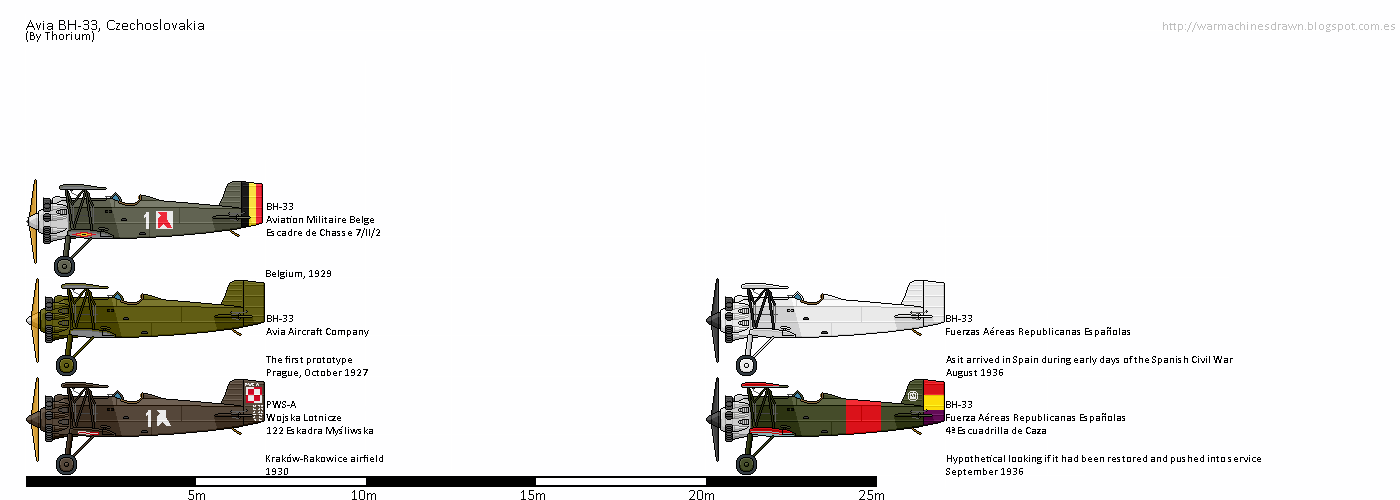
Trials were satisfactory and a new design was born, with the given name of Avia BH-33. It was the last fighter designed by Miroslav Hajn and Pavel Benes for Avia and was also the first Avia fighter to feature a fixed tail fin from the outset. Trials on the new design started in 1927 and were satisfactory enough for the Czechoslovak Army Air Corps, but not brilliant enough that they only ordered 5 airplanes. It was powered by a Walter-built Bristol Jupiter VI engine delivering 543hp at take-off and was armed with two Vickers 0.303in machine guns.
In Belgium, one Avia BH-33 powered by a Bristol Jupiter VII engine was one of the contenders for the Aéronautique Militaire fleet standaristation programme which was eventually won by the Fairey Firefly.
Regarding to Spain, apparently a single BH-33 painted entirely in white flew to Spain in the early days of the Spanish Civil War loosing it's machine-guns and synchronisation gear en route. It's unknown what happened to it, but we couldn't resist the impulse of thinking how it would've looked like if it had been repaired, repainted and push into service.
Poland adquired a manufacturing license in 1928 with PZL building 10 pre-production airplanes of this type and PWS building 50 of them as the PWS-A from 1930 onwards.
Sources:
1. https://en.wikipedia.org/wiki/Avia_BH-33
2. Salamander Books - The Complete Book of Fighters
3. http://bioold.science.ku.dk/drnash/model/spain/did.html
4. http://www.belgian-wings.be/Webpages/Navigator/Photos/MilltaryPics/interbellum/avia_bh33.htm
Trials were satisfactory and a new design was born, with the given name of Avia BH-33. It was the last fighter designed by Miroslav Hajn and Pavel Benes for Avia and was also the first Avia fighter to feature a fixed tail fin from the outset. Trials on the new design started in 1927 and were satisfactory enough for the Czechoslovak Army Air Corps, but not brilliant enough that they only ordered 5 airplanes. It was powered by a Walter-built Bristol Jupiter VI engine delivering 543hp at take-off and was armed with two Vickers 0.303in machine guns.
In Belgium, one Avia BH-33 powered by a Bristol Jupiter VII engine was one of the contenders for the Aéronautique Militaire fleet standaristation programme which was eventually won by the Fairey Firefly.
Regarding to Spain, apparently a single BH-33 painted entirely in white flew to Spain in the early days of the Spanish Civil War loosing it's machine-guns and synchronisation gear en route. It's unknown what happened to it, but we couldn't resist the impulse of thinking how it would've looked like if it had been repaired, repainted and push into service.
Poland adquired a manufacturing license in 1928 with PZL building 10 pre-production airplanes of this type and PWS building 50 of them as the PWS-A from 1930 onwards.
Sources:
1. https://en.wikipedia.org/wiki/Avia_BH-33
2. Salamander Books - The Complete Book of Fighters
3. http://bioold.science.ku.dk/drnash/model/spain/did.html
4. http://www.belgian-wings.be/Webpages/Navigator/Photos/MilltaryPics/interbellum/avia_bh33.htm
Subscribe to:
Posts (Atom)


