Showing posts with label Belgium 1946-1949. Show all posts

Monday, 4 November 2024

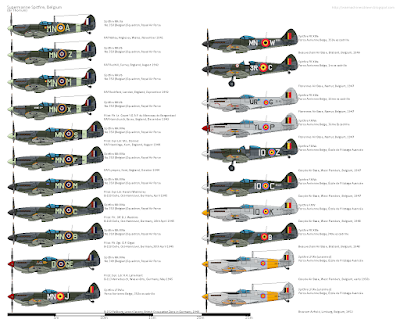
Supermarine Spitfire. European Users, part one. Belgium.

Sources:


The Supermarine Spitfire was also employed by Nos. 349 and 350 squadrons, composed by Belgians during World War 2.
  • No. 349 Squadron: This unit switched their Curtiss Tomahawk for Spitfires Mk.V-s in June 1943 and was rebased to southern England to take part in bomber escort duties and fighter sweeps over mainland Europe. The squadron took part in Operation Overlord and kept the same role, escorting bombers and providing some ground support. In August 1944 the unit was rebased to France performing armed reconnaissance missions. 
    In February 1945 they returned to England to be re-equipped with the Hawker Tempest, however, the pilots did not appreciate the aircraft and opted for the Spitfire Mk.IX instead. They were rebased to the Netherlands and finally to Belgium, where it was transferred to the Belgian Air Force on 24th October 1946. 
    Once in Belgian command (renamed as '349e Escadrille') it was equipped with the Spitfire Mk.XIV. 
  • No.350 Squadron: This formation acquired the Spitfire Mk.II in November 1941 and shortly later, in February 1942 they transitioned to the Mk.V and were assigned to convoy protection duties over the Irish Sea. In April 1942 they were relocated to south-east England where they carried out many offensive sweeps over occupied France. They took part in Operation Overlord and, in August 1944 they engaged many V-1 flying bombs attacking England. The squadron was rebased to Belgium in December 1944, where it remained until the end of the war. 
    On 15th October 1946 it was transferred to the Belgian Air Force, was renamed to 350e Escadrille, and kept their Spitfire Mk.XIV until July 1949 when they were replaced by the Gloster Meteor. 
Aside from those two squadrons, the École de Pilotage Avancée (Advanced Flying School) also employed the Spitfire Mk.IX. Those were supplied from RAF surplus stockpiles in August 1947 when 28 machines were ordered, followed by 18 second-hand more, as attrition was taking a toll on the Mk.IX-s. 
In 1952 a demonstration team was created for a short period of time but an unfortunate accident led to the disbandment of that unit. They were gradually written off and acquired by Cogea Nouvelle of Oostende which used them as target tugs. Most of them survived and were used for filming, some of them appearing in the 1969 movie Battle of Britain.


Sources:
1st https://en.wikipedia.org/wiki/349th_Squadron_(Belgium)
2nd https://en.wikipedia.org/wiki/350th_Squadron_(Belgium)
3rd https://www.belgian-wings.be/supermarine-spitfire-lf-ixc-e

Thursday, 3 November 2022

Miles M.25 Martinet. Part One, Foreign Users

 
The Miles M.25 Martinet was a target tug aircraft that served with many users, among them, the following ones:
  • Belgium: A total of 9 Martinet were ordered by the Belgian Air Force to be used at the Fighter School of Koksijde, West Flanders. All of them were delivered in 1947. However, two machines were in bad shape that they were refused by the Belgians and were replaced by two other Martinets. Initially they served with a ghost unit (IE a de-facto unit) that didn't exist on paper and gathered all available aircraft for the fighter school. They were in active until being replaced by the De Havilland Mosquito TT.Mk.35, the target tug variant, in the early 1950s.
  • France: The French Armée de l'Air (French Air Force) employed a total of 41 Martinet TT.1 at many of their Aerial Schools. These were delivered between 1945 and 1948 and, according to some sources, were kept in active until 1958. 
  • Greece: Actually, Greece didn't have Martinets, however, some efforts were made to sell some surplus Martinets as artillery spotters, general observations or even close support to the Royal Hellenic Air Force. Eventually they were not sold, however, we drew an hypothetical-looking version of the Martinet serving with the Greeks.
  • Ireland: Two Martinet TT.Mk.1 were delivered in 1946 to the Irish Air Corps. They were probably replaced later, during the 1950s by other type of aircraft.
  • Portugal: In September 1943 ten Martinets were supplied to the Portuguese Arma da Aeronáutica Militar (Military Aeronautics Arm-AAM). Six were employed by the AAM and four by the Forças Aéreas da Armada (Navy Air Forces).
    When the Força Aérea Portuguesa (FAP) was established in 1952 the Martinets were still in active service, and were transferred to the FAP, however soon after, they were replaced. 
  • Sweden: A Swedish regional airline called Svensk Flygtjänst AB bought 9 Martinets and employed 8 of them as tugs between the years 1946 and 1951.
  • Turkey: In March 1945 seven Martinets were supplied to the Turkish Military Aviation. They were supplemented by 12 additional ones in the following months. They were used as target tugs in various regiments until they were eventually replaced by the North American Texan in 1948.


Sources:
1. https://en.wikipedia.org/wiki/Miles_Martinet
2. https://www.belgian-wings.be/miles-m-25-martinet-tt-1
3. https://www.key.aero/forum/historic-aviation/91078-portuguese-miles-martinets
4. http://www.tayyareci.com/digerucaklar/turkiye/1923ve50/miles-master.asp
5. Scale Aircraft Modelling - vol.19 nº08 (1997.10) - Miles Military Trainers
6. Putnam - Miles Aircraft

Tuesday, 25 October 2022

Miles M.9 Master. Part two. More Foreign Users


The Miles M.9 Master was a British two-seat monoplane advanced trainer which was designed and built by Miles Aviation Company. It was used mainly by the Royal Air Force (RAF) and the Fleet Air Arm (FAA) but some other users also employed the type, among them, the following ones:

  • Belgium: One Master II ,which previously belonged to the RAF (Belgian) training school at Snailwell (Cambridgeshire), was used as a ground instructional airframe at the Technical School of Saffraanberg in February 1946. Most likely this machine was destroyed in a fire that took place at the school two years later on 8th August 1948. The remains were scrapped as it didn't reappear in inventory when the school reopened at Tongeren.
  • France: A small number of Master II were used by the French Armée de l'Air in Morocco from 1946 to 1948 serving in various piloting schools set up there. Odd enough, they bore RAF style markings and roundels but in French tones of red white and blue. 
    Some Master III (a version powered by the 825hp Pratt & Whitney engine) were also used by the École de Pilotage (Flying School) at the city of Cognac during 1947 and 1948. They were used as interim machines until the North American T-6 Texan were supplied in numbers. 
  • Ireland: A total of twelve former RAF Master II were purchased by the Irish Air Corps. Six in 1943 and other six in 1945. They were employed as trainers until 1949, when it was decided to replace them by the Percival P.56 Provost in the 1950s.
  • Portugal: As part of a treaty to use Azores Islands as bases, two Master III were delivered to Lisbon on 10th October 1941. These were followed by eight additional ones delivered during the month of April 1942. 
    The Masters were assigned to the Base Aérea Nº1 (No.1 Air Base) at Sintra, Lisbon, to train their pilots from fixed landing gear aircraft to retractable ones. In September 1942 two Masters were sent to Lajes Air Base, in the Azores, to train their pilots, as the old Gloster Gladiators based there were to be replaced by the Supermarine Spitfire. 
    In September 1943 four additional Master II were delivered by the United Kingdom and were assigned to Sintra Air Base. The Miles Masters in Portugal were kept in active service until 1950 (though some sources claim their use was stretched until 1958).


Sources:
1. https://en.wikipedia.org/wiki/Miles_Master
2. https://www.belgian-wings.be/miles-master-ii
3. https://www.traditions-air.fr/unit/ecole_centre/31500.htm (translated)
4. http://avions-de-la-guerre-d-algerie.over-blog.com/article-les-miles-master-et-martinet-116685844.html (translated)
5. http://www.aeroflight.co.uk/user/every/ireland-af-all-time-aircraft-used-listing.htm
6.https://altimagem.blogspot.com/2013/02/59-miles-master.html (translated)

Thursday, 18 August 2022

Miles M.14 Magister, part three. Some European users.

 
The Miles M.14 Magister was a British two-seat elementary trainer aircraft of the 1930s which was used mainly by the Royal Air Force (RAF) but also by many other users such as the following ones:
  • Belgium: After the war, three Magisters were transferred to Belgium on 3rd October 1946. They were employed as instructional aeroframes at the technical school in Safraanberg, Flanders. During the following year, the aircraft was made airworthy and was delivered to No. 367 Squadron of the No.169 Wing, based at Evere airport in Brussels. It was employed as a courier until 1953 when it was written off and sold to a private owner. Later, during the 1970s bought by the Belgian Royal Army Museum and is nowadays in display there.
  • Estonia: The Estonian Ohukaitse (Air Defence) bought a single Miles Magisters in 1938. They were assigned to the 3rd Aviation Division based in Tallinn. It served alongside with another Estonian-built and designed PTO-4 as the basic trainer for the Estonian Air Defence and during 1939 it took part, together with another two PTO-4s in an official state visit to Latvia. In 1940, when the USSR invaded the Baltic countries, they were captured by the VVS (Soviet Air Force).
  • Germany: The Sonderstaffel Buschmann (a Luftwaffe unit composed of Estonian volunteers) operated a single ex-Latvian Miles Magister registered as SB+AF. 
    It was also employed by an Ausbildungswessel, an unit established by the Luftwaffe in Latvia which operated ex-Latvian Air Force aircraft. During their service with the Luftwaffe they were only used as reconnaissance planes. 
  • Ireland: In 1939 (though, according to some other sources it was in 1938) the Irish Air Corps bought 27 Magisters which constituted their basic trainer throughout the whole war and the postwar, as they were retired in 1952.


Sources:
1. https://en.wikipedia.org/wiki/Miles_Magister
2. https://www.belgian-wings.be/miles-magister
3. https://www.britmodeller.com/forums/index.php?/topic/235039699-miles-m14a-magister-estonian-air-force-1938-1940-rs-model-172/
4. https://et.wikipedia.org/wiki/Sonderstaffel_Buschmann (translated)
5. https://www.feldgrau.net/forum/viewtopic.php?t=1392

6. Scale Aircraft Modelling - October 1997 - Miles Military Trainers
7. Putnam & Co. - Miles aircraft since 1925 

Tuesday, 2 June 2020

Airspeed AS.10 Oxford, part three, Belgian & Czechoslovak users

The Airspeed AS.10 Oxford was a British twin-engined multi-purpose aircraft that was designed and developed by Airspeed Ltd.. It was conceived as a trainer variant of Airspeed's previous design, the Airspeed Envoy, but it quickly grew as an aircraft of its own. It was exported to many countries, among them, Belgium and Czechoslovakia:

  • Belgium: In July 1939 a single Oxford owned by Airspeed Ltd. was flown to Evere Airport, in Brussels. It was piloted by Georges B.S. Errington and the aircraft was to be displayed at the IIe Salon Aéronautique de Bruxelles (Brussels' Aeronautical Show). Shortly later, in August, the Belgian Aéronautique Militaire (Belgian Army's Aeronautical branch) announced the purchase of that particular machine. It was intended to be used for advanced training and communications role. In fact, back in March 1939 the Oxford had been selected as the winner competing against the French Potez 561, the Germans Focke-Wulf Fw.58 Weihe and Siebel Si.204 Halle and the Italian Caproni Ca.310.
    After successful further trials, apparently the Belgian Oxford was registered as D-1. However, some sources claim it wasn't registered at all. Anyway, an order for further 5 machine was placed. Those additional Oxfords were to be assembled by both Renard and SABCA. However, that process was halted when Germany invaded Belgium in May 1940 and the Germans captured the aircraft (its fate is unknown). This single Oxford was used by the Ecole d'Aeronautique (Aeronautical School) based at Evere Airport, in Brussels and then it was transferred to No.3 Squadron of the Ecole de Pilotage (Pilots School) in Deurne, in Antwerp.
    After the war, for the newly founded Belgian Air Force, 30 Oxfords were ordered on 16th January 1947. Most of the Oxfords served with the Ecole Pilotage Avancé (Advanced Piloting School) and the 15th Transport Wing. Many of them were also used as base hacks in different wings through the Royal Belgian Air Force. In July 1955, the Belgian Air Force decided that every Oxford should be flown to their next main overhaul after which they were scrapped at Evere because their wooden structure didn't allow them to extend their useful live. Nowadays a single Oxford is preserved at the Royal Army Museum in Brussels.
  • Czechoslovakia: A single Oxford T.1 (the trainer variant) which belonged to No.311 (Czechoslovak) Squadron of the Royal Air Force (RAF) flew, in September 1945 from RAF Manston, in Kent, to Prague with a crew of three. The machine was pushed into service with the back then, newly founded Czechoslovak Air Force. The Oxford then received various different codes and served with various units until 1950 when, due to a lack of spare parts the machine was abandoned and scrapped.


Sources:
1. http://www.belgian-wings.be/Webpages/Navigator/Photos/MilltaryPics/post_ww2/Airspeed%20Oxford/airspeed_oxford%20frontpage.htm
2. http://www.belgian-wings.be/Webpages/Navigator/Photos/MilltaryPics/interbellum/Airspeed%20Oxford%20I/Airspeed%20Oxford%20I%20Frontpage.html
3. https://en.wikipedia.org/wiki/Airspeed_Oxford#Other_users
4. https://www.super-hobby.com/products/Airspeed-Oxford-Mk.I-II-Foreign-Service.html

Thursday, 16 April 2020

Avro Anson, part six, some European Users

The Avro Anson is a British twin-engined multi-role aircraft that was used by many countries all around the globe. The following European countries had the Ansons serving with them:

  • Belgium: In 1947 the British Government authorised deliveries of a number of Ansons Mk.I for the new Belgian Air Force. They were delivered to Evere airfield, in Brussels though few of them survived for long time. One was flying by No.7 Wing as a squadron hack flying crews to Schiphol, Amsterdam to work in Fokker's factory to pick up the newly built Gloster Meteor F.8 which were being manufactured under license there in 1950.
    The No.21 Smaldeel (Squadron) was equipped with Ansons which were separated into various different flights when the unit received the Douglas DC-4 for long range transportation.
    The Air Force's Main Transport Flight had also Douglas C-47s as its personnel was part of the No.525 Squadron during the War. This squadron was known as the 'Verbindingsflight' and took two Ansons into service when they departed RAF Hendon in August 1946. The flight was later upgraded to squadron-strength and named 'No.367 Squadron' and was later renamed as '21 Smaldeel' and was used for communications duties.
    One C.19 one was also used by SABENA (Belgian National Airline) to cover some internal aerial routes before it was sold to Air Congo and sent to the Belgian Congo. Two more served with Air Congo (making a total of three) and one of them served with John Mahieu Aviation in Brussels.
  • Czechoslovakia: Three Ansons were given in total to Czechoslovakia after the War. Two Mk.XII and a single Mk.I but one of them crashed into the sea off the Danish coast. The remaining two were assigned to the Air Traffic Regiment of the newly formed Czechoslovak Air Force in 1946 and 1947. Their fate is unknown.
  • Estonia: One Anson Mk.I was delivered to the Estonian Air Force in 1936 (although some sources claim it was in 1937). It received the serial 158 and when the country was occupied by the USSR, it was passed on to the Soviet Air Force.
  • Finland: Before the War, the Ilmavoimat (Finnish Air Force) ordered three Ansons Mk.I. Finnish pilots were trained at Woodford in Stockport, Greater Manchester and the first Anson arrived in Utti, Finland, on 27th September 1936. The three Ansons were initially used for twin-engined aircraft training, while the Bristol Blenheim bombers arrived. When the Winter War started on 30th November 1939, they were used for aerial reconnaissance works. During one of those missions, one of them was lost to a crash in February 1940, another one crashed in 1943, when it was written off. The last one survived until 1947 when it made its last flight.


Sources:
1. Hall Park Books - Warpaint 53 - Avro Anson
2. https://en.wikipedia.org/wiki/Avro_Anson
3. http://britishaviation-ptp.com/avro652_3.html
4. https://www.armedconflicts.com/Avro-Anson-C-Mk-12-t50511
5. http://www.svazletcu.cz/eng/csl2_2.html#