Thursday, 30 June 2016

Atlas Carver

The Atlas Carver (commonly known as CAVA) was a projected multi-role fighter designed by the South African Atlas in order to replace the aging fleet of Blackburn Buccaneer, English Electric Canberra and Dassault Mirage III that were still in service with the South African Air Force during the 1980s.
Initially the Cheetah was just an interim solution until this airplane, the Carver would have entered service, which was expected at the late 1990s. It was necessated by the UN arms embargo against South Africa due to the apartheid.

It was officialy cancelled in 1991 when the president F.W. de Klerk announced it's cancellation together with the South African nuclear programme. Approximately 10 billion rands were spent on the project as well as a mock-up system placement. It's said that wind tunnel tests and a host related work was completed and everything points that the construction of a prototype had started or was about to start.

Even if there aren't official concepts or conceptual work available for the public, there are some very plausible models and blueprints made by enthusiasts all over the internet and we decided to catch one of them. It would've resembled to the Mirage 2000, Mirage 4000 and Rafale.

It was designed to be a fly-by-wire unstable composed by a large percentage of composites.


Source:
1. https://en.wikipedia.org/wiki/Atlas_Carver

Wednesday, 29 June 2016

Atlas Cheetah - South African Users, Part Two

Today we center ourselves on the operational history and variants of the Atlas Cheetah.

As we said earlier, the Cheetah was, basically, a vast development of the Dassault Mirage III, and the first of those airplanes to be converted was the Mirage IIIDZ no.845 which was bought by Atlas Aircraft Company in April 1983 and the modifications were finished on 16th July 1986, by the time that various Cheetah Ds were in active service with the South African 89. Combat Flying School based at AFB Pietersburg but it wasn't only until 1987 that the type was declared operational.
Later, the company bought some Mirage IIIEZ in order to convert them into Cheetah Es and entered service with the South African Air Force at AFB Louis Trichardt serving with the 5.Squadron. More precisely, 16 of each type were in service by 1991 when the production lines for the Cheetah E and D closed, by which time the Cheetah C were being converted and the first of them rolled out of the production lines on January 1993.
Every Cheetah C entered service with the 2. Squadron SAAF, which was also based at AFB Louis Trichardt.
None of the Cheetahs saw combat action in the Border war, so their performance was never tested against the MiG-23 and the Cheetah Es were used as interceptors with a minimum of two of them staying in permanent alert status until the Border War ended in 1989.
When the more modern Cheetah C entered into service, the Cheetah Es were withdrawn from the active service and the 5. Squadron SAAF was disbanded in 1992. Soon after, the 89. Combat Flying School was also disbanded and the Cheetah Ds were transferred to 2. Squadron SAAF, where they remained in active service until 2008.
However, two Cheetah Ds are still operated by Denel Aviation at the Overberg Test Flight and development center.

The variants of the Cheetah are:

  • Cheetah D: The sole two-seater variant which was used mainly for training duties. It had also secondary attack capabilities as it could deliver some PGM. Some of them received an upgraded version of the Atar 9K50C-11 engine plus some upgrades in avionics systems.
  • Cheetah E: A variant developed as an interim fighter until the Cheetah C were available, as it was thought as an interceptor, it was armed mostly with air-to-air weaponry, mainly V3B and V3C missiles.
  • Cheetah C: The final development of the Cheetah, was the only fighter type serving with the South African Air Force until being replaced by the SAAB JAS39 Gripen in 2008. It was equipped with an improved pulse-doppler multi-mode radar (ELTA) and had also improved helmet and HUD systems. It featured also an anti-radiation shield wraped around the windshield a revised in-flight probe, an upgraded version of the Atar 9K50 engine and a new nose to fit the new radar. As the previous versions it could deliver precision-guided munitions, GPS-guided bombs and TV guided bombs plus various air-to-ground weapons and air-to-air missiles.


Sources:
1. https://en.wikipedia.org/wiki/Atlas_Cheetah
2. Salamander Books - The Complete Book of Fighters

Tuesday, 28 June 2016

Atlas Cheetah - South African Users, part one

As South Africa needed a modern fighter that could also act as a strike fighter in the 1980s, specially when their enemies in the border war, like Angola or Cuba counted with the newer Mig-23, and considering that South Africa was under an arms embargo by the United Nations due to the apartheid, made the upgrade of the already available material the only real choice for the South African Air Force.

As, they had a respectable amount of Dassault Mirage III and Mirage F.1, the Atlas Aviation company, using expertise gained from the aborted Israeli IAI Lavi fighter upgraded the main airframe of a Mirage III down to zero hours, fitted non-moving canards aft of the engine intakes, added two new wings store pylons at the wing roots, an aerial refuelling probe, new ejection seats, a new and more powerful engine (an upgraded SNECMA Atar 9k50C-11), a new main wing spar together with a new drooping leading edge and a dog-tooth incisition on each wing, modernized elevons controlled by a twin computer flight control system and strakes on the nose in order to improve the high angle of attack performance.
Just the aerodynamical improvements increased the performance of the aircraft by a respectable 15%, increased the angle of attack, reduced the minimum airspeed to 100kt and increased the maximum take-off weight by 700kg with the cost of a lost of a 5% in maximum level of speed and acceleration.

Additionaly a highly sophisticated avionics, radar, electronic warfare and self-protection suit was installed making the increase of the nose lengthness necessary. Missile and radar warning sensors were also installed as they were needed like electronic jammers, automatic chaff/flare dispensers, an integrated helmet mounted sight and oversized heads-up-display (HUD) an advanced pulse-doppler radar and sophisticated cockpit instrumentation.
It's suspected that Israel Aircraft Industries was involved at least initially and even some components were imported from Israel and even that some IAI Neshers were bought by South Africa for Cheetah trials and then absorbed into the existing fleet.

We are covering those conmemorative or special painted aircrafts, that were non combatant, leaving the combatant ones for the next post.


Sources:
1. https://en.wikipedia.org/wiki/Atlas_Cheetah
2. Salamander Books - The Complete Book of FIghters

Monday, 27 June 2016

Atlas Cheetah - Foreign Users

Yes, that's the South African roundel of the 1980s.

The Atlas Cheetah is a South African fighter that was developed as a major upgrade for the Dassault Mirage III made by Atlas Aircraft Corporation (actually called Denel Aviation) and based on the Israeli IAI Kfir. Three different variants were created, a training one, called Cheetah D, single-seat one, Cheetah C and E, and a reconnaissance, unbuilt one, R.

As we are centering on it's foreign users, we directly move on to the operational history while serving both with Chile and Ecuador.

In 2003, Chile bought five mothballing Cheetah Es to scrap them to use them as a spare parts source for the similar ENAER Pantera, that was also an upgraded variant of the Dassault Mirage 5. Chile wrote off their last Pantera, shuting down their Grupo 4, in 2007 after their last Mirage Elkan was retired in 2006. As theywere bought for scrap, we haven't drawn them, since most probably they weren't repainted in Chilean colours.

On 23rd September 2009 the Ecuadorian Defence Ministry bought 10 ex-SAAF Cheetahs C and two Cheetahs D to replace their fleet of Dassault Mirage F.1 equipping the Escuadrón de Combat 2112 (Combat Squadron 2112) which is one of the two supersonic combat squadrons that Ecuador has. After some delays, the first airplanes arrived in Ecuador on April 2011.


Sources:
1. https://en.wikipedia.org/wiki/Atlas_Cheetah
2. Salamander Books - The Complete Book of Fighters.

Sunday, 26 June 2016

Asja Jaktfalk - Swedish Users

The Asja Jaktfalk was a Swedish single-seat biplane fighter aircraft built in the late 1920s.

It started as a private venture by the defunct Svenska Aero company when the company board contacted the Swedish Air Board asking them for guidelines and wishes for a fighter aircraft. As they didn't receive any answer, Svenska Aero contacted with foreign designers in order to get some guidance.

Designed by Carl Clemens Bückler, it was a conventional biplane powered by the Armstrong-Siddeley Jaguar 14-cylinder radial engine and featured a fixed landing gear plus a skid under the tail section. Fuselage was made of welded beams covered with fabric while fore and aft parts were covered in aluminium sheet and it had a fuel tank between the engine and cockpit.

The test pilot, Nils Söderberg, after having tested it, stated that it was the best airplane he had ever flown and, after that test, it was presented the first prototype to the press on 11th November 1929. The prototype was bought by the Swedish Air Force on 9th January 1930 and was given the designation J5 and on February 1930 the Air Board decided that it had to be powered by a Bristol Jupiter engine, forcing that way to redesign it, specially the front part and some fuselage parts. The reformed version received the name of J6 or Jaktfalken I. It was followed by a new order of 5 new aircrafts this time powered by Bristol Jupiter VII engines in 1930 but when tested, the vibrations produced by the engine were too much and, despite that the they tried to solve the problem, no solution was found. After that, Bückler redesigned the landing gear and redesigned it to be powered by the Bristol Jupiter VIIF, or Jaktfalk II which were delivered to the Swedish Air Force in 1932.
Further minor modifications in the windshield and stabilizer were carried out in 1933 when Svenska Aero was merged into Asja and delivered seven additional airplanes, calleb J6B, to the Swedish Air Force.

Initially all fighters were assigned to the F1 Squadron at Västeras air base, and later they were transferred to the F8 Squadron based at Barkarby air base in October 1938 to be used as trainers. During the Winter War, three aircrafts were given to Finland as part of the aid-programme and the rest were scrapped in 1941.


Sources:
1. https://en.wikipedia.org/wiki/Svenska_Aero_Jaktfalken
2. Salamander Books - The Complete Book of Fighters.

Saturday, 25 June 2016

Asja Jaktfalk II - Foreign Users

Yes, that's the roundel used by the Swedish Air Force during the late 20s and mid 30s.

As we are covering it's foreign users, we are leaving technical descriptions for later.

The Asja Jaktfalk was a Swedish single-seat biplane fighter built in the late 20s, but it's most developed version, the Jaktfalk II, saw the light in 1932.

The Asja Jaktfalk was firstly tested by military representatives of both Argentina and the Empire of Japan, but they placed no orders as they weren't satisfied by it's performance, however we decided to draw some paintjobs to see how they would've looked like if they had bought them.
They also served in the Finnish Air Force who received three of them on 8th December 1939 as part of the Swedish help on the Finnish winter war. As they were seriously outdated, they were used for training purposes at the airfield of Kauhava until as late as 1945 when they were all scrapped.
Apparently, it also served with the Latvian navy, however as we only could find a text reference on wikipedia to this, the Lavtian profile of this airplane should be considered speculative.
Finally a modified version, powered by an Armstrong Siddeley Panther IIIA engine was built for Norway in order to test it against the British Hawker Fury.


Sources:
1. https://en.wikipedia.org/wiki/Svenska_Aero_Jaktfalken
2. Salamander Books - The Complete Book of Fighters

Friday, 24 June 2016

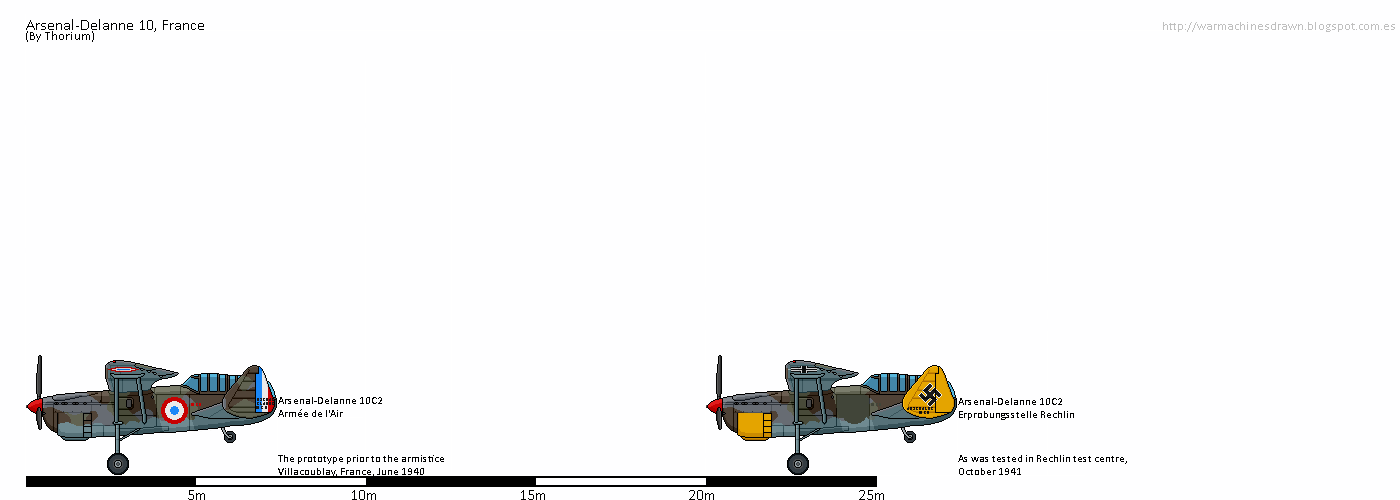
Arsenal-Delanne 10

Arsenal-Delanne 10 was an experimental French aircraft. It had a distinctive tandem wing and rear cockpit.

It was a two-seat fighter designed by Maurice Delanne and built by Arsenal de l'Aeronautique and was of the so-called Nenadovich configuration or tandem winged which provided a continuous slot effect and offered an exceptional center of gravity range. It was made entirely out of metal stressed-skin construction employing a sandwich technique with a smooth dural skin welded to a corrugated sheet.
Both pilot and gunner sat in tandem under a single canopy at the rear of the fuselage which was leveled with the rear wing which carried twin tailplanes. Such arrangement gave the gunner a clear field of fire for his, never installed, armament of two 7,5mm machine guns suplemented by a 20mm cannon firing through the propeller hub and two more machine-guns placed in the wings. The tailwheel undercarriage was retractable and the airplane was powered by a single 860hp Hispano-Suiza 12Ycrs 12-Cylinder liquid-cooled engine.

The first prototype was virtually completed at Villacoublay when the Germans occupied the factory in June 1940. However, the work on the aircraft continued after the ocupation in a desultory fashion and it flew for the first time on October 1941 and, after completion of the innitial test programme it was ferried to Germany for further trials.


Sources:
1. https://en.wikipedia.org/wiki/Arsenal-Delanne_10
2. Salamander Books - The Complete Book of Fighters

Thursday, 23 June 2016

Unbuilt Arsenal VG-90 projects

As most of these are left undrawn, as there aren't blueprints or profile drawings we are gathering them all in one post. The only one that apparently was drawn in a blueprint was the VG-93.

The Arsenal VG-91 was an intended single-seat fighter for the French Air Force and, apparently it was going to be powered by the French Atar C.101 engine and was expected that it would've achieved the speed of 953km/h. It was going to be also a little bit longer.
Arsenal VG-92 was just a regular VG-90 refitted with the newer Rolls-Royce Nene II engine. It was intended for Aeronaval service.
Arsenal VG-93 was a VG-90 powered also by the Rolls-Royce Nene II engine, and it would've featured ramjets placed on the wingtips. It was estimated that it would've achieved speeds of 1095Km/h.
Arsenal VG-94 was also a derivative of the VG-90, intended for the Navy and powered by a Rolls Royce Nene 104 delivering 3100Kgp of thrust and intended to achieve speeds of 1100km/h.


Sources:
1. http://www.secretprojects.co.uk/forum/index.php?topic=1242.10;imode

Wednesday, 22 June 2016

Arsenal VG-90

The Arsenal VG-90 is a French carrier fighter built after the World War II that never went beyond the prototype stage.

In 1946 the French air ministry launched a jet-powered carrier-based fighter programme for the French Aéronautique Navale (the French Navy's air arm). Three aircrafts, all of them powered by the Rolls-Royce Nene, built under license by the Hispano-Suiza were presented in the Centre d'essais en vol (flight test centre) at Bretigny, among them the Aérocentre N.C.1080 the Nord 2200 and, of course the Arsenal VG-90.

Designed by the engineer Jean Galtier taking the Arsenal VG-70 as a basis, it was a high-winged monoplane with swept wings and stabilizers. The fuselage was made entirely out of metal and was of monocoque structure. Wings had a metal structure with a plywood covering. The air intakes were placed at both sides of the fuselage, tricycle configuration was chosen for the landing gear with the main wheels retracting into the wings. Planned armament changed during the development stage as initially it was going to be armed with 3 Hispano-Suiza 30mm cannons and up to 500kg of bombs under wings and later it was modified to two 20mm Hispano-Suiza cannons, seven 7,7mm machine-guns mounted in the wings, a retractable ventral pannel containing 36 rockets and external fuel tanks mounted under wings.

Three prototypes were built, flying the first one on 27th September 1949 and the flight tests at CEV Brétigny started on 10th April 1950 but on 25th May 1950 the first prototype crashed killing the test pilot, Pierre Decroo. The investigation concluded that one of the landing gear doors tore apart hitting the tail and rendering the prototype uncontrollable. It was replaced in June 1950 by a second prototype made completely out of metal but on 21st February 1952 the tail of the aircraft was torn off due to aerodynamic flutter. The test pilot, Claude Dellys couldn't make his ejector seat to work in time, killing him. Flight tests were interrumpted and the third prototype, which was being retrofitted with a 4000kgp thrust Snecma Atar 101F engine wasn't completed.

This programme in general was very disastrous as the other competitors had a lot of technical problems, the Aérocentre N.C.1080 which flew for the first time on 29th July 1949 was destroyed during a flight on 7th April 1950 killing the pilot Pierre Gallay and the last contender, the Nord 2200 was considered too heavy to operate from a carrier and was discarded. In the end, it was decided to buy a license to build the De Havilland Sea Venom, which was known as the Sud-Est Aquilon.


Sources:
1. https://fr.wikipedia.org/wiki/Arsenal_VG_90 (translated)
2. https://en.wikipedia.org/wiki/Arsenal_VG_90
3. Salamander Books - The Complete Book of fighters

Tuesday, 21 June 2016

Arsenal VG-70 & VG-80

The Arsenal VG-70 was a French experimental airplane developed just after the World War II.

Back in 1939 the engineer Jean Galtier had started to work on the design of a wooden fighter powered by a supercharged Hispano-Suiza 12Y-51 capable of delivering, theoretically, 1000hp of power. That project was called VG-60. That project was relaunched in 1942 around another supercharged Hispano-Suiza 12Z capable of achieving 1200hp of power, but with the liberation, the objectives of the French aeronautical sector, changed radically as the industrial priority was to adquire experience with the newly built jet engines and/or fighters. So, since September 1944 Arsenal de l'Aeronautique made some studies on how to adapt the German Jumo 004 engine on the fuselage of an Arsenal VG-60, which was never fully built.

During the summer of 1943 the engineers at the design bureau of Messerschmitt carried out some wind-tunnel tests at Chalais-Meudon in order to develop the P.1092 programme. That program never materialized, but Jean Galtier had knowledge of the results and decided to use them, so during the autumn of 1945 it was decided to build a swept-wing research prototype resulting in a 38º swept-winged monoplane resting on a retractable tricycle landing gear with a ventral air intake placed just under the cockpit. It was of mixed construction, since the fuselage was made out of metal but the wings and the vertical stabilizers were made out of wood.

It flew for the first time on 23rd June 1948 at Melun-Villaroche piloted by Modeste Vonner. It had the honour of being the second French jet airplane to fly after the SNCASO SO.6000 Triton and it achieved the speed of 760Km/h. It was expected to replace the Junkers Jumo 004 with a Rolls-Royce Derwent and it would've been called Arsenal VG-80, but the programme was abandoned in favour of the Arsenal VG-90.

Finally, as we like to run our imagination wild, we thought that it would've been interesting if the Frenchs, would've armed the aircraft to use it as a rocket fighter.


Sources:
1. https://fr.wikipedia.org/wiki/Arsenal_VG_70 (translated)
2. https://en.wikipedia.org/wiki/Arsenal_VG_70

Monday, 20 June 2016

Arsenal VB-10 Fictional versions

The Arsenal VB-10 was too tempting to not draw hypothetical fictional versions of it, so we fixed that.

Firstly we thought it would've made a decent night fighter, so we took the original VG-20, designed in 1939 equipped it with an AI MK.IV radar (hence the antennas at the front), fitted a second crew member in order to operate it and voilá! There's the night fighter version.

Secondly we thought it would had have place for small bombs, since other comparable French heavy fighters of that era like the Potez 630 had place for bombs. Apparently the French bombs were painted in yellow.

Then, we made a leap forward in time and thought that it would've taken part in the French colonial wars like Algeria or Indochina and that's why we equipped a version with six American HVAR rockets, something very plausible, considering that French bought loads and loads of American ordnance in the postwar years.
Finally, we thought that maybe an anti-submarine version wouldn't have been out of place and we loaded a version with four American 3.5inch FFAR rocket that were used with limited success during World War II against Japanese submarines.


Sources:
1. Our collective imagination

Sunday, 19 June 2016

Arsenal VB-10

The Arsenal VB-10 was a French heavy fighter designed in 1938 by the engineer Air General Michel Vernisse and assisted by the engineer Badie (hence the initials of the prototype VB). The prototype couldn't be completed before the armistice of 1940.

In 1938 l'Arsenal de l'Aeronautique received an order for a heavy fighter to serve both in the Air Force and the Aéronavale (the French Navy's air arm). So, taking advantage of the 2000hp engines they had available for a civilian trasatlantic airplane (which was the original VG-50 project) that was never materialized, Vernisse had already studied the possibilities of mounting the engines in a tandem configuration having contra-rotating propellers. This idea was accepted for the future heavy fighter which the first prototype, named VG-10, was going to be powered by two 590hp Hispano-Suiza 12X engines, but due to unknown circunstances, the work on that project was abandoned in favour of the VG-20 which looked the very same as the VG-10 but was going to be powered by two 900hp Hispano-Suiza 12Y engines instead. Something interesting to point out about these two projects is that initially they were going to be built out of wood.

Original blueprint for the VG-50
Initially the VB-10 project was presented as a single-seat low-wing monoplane with a conventional retractable landing gear and looking like a conventional single-seat fighter since both engines were in tandem configuration and not mounted in the wings like most of the two-engine airplanes from that era. That particular engine configuration led to the also particular contra-rotating propeller configuration, something never seen. The cockpit was placed between the two engines and the planned armament was pretty impressive, specially for those years as it was expected to be armed with four 20mm cannons and six 7,7mm machine-guns wing-mounted all of them. It promised to be a modern and ambicious fighter made entirelly out of metal, but, given the lack of alluminium in France during the 30s, it was decided to change part of the fuselage to make it out of wood.

The decission of building an airplane made out of non-strategical materials was a major set back for the project and, despite that 40 airplanes were ordered in May 1940, the VB-10 didn't make it to the skies before the armistice. However, during the occupation years, the German RLM (the German ministry of aviation) allowed, in April 1942, the Vichyist authorities to retake the project but the engineer Michel Vernisse was arrested by the Germans for not collaborating and, in addition to that, the original testbed engine was destroyed in an Allied raid at Lyon-Bron airport on 30th April 1944.
Work was retaken in July 1944, just some months before Lyon was liberated (in fact it was liberated on 2n September of that same year) and it wasn't until 7th July 1945 when the original VB-10 made it's maiden flight piloted by Modeste Vonner. It was powered by two Hispano-Suiza 12Y-31 delivering each of them 860hp of power. On December 22 1945, the prototype achieved the respectable speed of 490Km/h and thank to that, the French authorities ordered the production of 200 airplanes.

The second prototype was powered by two Hispano-Suiza 12Z-12/13 delivering each of them 1150hp of power and flown for the first time on 21st September 1946 and was followed by the first production airplane on 3rd November 1947 powered by two Hispano-Suiza 12Z Ars 15/16 engines. However, those engines, built after the war resulted very disappointing as they generated stalls and tend to overheat so the initial order was cut to 50 of them. On 10th January 1948 the second prototype caught fire whilst flying south of Paris. It's pilot, Pierre Decroo, managed to prevent the airplane to crash in an inhabited area before parachuting out, but he was severely burned. On 15th September 1948 the pilot Koechlin perished carbonized on board of the third airplane and that was the last of them to fly as that accident led to the cancellation of the whole project on september 21st and scrapping the existing airplanes (5 in total) and airframes.


Sources:
1. https://fr.wikipedia.org/wiki/Arsenal_VB-10 (translated)
2. https://en.wikipedia.org/wiki/Arsenal_VB_10
3. Salamander Books - The Complete Book of fighters
4. http://www.aerobuzz.fr/culture-aero/article/la-recherche-aeronautique-aux-18e (for the VG-50 civilian trasatlantic airplane)

Saturday, 18 June 2016

Arsenal VG-60

This is the last post about the Arsenal VG-30 saga.

After having learned their lessons about aerodynamic cleanliness, thanks to the various variants and sub-variants , materialized or not, of the Arsenal VG-33, they decided that it would be best to design a new fighter from scratch.

It was expected that it would greatly improve the performance of it's predecessors and, in order to do so, the design embodied an all-metal monoplane with a low-wing position with the back undercarriage retracting into the fuselage and the main one folding into the wings. A bubble type canopy was chosen in order to achieve greater aerodynamical performance and it would've been powered by an Hispano-Suiza 12Y-51 inline engine, capable of delivering 1200hp of power. It's interesting to point out that the engine was a French copy of the German Junkers 213E and that it was slightly longer than the original. In fact, it was expected that the first prototype would've flown powered by an original German engine since this project was retaken in 1945 after the war ended, the original sketches date from 1940.It was expected that, thanks to that engine, it would've reach speeds of 700km/h.
Unusually it was going to have a very powerful armament, for a French fighter designed in 1940, since it was expected to be armed with eight 12,7mm machine guns in the wings, four in each one, plus the usual 20mm cannon firing through the hub propeller.

This airplane was just a preliminary sketch back in June 1940 and was totally abandoned during the occupation but was retaken after the war. However it was clear that the future of the fighter airplanes relied in Jet technology and therefore further development and/or study on this airplane was abandoned.


Sources:
1. http://www.unicraft.biz/on/vg60/vg60.htm
2. http://www.aviarmor.net/aww2/projects/fra/arsenal_vg60.htm (translated)

Friday, 17 June 2016

Arsenal VG-37/38/39bis/40/50

Today it's the turn of the unbuilt projects of the VG-30 variants.
There were many.
The VG-37 was a projected extended-range version of the VG-36. We couldn't find further info about it's lookings so we assumed that it would've had extra fuel tanks mounted in the wings, it should be considered as purely hypothetical as it's not based in actual blueprints.
The VG-38 was a regular VG-36 powered by an Hispano-Suiza 12Y-77 which was left unbuilt.
The VG-39bis was a regular VG-39 with the P-51 type streamlined radiator and it was intended to be the production version of the VG-39. It would've been powered by the back then, newly manufactured, Hispano-Suiza 12Z-17.
The VG-40 was another variant projected this time powered by a British Merlin III engine and, the VG-50 would've been a variant powered by an American Allison V-1710-39 engine. The designation VG-50 was also used for another trasatlantic airplane airplane that was left unbuilt.


Sources:
1. https://en.wikipedia.org/wiki/Arsenal_VG-33
2. Le Fana de l'Aviation - Arsenal VG-33

Thursday, 16 June 2016

Arsenal VG-36/39

Another day, another post about the Arsenal VG 30 family.

The Arsenal VG-36 was a modified VG-35 powered by a Hispano-Suiza 12Y-51 delivering 1000hp of power, was armed with one Hispano-Suiza HS 404 20mm cannon and four 7,5mm MAC 1934M1939 machine-guns. It's interesting to point the shape of the streamlined radiator, which was very similar to the one that would later be used in the P-51B Mustang.
A prototype was built and was flown for the first time on 14th May 1940 and the fate of the prototype is unknown.

The Arsenal VG-39 was the final development of the VG-30 series to be flown. It started the flight test programme on 3 May 1940 and it differed from the regular VG-33 being powered by an Hispano-Suiza 12Z engine capable of delivering 1200hp of power with an ellongated propeller shaft, a revised wing structure which retained the profile and contours of the earlier wing and six wing-mounted 7,5mm MAC 1934M39 machine guns. When flight tested, the prototype achieved a maximum speed of 625Km/h (388mph) at an altittude of 5750m.


Sources:
1. https://en.wikipedia.org/wiki/Arsenal_VG-33
2. Salamander Books - The Complete Book of Fighters

Wednesday, 15 June 2016

Arsenal VG-34/35

This is just another post in order to cover another two sub-variants of the Arsenal VG-30 series.

While the VG-33 was still under production, Arsenal tested a new prototype fitted with the Hispano-Suiza 12Y-45 delivering 935hp of power, that was the VG-34. The VG-35 was a direct variant of the VG-33 fitted with a Hispano-Suiza 12Y-51, only one prototype was fitted and it was modified in order to build the next development in the series, the VG-36.
The VG-34 was armed with the usual four 7,5mm MAC 1934 machine guns mounted in the wings plus one 20mm Hispano-Suiza HS.404 gun mounted in the engine and firing through the propeller hub.
The VG-35 wasn't armed with a cannon, and had only the four machine guns in the wings, two per wing.

When tested, the VG-34 was flown in 20th January 1940 and it achieved speeds of 575Km/h at 6200m high and the fate of the prototype is unknown.
The VG-35, AKA VG-33-04 was flown for the first time on 25th February 1940. The protype was at the Orleans-Bricy air base when the Germans arrived and it's fate after then is unknwon.


Sources:
1. https://fr.wikipedia.org/wiki/Arsenal_VG_33 (translated)
2. Salamander Books - The Complete book of fighters
3. https://en.wikipedia.org/wiki/Arsenal_VG-33

Tuesday, 14 June 2016

Arsenal VG-33

We keep going, now with the turn for the most produced variant of this French fighter.

The Arsenal VG-33 was a heavily modified VG-31 fitted with a Hispano-Suiza 12Y-31 engine. It made it's maiden flight on 25th April 1939 and showed surprisingly good performance. In fact it achieved speeds of 560km/h and it was awarded with a production contract for 220 units due to September. Later that number was raised to 1000.
The production started soon, but most of the airframes never were fitted with engines and they sat at the factory when it fell to the Germans.

It could compete against the Dewoitine D.520, considered officialy as the best French fighter of the war, however it was seriously under-armed when compared to the German Bf-109 even if it matched it in terms of speed and maneouvrability, but same was the case for the D.520 and, because of limitations on the supercharger of the engine, that could only be achieved at altittues below 5000m.
Anyway, the VG-33 never took part in any combat due to continued production problems and the Armée de l'Air (the French Air Force) only received 19 of around 40 (in order to equip a complete squadron) airplanes and 160 of them were almost completed on the armistice day. Just two airplanes flew in an unit, the Grouppe Chausseur 1/55 which was formed in Bordeaux under chaotic conditions four days before capitulation and hadn't therefore, an opportunity to enter combat.
It was used also tested by the German foreign aircraft testing unit at Rechlin.


Sources:
1. https://en.wikipedia.org/wiki/Arsenal_VG-33
2. Salamander Books - The Complete Book of Fighters

Monday, 13 June 2016

Arsenal VG-30/31/32

We move to France, after our brief visit to the USSR, this time to post about maybe the best French fighter of the whole World War II.

The saga of this fighter started in 1936 when the French minister of air raised a contract for a modern aircraft fighter that could be supplied quickly. Three prototypes were presented by that same year, built by the two main French aeronautical companies, Caudron, with the Caudron C.714 and Bloch with the Bloch MB.700 plus a new company that had been founded that same year, Arsenal, presented the Arsenal VG-30.

It was named after the designers, Michel Vernisse and Jean Galtier (hence the VG). The first prototype, was of wooden construction, using plywood over stringers in a semi-monocoque construction with a conventional layout for a low-wing monoplane that resembled heavily the Italian Macchi C.202 which flew for the first time two years later. It was armed with a 20mm Hispano-Suiza HS.404 cannon firing through the propeller hub and four 7.5mm MAC 1934 M39 drum-fed machine guns, two in each wing. Initially it was going to be powered by a Potez 12Dc flat-12 air-cooled inline engine, but as it's development was troublesome, it was fitted with a Hispano-Suiza 12Xcrs and flew with this engine for the first time in October 1938.

In order to fix the engine issue, the VG-31 was equipped with a 860hp Hispano-Suiza 12Y-31 and flew for the first time in 1939 giving some excellent results and was entirely made out of metal, just like the rest of the derivates in the series, whilst, at the same time, the VG-32 was equipped with the American Allison V-1710C-15 (the same engine that powered the Curtiss XP-37, one of the prototypes of the widely renown Curtiss P-40) was completed in early 1940 and was captured by German forces when it was waiting to be tested.


Sources:
1. https://en.wikipedia.org/wiki/Arsenal_VG-33
2. Salamander Books - The Complete Book of Fighters

Sunday, 12 June 2016

Antonov E-153 & Antonov Masha

And now, we continue with another fighter designed by Antonov, the Antonov Masha, AKA Antonov M.

After the OKB abandoned the Antonov Salamandra, they started working on a lightweight tailless fighter in a flying wing configuration. According to official instructions, it had to be powered by two RD-10 engines which had to be feed by root intakes. The wing had 60º of sweep on the leading edge and had full span flaps plus all-flying forward-swept ailerons, the latter forming the outer-wing sections.
Twin fins were used, mounted at the tips inside the ailerons, and it would've been armed with four 23mm cannons or two 37mm plus two 23mm ones, housed underneath the intake and underneath the nose. It would've had a trycicle undercarriage and was named "Masha" or, abbreviated just M as it was designed by A.A. Batumov and V.A. Dominikovskiy.
It was almost completed when the OKB was told to replace the RD-10 with an RD-45 (a copy of the British Rolls-Royce Nene) in 1947, and that required the airplane to be redesigned. In fact, apart from the forward fuselage, the redesign was almost total and, after some wind tunnel tests, the construction of the prototype proceeded with haste.
The redesigned layout of the fuselage had a new wing with a larger span and area and was, in fact, a delta wing. The root intakes and the tip ailerons were also replaced by elevons. It was stimated that it could've reach 5000m in five minutes, having a service ceiling of 10000m and a range, when flying at 8000 of 620km (385 miles). A 1/10 model was built to check the flying and spinning characteristics and make some performance stimations, but it was impossible to make all that with just a scale model, so it was decided to build a scale mock-up glider, the E-153.

The Antonov E-153 was the designation given to a full-sized glider made out of wood which served also a structural and equipment mock-up for the Antonov Masha. It was to be launched using a dolly as an undercarriage, to be jettisoned after having taken-off, whilst a fixed skid was fitted for landing.
However, in July 1948, shortly before the glider flight test, both Masha and E-153 were terminated by order of the Soviet MAP (the Ministry of Aviation Industry) as they considered that there were already many fighter designs.
When the order was issued, the prototype of the Masha was almost completed and Antonov was disappointed as he thought that the Masha would have been far more maneouvrable than any of the other designs and he felt that it should have flown. There was also potential for radar equipment and for a more powerful engine to be fitted.


Source:
1. Midland Publishing - Soviet Secret Projects - Fighters since 1945

Antonov Salamandra

We make a brief visit to the USSR to cover some never materialized projects made by Antonov, which was famous for designing and manufacturing big cargo airplanes, and enormous strategical bombers.

The first project to cover is the Antonov Salamandra. Back in the days when Antonov design bureau was newly founded, they had a go at fighter design, even if they had their design staff cut by a third. During the World War II, Oleg Konstantinovich Antonov, worked for the design department of Yakovlev as a deputy. He was impressed by the Heinkel He.162 "Salamander", which was designed and produced incredibly fast during the closing stages of the war. That aircraft, as it's widely known, had the engine mounted on top of the fuselage and also twin tail fins to keep the rudders out of jet efflux, so it comes no surprise that the Antonov design copied this layout and was also called Salamandra (Salamander). The design began in the spring 1946, just after the completion of the Antonov An-2 design.
Antonov Salamandra

It was powered by a single RD-10 engine on the back of the fuselage and this position removed the risk of ingestion and foreign object damage coming from rough field operations, which was the intended field of act of this airplane and also made the maintenance of the airplane easier.

A wind test model was tested on 6th April 1946, but Antonov received intructions from the NKAP (the Soviet bureau of new technology) ordering them to concentrate in a new fighter design powered by two RD-10 engines. Therefore, Antonov abandoned the project and concentrated on the Antonov M or Antonov Masha.

Unfortunately as we couldn't find blueprints of profile drawings for this one, we couldn't draw it. However we found two pics of the wind test model.

Antonov Salamandra

Source:
1. Midland Publishing - Soviet Secret Projects - Fighters since 1945

Saturday, 11 June 2016

Armstrong Whitworth A.W.21

Today we go back to the early 1930s to post about this forgotten never-built airplane.

The Armstrong Whitworth A.W.21 was a project submitted by Armstrong Whitworth for the F.7/30 air ministry's specification that was eventually won by the Gloster Gladiator.

The design was a monocoque monoplane made in steel tube (something not very common for those days). It featured also a retractable landing gear, feature that was neither common for the early 1930s.

It was going to be armed with two 0.303 Vickers machine guns and it was expected that it could carry four small bombs under the wings. It would've been powered by the failed Armstrong Siddeley Hyena engine.


Source:
1. http://p-d-m.livejournal.com/242051.html (translated)

Friday, 10 June 2016

Armstrong Whitworth A.W.169

This design, as it's obvious, was based on the AW 166. It was going to be made out of light alloy materials that allowed for an adequater strength and stiffness margin up to a specified 'dive speed' of Mach 2.55.
A detailed study concluded that various problems, derived from the high altitude, high speed and high maneouvrability requeriments mixed with the large thrust and stringent fuel demands, all of them combined, gave a high gross weight. Therefore Armstrong Whitworth established that the actual weight grow factor rose too fast with increased military load and devoted much time to the restriction of this item which prevented the aircraft from being excessively large (even if it was already enormous), gross take-off weight finishing in the region of 54000lb(24494Kg).
At sea level the engine performance was limited to Mach 1 in order to maintain a reasonable structure and power plant weight in an aircraft intended basically for high altitude operations.
From the performance point of view, it could easily reach up to Mach 2.7 at any height.

The wings were very thin so any substantial fuel and storage capacity was limited and all of them were carried in the fuselage. The four Gyron Junior engines were to be slung in paired nacelles under the wings to keep complete continuity of the main spar structure. This particular engine layout gave a convenient location for the main undercarriage wheels between air intake ducts keeping, that way, drag to the minimum. Air intake had moving centre bodies with variable convergent-divergent nozzles. A Spectre rocket motor with variable thrust was installed under the fuselage to provide the thrust needed for high altitude acceleration and maneouvrability and the all-moving tail was located on the fin.

Wind-tunnel models were built and even a replica of the cockpit at the factory of Baginton. The main radar dish was on the nose which was an X band Air Interception radar system of 20miles (32km) range. It had an additional Q-band installation in one of the nacelle centre-bodies to give range information on a jamming target up to about 8 miles (13km) range. It would have carried only two missiles at the wing tips, which was considered the best position to reduce the drag.
Armstrong Whitworth considered that the proposal could be accomplished by 1962, but further developments delayed the design. From a January 1956 ITP first flight was predicted to be in June 1959 entering it into squadron service in April 1962. However it was delayed indefinitely.
It was expected that, if more powerful engines had been installed, and if it was made out of stainless steel, it could've achieved Mach 3.0.


Source:
1. Midland Publishing - British Secret Projects - Jet Fighters since 1950

Thursday, 9 June 2016

Armstrong Whitworth A.W.166

This project started, like other Armstrong Whitworth aircrafts, as a research airplane on mach speeds.

Made out of light alloys, Armstrong Whitworth stated that a steel wing would be lighter due to the substantial loss in effective depth of the spar box when using a very thick light alloy flanges.
As it was designed the airplane would only reach Mach 1,5 at sea level unless it was made entirely of steel. Armstrong Whitworth preferred to base it's proposals on the more familiar design and fabrication of light alloy to reduce riveting and stiffening, but steel was chosen in the parts of the all-moving tail for stiffness.

The specification ER.134T required a top speed about twice of the current fighter prototypes with a wing around half the present thickness/chord ratio. Armstrong Whitworth's 4% needed moving surfaces on both leading and trailing edges and the high wing loading was considered to be an advantage in obtaining very high speed at moderate altitude, but, on the downhill, it also meant that a standard low maneouvrability had to be accepted.
The wing was originally drawn tapered 10º on both edges. A later proposal made the inner wing straight but the outer one swept 55º. It would've been powered by two Armstrong Siddeley Sapphire Sa.7 engines mounted in underslung mid-wing nacelles with two position nozzles and variable centerbody intakes, with reheat providing 25% static thrust augmentation.
The AW.166 was going to have a bicycle undercarriage with the wheels folding into the engine nacelles and a 900gl (4091liters) fuel tank would've been placed in the fuselage. That amount of fuel was considered more than enough by the company.
The aircraft would've reached Mach 2 between 10973 and 15240m high for the required 10 minutes.
Armstrong Whitworth considered Mach 2 at sea level to be easy to achieve apart from cockpit cooling and conversion to all steel and, in spite of the difficulties meeting the ER.134T specification, Armstrong Whitworth was satisified as it seemed that this design would achieve speeds of Mach 2 and beyond with barely any difficulty.

A small unrequested brochure was presented for an AW.166 for Australia, powered by two Armstrong Siddeley Sapphire Sa.10,equipped with an Ai.18 collision course interception radar, a fatter nose and unspecified wing tip missiles (most probably the Firestreak or the Red Top).


Sources:
1. Midland Publishing - British Secret Projects - Fighters since 1950

Wednesday, 8 June 2016

Armstrong Whitworth A.W.165

The Armstrong Whitworth AW.165 was a study for a new type of fighter that could've been denominated big, or very big fighter.
It started as a private venture as there wasn't any requirement whatsoever.
The first draft appeared in an internal brochure of the Armstrong Whitworth company dated back from November 1952 and described the aircraft as a supersonic fighter that would be the first of a family, being the other ones the AW.166 and AW.169.

As the latest generation bombers relied on their higher speed and altittude to evade the interceptors, Armstrong Whitworth thought that a good interceptor should sacrifice range in order to achieve great speeds and service ceilings, that's why, when they designed this aircraft, they would have limited the speeds of this airplane to mach 1.0 or 1.2 as it felt adequate to catch the latest bombers.

Initially it was considered by the designers of the company as a replacement for the Gloster Javelin, the equipment required by a two-seat all-weather fighter ruled out a small aircraft. The layout was conventional bar heavy sweep back on wing and tail but a high lift for maneouvrability at altittude was achieved by means of wing fences. Low speed performance was also achieved by fitting plain trailing edge flaps. It would've been powered by two Sapphire Sa.7 engines delivering each of them 11000lb (48.9Kn) of thrust power mounted in tandem using a common air intake which divided internally in order to feed both engines.
Upper nose would house the interception radar scanner, which was considered a handicap for supersonic airplanes but, back then, there wasn't any other way of locating airplanes in battle.
Undercarriage would have retracted into the fuselage because the wings would haven't been depth enough. An all-moving tail was mounted on a special ring which encircled the rear jet pipe and all controls were power operated using a system that was fully duplicated as long as one of the engines continued to function.
It would've been armed with two wing-root mounted 30mm Aden guns or two batteries of 40 unguided rockets in the fuselage and/or two underwing Blue Jay missiles. The design was used for private aerodynamic research and it was completed well into 1954 in spite of the lack of support from mid-1953. According to some source, the MoS lacked interest on it as it viewed it as 'too short a step in performance and too large and complex compared to the then official concept.


Source:
1. Midland Publishing - British Secret Projects - Jet Fighters since 1950