On 21st April 1944 Barracudas belonging to 827 Naval Air Squadron (NAS), on board HMS Illustrious (87) began operations against Japanese forces. The Barracuda took part in aerial raids on Sabang, in Sumatra, which were known as Operation Cockpit. In the Pacific Theatre, it's performance was considerably reduced by the prevailing high temperatures. In fact, its combat range was reportedly reduced in a 30%, which was a determining factor in the decision to re-equip the torpedo bomber squadrons aboard the aircraft carriers of the British Pacific Fleet with American-built Grumman Avengers.
In the Pacific, a major problem that hindered the Barracuda was the need to fly over Indonesian mountain ranges to strike at targets located at the eastern side of Java, which needed a high-altitude performance that Barracuda's low-altitude rated Merlin 32 engine with its single-stage supercharger could not provide in an effective way. Furthermore, the carriage of maximum underwing bomb load resulted in additional drag, which reduced performance even further. Nonetheless, the Light Fleet Carriers of the 11th ACS, which joined the British Pacific Fleet in June 1945 were all equipped with a single Barracuda and a single Corsair squadron, so, by Victory over Japan Day, the British Pacific Fleet counted with a total of five Avenger and four Barracuda squadrons embarked on all its carriers.
Sources:
1. https://en.wikipedia.org/wiki/Fairey_Barracuda
2. https://www.valka.cz/Fairey-Barracuda-Mk-II-t8638
3. Hall Park Books - Warpaint 35 - Fairey Barracuda
A blog dedicated to draw historical, ahistorical and fictional warplanes and other military vehicles in 1/34 scale. Disclaimer: We just draw for the fun of doing it. If you want you can display the drawings of this blog in your website or forum as long as you credit the source. To properly view the drawings, click on them.
Saturday, 30 November 2019
Thursday, 28 November 2019
Fairey Barracuda, part six
During July 1943 the Barracuda saw action for the first time with the 810 Naval Air Squadron (NAS) aboard HMS Illustrious (87) off the Norwegian coast. Shortly later, the squadron was re-assigned to the Mediterranean to provide support for the landings at Salerno, in Italy, which was a critical position for the Allied Invasion of Italy.
Considering that the Barracuda was the only aircraft in service with the Fleet Air Arm (FAA) that was stressed in dive bombing after the retirement of the Blackburn Skua, the Barracuda took part in the Operation Tungsten, which was an attack on the German Battleship Tirpitz when it was moored in Kafjord, Alta, Norway. On 3rd April 1944 forty-two aircraft were dispatched from HMS Victorious (R38) and HMS Furious (47) to strike on the German Battleships. The Barracudas managed to score 14 direct hits on the Tirpitz using a combination of 1600 lb (730 kg) and 500 lb (230 kg) for the loss of just one airplane. The attack damaged the Tirpitz killing 122 of her crew and injuring 316 and disabling the ship for over two months. However, the slow speed of the Barracudas, contributed to the failure of both Operations Mascot and Goodwood, which were attacks on the Tirpitz in July and August that same year.
Sources:
1. https://en.wikipedia.org/wiki/Fairey_Barracuda
2. https://www.valka.cz/Fairey-Barracuda-Mk-II-t8638
3. Hall Park Books - Warpaint 35 - Fairey Barracuda
Considering that the Barracuda was the only aircraft in service with the Fleet Air Arm (FAA) that was stressed in dive bombing after the retirement of the Blackburn Skua, the Barracuda took part in the Operation Tungsten, which was an attack on the German Battleship Tirpitz when it was moored in Kafjord, Alta, Norway. On 3rd April 1944 forty-two aircraft were dispatched from HMS Victorious (R38) and HMS Furious (47) to strike on the German Battleships. The Barracudas managed to score 14 direct hits on the Tirpitz using a combination of 1600 lb (730 kg) and 500 lb (230 kg) for the loss of just one airplane. The attack damaged the Tirpitz killing 122 of her crew and injuring 316 and disabling the ship for over two months. However, the slow speed of the Barracudas, contributed to the failure of both Operations Mascot and Goodwood, which were attacks on the Tirpitz in July and August that same year.
Sources:
1. https://en.wikipedia.org/wiki/Fairey_Barracuda
2. https://www.valka.cz/Fairey-Barracuda-Mk-II-t8638
3. Hall Park Books - Warpaint 35 - Fairey Barracuda
Tuesday, 26 November 2019
Fairey Barracuda, part five
The first Barracudas saw operational service for the first time on 10th January 1943 with 827 Naval Air Squadron (NAS) of the Fleet Air Arm (FAA) and were deployed in the North Atlantic. A total of 24 front-line FAA squadrons were eventually equipped with the Barracuda. It's primary role was to function as a torpedo bomber, however, by the time it entered service, there was little-to-none Axis surface shipping in the North Atlantic, so, in the practice, it acted as a dive bomber. The next year, 1944, the Barracuda Mk.II was accompanied by the radar-equipped Barracuda Mk.III which were used to conduct anti-submarine operations.
The Royal Air Force (RAF) operated the Barracuda Mk.II too. During 1943 the first RAF's Barracudas were assigned to the No.567 Squadron, based at RAF Detling, in Kent. During 1944 identical models went to various squadrons, including No.667 Squadron at RAF Gosport, in Hampshire, No.679 Squadron at RAF Ipswich, in Suffolk and No.691 Squadron at RAF Roborough, in Devon. However, between March and July 1945 every RAF's Barracuda was withdrawn from service.
Sources:
1. https://en.wikipedia.org/wiki/Fairey_Barracuda
2. https://www.valka.cz/Fairey-Barracuda-Mk-II-t8638
3. Hall Park Books - Warpaint 35 - Fairey Barracuda
The Royal Air Force (RAF) operated the Barracuda Mk.II too. During 1943 the first RAF's Barracudas were assigned to the No.567 Squadron, based at RAF Detling, in Kent. During 1944 identical models went to various squadrons, including No.667 Squadron at RAF Gosport, in Hampshire, No.679 Squadron at RAF Ipswich, in Suffolk and No.691 Squadron at RAF Roborough, in Devon. However, between March and July 1945 every RAF's Barracuda was withdrawn from service.
Sources:
1. https://en.wikipedia.org/wiki/Fairey_Barracuda
2. https://www.valka.cz/Fairey-Barracuda-Mk-II-t8638
3. Hall Park Books - Warpaint 35 - Fairey Barracuda
Saturday, 23 November 2019
Fairey Barracuda, part four
The Barracuda Mk.II was powered by the more powerful Merlin 32 engine which yielded 400 hp more in power than the previous one. During late 1942 it was tested at RAF Boscombe Down and, when flown at 14250 lb (6477 kg) it showed a climb to 10000 ft (3048 m) in 13,6 minutes, with a maximum climb rate of 840 fpm (4.3 m/s) at 5200 ft (1585 m) and an effective ceiling of 15000 ft (4572 m). During June 1943 it underwent further testing at Boscombe Down which showed a maximum range while carrying either a 1630 lb (750 kg) torpedo or a single 2000 lb (909 kg) bomb, of 840 statute milles (1355 km) and a practical range of 650 statute milles (1048 km), but it was discovered that when loaded with 6 x 250 lb (114 kg) bombs the effective range was reduced to 780 milles (1258 km) and 625 milles (1008 km) respectively.
During its early part of service it suffered an unusual high rate of unexplained fatal crashes, often at the hands of experienced pilots. During 1945 it was discovered that the hydraulic system developed small leaks and the most common point for such leak to happen was at the point of entry to the pilot's pressure gauge and was placed such that the resulting spray was directed straight into pilot's face. The hydraulic fluid contained ether and, as the aircraft were rarely equipped with oxygen masks and few aircrew wore them below 10000 ft (3048 m), the pilot quickly became unconscious during such a leak, leading to a crash. At the end of May 1945 the Admiralty ordered all the examples of the type to be equipped with oxygen as soon as possible and for pilots to use the system at all times.
1. https://en.wikipedia.org/wiki/Fairey_Barracuda
2. https://www.valka.cz/Fairey-Barracuda-Mk-II-t8638
3. Hall Park Books - Warpaint 35 - Fairey Barracuda
During its early part of service it suffered an unusual high rate of unexplained fatal crashes, often at the hands of experienced pilots. During 1945 it was discovered that the hydraulic system developed small leaks and the most common point for such leak to happen was at the point of entry to the pilot's pressure gauge and was placed such that the resulting spray was directed straight into pilot's face. The hydraulic fluid contained ether and, as the aircraft were rarely equipped with oxygen masks and few aircrew wore them below 10000 ft (3048 m), the pilot quickly became unconscious during such a leak, leading to a crash. At the end of May 1945 the Admiralty ordered all the examples of the type to be equipped with oxygen as soon as possible and for pilots to use the system at all times.
1. https://en.wikipedia.org/wiki/Fairey_Barracuda
2. https://www.valka.cz/Fairey-Barracuda-Mk-II-t8638
3. Hall Park Books - Warpaint 35 - Fairey Barracuda
Thursday, 21 November 2019
Fairey Barracuda, part three
The Barracuda Mk.II was the definitive variant of the aircraft. It was powered by the Merlin 32 engine which yielded 1640 hp of power and drove a four-bladed propeller. A total of 1688 Mk.II were manufactured by various companies, with Fairey being the second main manufacturer with 675 machines made both at Stockport and Ringway, Blackburn being the first one with 700 machines made at Brough, Boulton Paul being the third with 300 machines made at Wolverhampton and Westland being the fourth one with just 13 machines manufactured at Yeovil. The Mk.II was equipped with the metric wavelength ASV II (Air Surface Vessel) radar with the Yagi-Uda antennae carried above the wings.
Early Merlin 30-powered Barracuda Mk.Is proved to be under powered and suffered from a poor rate of climb, however, once airborne, the type proved easy to fly. During October 1941 the Barracuda Mk.I was tested at RAF Boscombe Down and it was found that the aircraft had an overall weight of 12820 lb (5830 kg) if equipped with a 1566 lb (712 kg) torpedo. At that weight it showed a maximum speed of 251 mph (405 km/h) at 10900 ft (3322 m) with a climb to 15000 ft (4572 m) taking 19.5 minutes.
Sources:
1. https://en.wikipedia.org/wiki/Fairey_Barracuda
2. https://www.valka.cz/Fairey-Barracuda-Mk-II-t8638
3. Hall Park Books - Warpaint 35 - Fairey Barracuda
Early Merlin 30-powered Barracuda Mk.Is proved to be under powered and suffered from a poor rate of climb, however, once airborne, the type proved easy to fly. During October 1941 the Barracuda Mk.I was tested at RAF Boscombe Down and it was found that the aircraft had an overall weight of 12820 lb (5830 kg) if equipped with a 1566 lb (712 kg) torpedo. At that weight it showed a maximum speed of 251 mph (405 km/h) at 10900 ft (3322 m) with a climb to 15000 ft (4572 m) taking 19.5 minutes.
Sources:
1. https://en.wikipedia.org/wiki/Fairey_Barracuda
2. https://www.valka.cz/Fairey-Barracuda-Mk-II-t8638
3. Hall Park Books - Warpaint 35 - Fairey Barracuda
Tuesday, 19 November 2019
Fairey Barracuda, part two
Back in 1937 the British Air Ministry issued Specification S.24/37 for a monoplane torpedo-bomber which would satisfy the Operational Requirement OR.35. The envisioned aircraft was a three-seater with bot a high payload capacity and a high maximum speed. A total of six submissions were received by the Air Ministry and only two of them were accepted, those of Supermarine and their Type 322 and Fairey's one. Therefore a pair of prototypes of each design were ordered. On 7th December 1940 the first Fairey prototype flew for the first time, while its rival, the Supermarine Type 322 didn't get to the skies until 1943.
The Barracuda was a shoulder-wing cantilever monoplane with a retractable undercarriage and a non-retractable tail wheel.
The hydraulically-actuated main landing gear were "L"-shaped which retracted into a recess in the side of the fuselage and the wing, with the wheels within the wing. A flush arrestor hook was fitted directly ahead of the tail wheel. It had a crew of three, who seated in a tandem position under a continuous-glazed canopy. The pilot had a sliding canopy while the other two crew members' canopy was hinged. The two rear-crew had alternate locations in the fuselage, as the navigator's position had bay windows below the wings for downwards visibility. The wings were furnished with large Fairey-Youngman flaps which could also act as dive brakes.
Originally it was fitted with a conventional tail, but flight tests suggested that stability would be improved if the stabiliser was mounted higher, similar to a T-tail, an arrangement which was implemented on the second prototype. For carrier operations the wings could be folded back horizontally at the roots as the small vertical protrusions on the upper wingtips held hooks that attached to the tailplane.
The Barracuda was originally going to be powered by the Rolls-Royce Exe X block, sleeve valve engine. However, as that engine was problematic and eventually abandoned, delaying the prototype's trials. It was decided instead to fit a lower-powered 12-cylinder Vee-type Rolls-Royce Merlin 30 engine rated at 1260 hp driving a three-bladed de Havilland propeller, which would be the configuration in which the prototypes would eventually flow. The experience gained from the prototype's flight testing, as well as the operations with the first production aircraft, denominated as Barracuda Mk.I, showed that the aircraft was underpowered. This was attributed to the weight of the many extra equipment introduced since the initial design phase. Just 23 machines of the Mk.I series were manufactured, 5 of them by Westland Aircraft, and all of them were used just for trials and conversion training.
The powerful flaps/airbrakes the aircraft was fitted with, became very appreciated among pilots, as the task of landing on an aircraft carrier was relatively straightforward thanks to a combination of the flaps and good visibility from the cockpit. Retracting the airbrakes at high speed while at the same time applying rudder, would cause a sudden change in trim, which could launch the aircraft into an inverted dive. Incidents like those occurrence proved fatal in, at least, five occasions during practice torpedo runs. However, once the problem was identified, appropriate pilot instructions were issued prior to the aircraft entering carrier service.
Sources:
1. https://en.wikipedia.org/wiki/Fairey_Barracuda
2. https://web.ipmsusa3.org/content/fairey-barracuda
3. Hall Park Books - Warpaint 35 - Fairey Barracuda
The Barracuda was a shoulder-wing cantilever monoplane with a retractable undercarriage and a non-retractable tail wheel.
The hydraulically-actuated main landing gear were "L"-shaped which retracted into a recess in the side of the fuselage and the wing, with the wheels within the wing. A flush arrestor hook was fitted directly ahead of the tail wheel. It had a crew of three, who seated in a tandem position under a continuous-glazed canopy. The pilot had a sliding canopy while the other two crew members' canopy was hinged. The two rear-crew had alternate locations in the fuselage, as the navigator's position had bay windows below the wings for downwards visibility. The wings were furnished with large Fairey-Youngman flaps which could also act as dive brakes.
Originally it was fitted with a conventional tail, but flight tests suggested that stability would be improved if the stabiliser was mounted higher, similar to a T-tail, an arrangement which was implemented on the second prototype. For carrier operations the wings could be folded back horizontally at the roots as the small vertical protrusions on the upper wingtips held hooks that attached to the tailplane.
The Barracuda was originally going to be powered by the Rolls-Royce Exe X block, sleeve valve engine. However, as that engine was problematic and eventually abandoned, delaying the prototype's trials. It was decided instead to fit a lower-powered 12-cylinder Vee-type Rolls-Royce Merlin 30 engine rated at 1260 hp driving a three-bladed de Havilland propeller, which would be the configuration in which the prototypes would eventually flow. The experience gained from the prototype's flight testing, as well as the operations with the first production aircraft, denominated as Barracuda Mk.I, showed that the aircraft was underpowered. This was attributed to the weight of the many extra equipment introduced since the initial design phase. Just 23 machines of the Mk.I series were manufactured, 5 of them by Westland Aircraft, and all of them were used just for trials and conversion training.
The powerful flaps/airbrakes the aircraft was fitted with, became very appreciated among pilots, as the task of landing on an aircraft carrier was relatively straightforward thanks to a combination of the flaps and good visibility from the cockpit. Retracting the airbrakes at high speed while at the same time applying rudder, would cause a sudden change in trim, which could launch the aircraft into an inverted dive. Incidents like those occurrence proved fatal in, at least, five occasions during practice torpedo runs. However, once the problem was identified, appropriate pilot instructions were issued prior to the aircraft entering carrier service.
Sources:
1. https://en.wikipedia.org/wiki/Fairey_Barracuda
2. https://web.ipmsusa3.org/content/fairey-barracuda
3. Hall Park Books - Warpaint 35 - Fairey Barracuda
Saturday, 16 November 2019
Fairey Barracuda, part one
The Fairey Barracuda was a British carrier-borne torpedo and dive bomber that was designed by Fairey Aviation. It was the first aircraft of this type operated by the Fleet Air Arm (FAA) that was entirely made out of metal.
Operated mainly by the Royal Navy's FAA, it was exported to some countries and saw some service abroad.
- Canada: The 825 Naval Air Squadron (NAS) was reformed in July 1945 as a Canadian-manned squadron. It was intended to be equipped with 12 Barracuda Mk.II and be part of the 19th Carrier Air Group aboard a Colossus-class aircraft carrier, to take part in Operation Downfall (the Allied Invasion of Japan that never took place). However, that didn't happen immediately and it wasn't until 1946 when the HMCS Warrior (R31) was leased to the Royal Canadian Navy that Barracudas served aboard a Canadian Aircraft Carrier. They served until May 1951 when the squadron changed its denomination and was re-equipped with Fairey Gannets.
- France: A single Barracuda Mk.III was leased after the War to France and served with ELA I./56 at Persan-Beaumont, close to Paris. It was evaluated against the Grumman Avenger, for a modern carrier-based torpedo-bomber. The Aéronavale (French Navy's Naval Air Arm) decided to go for the Avenger and the Barracuda was kept until the very late 1940s.
- Holland: The Dutch-manned 860 Naval Air Squadron was re-equipped with Fairey Barracudas in June 1945 and in August was designated to the escort-carrier HMS Nairana (D05) and the Barracudas weren't kept for a very long time because in May 1946 they were replaced by the Fairey Firefly.
Sources:
1. https://en.wikipedia.org/wiki/Fairey_Barracuda
2. https://web.ipmsusa3.org/content/fairey-barracuda
3. https://en.wikipedia.org/wiki/825_Naval_Air_Squadron
4. https://en.wikipedia.org/wiki/860_Naval_Air_Squadron
Thursday, 14 November 2019
Fairey Albacore, part five
The Fairey Albacore was designated as TBR (Torpedo-Bomber-Reconnaissance) and just like the Swordfish, it was capable of dive bombing. It had a maximum under-wing bomb load of 4 x 500 lb (230 kg) and was equipped with a three-bladed constant speed propeller, it was powered by a single Bristol Taurus II 14-cylinder two-row sleeve-valve radial piston engine which yielded 1065 hp for take-off. That engine was much powerful than the Swordfish' one and theoretically, it was more aerodynamically refined.
The first two prototypes flew for the first time on 12th December 1938 and the first batch was produced in 1939. The early types, designated as Albacore Mk.I, were fitted with the aforementioned Bristol Taurus II engine, but the later ones, were fitted with the more powerful Bristol Taurus XII radial engine which yielded 1130 hp of power. When it was tested at Boscombe Down in 1940 with the Taurus II engine , it showed a maximum speed of 160 mph (258 km/h) at 4800 ft (1463 m) high. Those numbers were achieved with four under-wing depth charges attached, while the maximum speed without them was 172 mph (277 km/h). The total weight of an Albacore carrying a torpedo was 11100 lb (5045 kg).
It was armed with a fixed forward-firing 0.303 in M1919 Browning machine gun which was placed in the starboard wing and had one (in some cases two) defensive 0.303 in Vickers K machine gun placed in the rear cockpit. It could carry either one 1670 lb (760 kg) torpedo or 2000 lb (910 kg) of bombs, depth charges or even flares.
A total of 803 aircraft were manufactured, including two prototypes from 1939 until 1943 when production ceased. All of them were manufactured at Fairey's Aviation Co. Ltd. factory at Hayes, and were test flown at what is now London Heathrow Airport.
Sources:
1. https://en.wikipedia.org/wiki/Fairey_Albacore
2. https://www.valka.cz/Fairey-Albacore-Mk-I-t1348
3. https://www.militaryfactory.com/aircraft/detail.asp?aircraft_id=1390
4. Hall Park Books - Warpaint 52 - Fairey Albacore
The first two prototypes flew for the first time on 12th December 1938 and the first batch was produced in 1939. The early types, designated as Albacore Mk.I, were fitted with the aforementioned Bristol Taurus II engine, but the later ones, were fitted with the more powerful Bristol Taurus XII radial engine which yielded 1130 hp of power. When it was tested at Boscombe Down in 1940 with the Taurus II engine , it showed a maximum speed of 160 mph (258 km/h) at 4800 ft (1463 m) high. Those numbers were achieved with four under-wing depth charges attached, while the maximum speed without them was 172 mph (277 km/h). The total weight of an Albacore carrying a torpedo was 11100 lb (5045 kg).
It was armed with a fixed forward-firing 0.303 in M1919 Browning machine gun which was placed in the starboard wing and had one (in some cases two) defensive 0.303 in Vickers K machine gun placed in the rear cockpit. It could carry either one 1670 lb (760 kg) torpedo or 2000 lb (910 kg) of bombs, depth charges or even flares.
A total of 803 aircraft were manufactured, including two prototypes from 1939 until 1943 when production ceased. All of them were manufactured at Fairey's Aviation Co. Ltd. factory at Hayes, and were test flown at what is now London Heathrow Airport.
Sources:
1. https://en.wikipedia.org/wiki/Fairey_Albacore
2. https://www.valka.cz/Fairey-Albacore-Mk-I-t1348
3. https://www.militaryfactory.com/aircraft/detail.asp?aircraft_id=1390
4. Hall Park Books - Warpaint 52 - Fairey Albacore
Tuesday, 12 November 2019
Fairey Albacore, part four
By mid-1942 there were up to 15 squadrons operating the Albacore, from the Arctic Circle protecting Soviet convoys to the Mediterranean, Western Desert and Indian Ocean.
The Albacores were also present at the Battle of El Alamein, as well as Sicily and Salerno landings. During the period ranging from September 1941 until June 1943 No.828 Naval Air Squadron, based in RAF Hal Far, Malta, had to operate a squadron of Albacores under severe blitz conditions due to the siege of Malta, mainly against Axis and Italian shipping and shore targets in Sicily.
On 9th March 1942 twelve Albacores from HMS Victorious (R38) were launched to attack the German Battleship Tirpitz at sea near Narvik, Norway. According to the information from one of six radar-equipped aircraft already airborne, Albacores from 817 and 832 Squadrons launched torpedoes and some even fired their machine guns. Apparently, one of the attacks came just 30 ft (9,1 m) of success at the bow, but the Fleet Air Arm's (FAA) attack on the Tirpitz failed with two aircraft lost and many others damaged.
By mid-1942 around 15 Squadrons were equipped with the Albacore and, in November 1942 the ones belonging to Nos. 817, 820, 822 and 832 Squadrons were deployed in combat to support the Allied landings in North-Western Africa, the so-called Operation Torch. They were employed in anti-submarine patrols and ground-support by bombing enemy coastal positions.
The year 1942 marked the zenith of the Albacore and, by 1943 it was progressively replaced by the Fairey Barracuda or the Grumman Avenger in the FAA. The last Albacore squadron, No. 841, which had been used for shore-based attacks against shipping in the Channel, for the whole of its career with the Albacore, was disbanded in late 1943.
The Royal Air Force (RAF) also employed Albacores. No.36 Squadron based at Singapore acquired five of them to supplement their obsolete Vickers Vildebeest at RAF Seletar in December 1941. The remnants of the squadron were captured by the Japanese in March 1942 when Singapore fell. In November 1943 No.415 Squadron Royal Canadian Air Force (RCAF) was equipped with Albacores coming from both No. 820 and 841 Squadrons FAA for use in the English Channel during Operation Overlord, being this way the last biplane in service with the RCAF. The Squadron was later reformed and transformed into No.119 Squadron RAF and, in July 1944 it was transferred to Belgium where their Albacores were replaced with the radar-equipped Swordfish Mk.III in early 1945, due to spare shortages.
The very last unit to used the Albacore was the Aden communications flight which used 17 Albacores between mid-1944 and 1946. Some of them were delivered from FAA stock in the SS Empire Arun in December 1945.
Sources:
1. https://en.wikipedia.org/wiki/Fairey_Albacore
2. http://www.pilotfriend.com/photo_albums/timeline/ww2/Fairey%20Albacore.htm
3. https://www.militaryfactory.com/aircraft/detail.asp?aircraft_id=1390
4. https://www.valka.cz/Fairey-Albacore-Mk-I-t1348
5. Hall Park Books - Warpaint 52 - Fairey Albacore
The Albacores were also present at the Battle of El Alamein, as well as Sicily and Salerno landings. During the period ranging from September 1941 until June 1943 No.828 Naval Air Squadron, based in RAF Hal Far, Malta, had to operate a squadron of Albacores under severe blitz conditions due to the siege of Malta, mainly against Axis and Italian shipping and shore targets in Sicily.
On 9th March 1942 twelve Albacores from HMS Victorious (R38) were launched to attack the German Battleship Tirpitz at sea near Narvik, Norway. According to the information from one of six radar-equipped aircraft already airborne, Albacores from 817 and 832 Squadrons launched torpedoes and some even fired their machine guns. Apparently, one of the attacks came just 30 ft (9,1 m) of success at the bow, but the Fleet Air Arm's (FAA) attack on the Tirpitz failed with two aircraft lost and many others damaged.
By mid-1942 around 15 Squadrons were equipped with the Albacore and, in November 1942 the ones belonging to Nos. 817, 820, 822 and 832 Squadrons were deployed in combat to support the Allied landings in North-Western Africa, the so-called Operation Torch. They were employed in anti-submarine patrols and ground-support by bombing enemy coastal positions.
The year 1942 marked the zenith of the Albacore and, by 1943 it was progressively replaced by the Fairey Barracuda or the Grumman Avenger in the FAA. The last Albacore squadron, No. 841, which had been used for shore-based attacks against shipping in the Channel, for the whole of its career with the Albacore, was disbanded in late 1943.
The Royal Air Force (RAF) also employed Albacores. No.36 Squadron based at Singapore acquired five of them to supplement their obsolete Vickers Vildebeest at RAF Seletar in December 1941. The remnants of the squadron were captured by the Japanese in March 1942 when Singapore fell. In November 1943 No.415 Squadron Royal Canadian Air Force (RCAF) was equipped with Albacores coming from both No. 820 and 841 Squadrons FAA for use in the English Channel during Operation Overlord, being this way the last biplane in service with the RCAF. The Squadron was later reformed and transformed into No.119 Squadron RAF and, in July 1944 it was transferred to Belgium where their Albacores were replaced with the radar-equipped Swordfish Mk.III in early 1945, due to spare shortages.
The very last unit to used the Albacore was the Aden communications flight which used 17 Albacores between mid-1944 and 1946. Some of them were delivered from FAA stock in the SS Empire Arun in December 1945.
Sources:
1. https://en.wikipedia.org/wiki/Fairey_Albacore
2. http://www.pilotfriend.com/photo_albums/timeline/ww2/Fairey%20Albacore.htm
3. https://www.militaryfactory.com/aircraft/detail.asp?aircraft_id=1390
4. https://www.valka.cz/Fairey-Albacore-Mk-I-t1348
5. Hall Park Books - Warpaint 52 - Fairey Albacore
Saturday, 9 November 2019
Fairey Albacore, part three
The Albacore served for the first time with No.826 Squadron which was formed at RNAS Ford, in Sussex, as a torpedo-bomber squadron purposely formed to fly the Albacore. They received 12 aircraft on 15th March 1940 and on 31st May they went into action attacking E-Boats off the coast of Zeebrugge and engaging road and railroad targets in Westende, in Belgium.
The squadron was rebased to Bircham Newton in Norfolk the following month, where it operated with the Coastal Command until November making night raids, laying mines and shipping bombing. More Albacore squadrons were formed in 1940: No.829 at RNAS Ford, Sussex, No.828 at RNAS Lee-on-Soilent, Hampshire and No.827 at RAF Yeovilton, Somerset, with this last one moving to Stornoway, Scotland for anti-submarine duties. The Albacores were used aboard aircraft carriers when both No.826 and No.829 were assigned to HMS Formidable (67) on 26th November 1940 for convoy escort duties to Cape Town, in the Mediterranean Sea. Aircraft from those squadrons took part in the Battle of Cape Matapan in March 1941 performing torpedo runs, in the most pure Swordfish' fashion, against the Italian Battleship Vittorio Veneto, the first time when the Albacore used torpedoes in action.
Albacores also took part in the raid on Kirkenes and Petsamo in July 1941 when a force composed of Fairey Albacores and Fairey Fulmar tried to attack the Northern Norwegian port of Kirkenes and the Finnish port of Petsamo but suffered heavy casualties when they were intercepted by Luftwaffe's fighters.
Sources:
1. http://www.pilotfriend.com/photo_albums/timeline/ww2/Fairey%20Albacore.htm
2. https://en.wikipedia.org/wiki/Fairey_Albacore
3. https://en.wikipedia.org/wiki/826_Naval_Air_Squadron
4. https://en.wikipedia.org/wiki/827_Naval_Air_Squadron
5. https://en.wikipedia.org/wiki/829_Naval_Air_Squadron
6. https://en.wikipedia.org/wiki/Operation_EF_(1941)
7. Hall Park Books - Warpaint 52 - Fairey Albacore
The squadron was rebased to Bircham Newton in Norfolk the following month, where it operated with the Coastal Command until November making night raids, laying mines and shipping bombing. More Albacore squadrons were formed in 1940: No.829 at RNAS Ford, Sussex, No.828 at RNAS Lee-on-Soilent, Hampshire and No.827 at RAF Yeovilton, Somerset, with this last one moving to Stornoway, Scotland for anti-submarine duties. The Albacores were used aboard aircraft carriers when both No.826 and No.829 were assigned to HMS Formidable (67) on 26th November 1940 for convoy escort duties to Cape Town, in the Mediterranean Sea. Aircraft from those squadrons took part in the Battle of Cape Matapan in March 1941 performing torpedo runs, in the most pure Swordfish' fashion, against the Italian Battleship Vittorio Veneto, the first time when the Albacore used torpedoes in action.
Albacores also took part in the raid on Kirkenes and Petsamo in July 1941 when a force composed of Fairey Albacores and Fairey Fulmar tried to attack the Northern Norwegian port of Kirkenes and the Finnish port of Petsamo but suffered heavy casualties when they were intercepted by Luftwaffe's fighters.
Sources:
1. http://www.pilotfriend.com/photo_albums/timeline/ww2/Fairey%20Albacore.htm
2. https://en.wikipedia.org/wiki/Fairey_Albacore
3. https://en.wikipedia.org/wiki/826_Naval_Air_Squadron
4. https://en.wikipedia.org/wiki/827_Naval_Air_Squadron
5. https://en.wikipedia.org/wiki/829_Naval_Air_Squadron
6. https://en.wikipedia.org/wiki/Operation_EF_(1941)
7. Hall Park Books - Warpaint 52 - Fairey Albacore
Thursday, 7 November 2019
Fairey Albacore, part two
The Albacore was conceived as a replacement for the outdated Fairey Swordfish. It was neat-looking and with an enclosed cabin with some luxuries as heating, a windscreen wiper and automatic dinghy ejection. However, the Albacore failed to deliver its high expectations. It failed to replace the Swordfish and, ironically, it was withdrawn before the Swordfish.
After the prototype was tested and production began in 1939 and in 1940 the first production machines were already rolling out from the factories. In that same year, the first production aircraft underwent testing at Aircraft and Armament Experimental Establishment at RAF Martlesham Heath, and since that moment it was reported that not everything was well with the Albacore. Elevators and ailerons were said to be very heavy, the stall with slots free was 'uncomfortable', the front cockpit was too hot under normal summer weather and the rear cockpit was cold and draughty. However some things were credited as better than the Swordfish. The Albacore was steady in a dive, with a smooth recovery when carrying a torpedo and the pilot's view was excellent. In spite of this unpromising results Albacores began to roll out from the factories after a hold-up caused by engine development problems. The initial Bristol Taurus II radial engine which delivered 1065hp of power was replaced by the Taurus XII which yielded 1130hp of power.
Sources:
1. http://www.pilotfriend.com/photo_albums/timeline/ww2/Fairey%20Albacore.htm
2. https://en.wikipedia.org/wiki/Fairey_Albacore
3. https://www.militaryfactory.com/aircraft/detail.asp?aircraft_id=1390
4. https://www.valka.cz/Fairey-Albacore-Mk-I-t1348
5. Hall Park Books - Warpaint 52 - Fairey Albacore
After the prototype was tested and production began in 1939 and in 1940 the first production machines were already rolling out from the factories. In that same year, the first production aircraft underwent testing at Aircraft and Armament Experimental Establishment at RAF Martlesham Heath, and since that moment it was reported that not everything was well with the Albacore. Elevators and ailerons were said to be very heavy, the stall with slots free was 'uncomfortable', the front cockpit was too hot under normal summer weather and the rear cockpit was cold and draughty. However some things were credited as better than the Swordfish. The Albacore was steady in a dive, with a smooth recovery when carrying a torpedo and the pilot's view was excellent. In spite of this unpromising results Albacores began to roll out from the factories after a hold-up caused by engine development problems. The initial Bristol Taurus II radial engine which delivered 1065hp of power was replaced by the Taurus XII which yielded 1130hp of power.
Sources:
1. http://www.pilotfriend.com/photo_albums/timeline/ww2/Fairey%20Albacore.htm
2. https://en.wikipedia.org/wiki/Fairey_Albacore
3. https://www.militaryfactory.com/aircraft/detail.asp?aircraft_id=1390
4. https://www.valka.cz/Fairey-Albacore-Mk-I-t1348
5. Hall Park Books - Warpaint 52 - Fairey Albacore
Tuesday, 5 November 2019
Fairey Albacore, part one
The Fairey Albacore was a British carrier-borne biplane torpedo-bomber that was built by Fairey Aviation between 1939 and 1943 for the Royal Navy Fleet Air Arm. It was used during the Second World War, had a crew of three and was designed for spotting and reconnaissance, level, dive and torpedo bombing.
It was commonly known as the "Applecore" and, although initially it was conceived as a replacement for the ageing Fairey Swordfish, it served alongside it and was even retired before, as it was replaced in 1944 by both the Fairey Barracuda and Grumman Avenger.
The prototypes were built to comply with the specification S.41/36 for a three-seat TSR (Torpedo/Spotter/Reconnaissance) for the Fleet Air Arm. It was designed as TBR (Torpedo/Bomber/Reconnaissance) and, like the Swordfish, it was capable of dive-bombing. It was ordered off the drawing board in May 1937 with the a contract put by the Air Ministry for two prototypes and a batch of 98 production aircraft. The prototype flew for the first time on 12th December 1938 at Fairey's Great Western Aerodrome (nowadays part of London Heathrow Airport) and production began in 1939. Apparently the prototype was also tested on floats at Hamble, Hampshire, in 1940 but it showed poor results so further development among those lines wasn't justified.
Sources:
1. https://en.wikipedia.org/wiki/Fairey_Albacore
2. http://www.pilotfriend.com/photo_albums/timeline/ww2/Fairey%20Albacore.htm
3. https://www.militaryfactory.com/aircraft/detail.asp?aircraft_id=1390
4. https://www.valka.cz/Fairey-Albacore-Mk-I-t1348
5. Hall Park Books - Warpaint 52 - Fairey Albacore
It was commonly known as the "Applecore" and, although initially it was conceived as a replacement for the ageing Fairey Swordfish, it served alongside it and was even retired before, as it was replaced in 1944 by both the Fairey Barracuda and Grumman Avenger.
The prototypes were built to comply with the specification S.41/36 for a three-seat TSR (Torpedo/Spotter/Reconnaissance) for the Fleet Air Arm. It was designed as TBR (Torpedo/Bomber/Reconnaissance) and, like the Swordfish, it was capable of dive-bombing. It was ordered off the drawing board in May 1937 with the a contract put by the Air Ministry for two prototypes and a batch of 98 production aircraft. The prototype flew for the first time on 12th December 1938 at Fairey's Great Western Aerodrome (nowadays part of London Heathrow Airport) and production began in 1939. Apparently the prototype was also tested on floats at Hamble, Hampshire, in 1940 but it showed poor results so further development among those lines wasn't justified.
Sources:
1. https://en.wikipedia.org/wiki/Fairey_Albacore
2. http://www.pilotfriend.com/photo_albums/timeline/ww2/Fairey%20Albacore.htm
3. https://www.militaryfactory.com/aircraft/detail.asp?aircraft_id=1390
4. https://www.valka.cz/Fairey-Albacore-Mk-I-t1348
5. Hall Park Books - Warpaint 52 - Fairey Albacore
Saturday, 2 November 2019
Messerschmitt Bf.108, part six
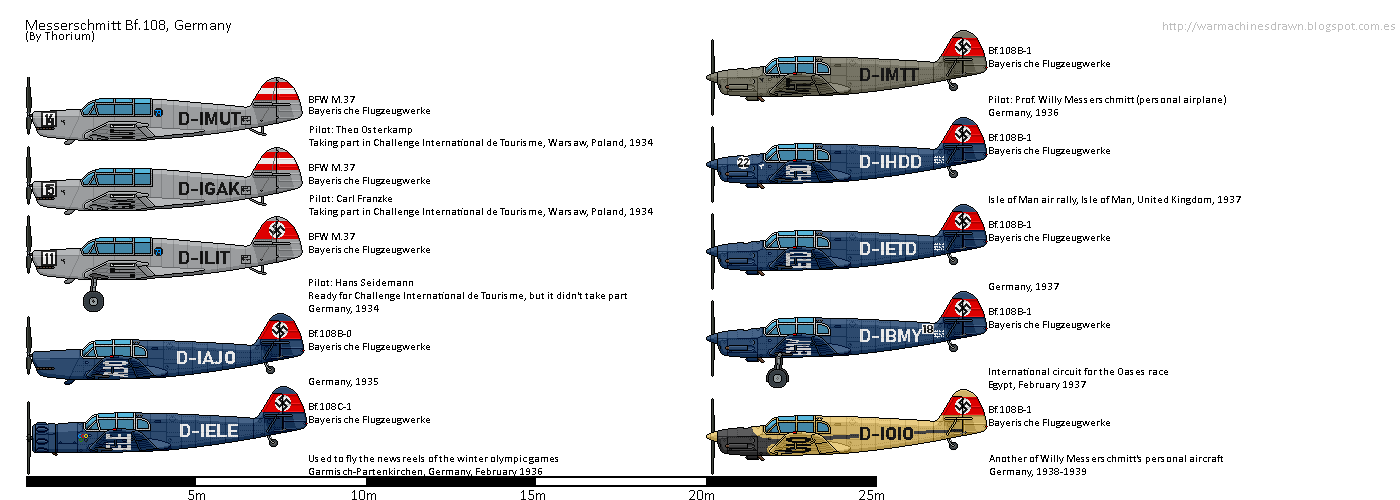
The Messerschmitt Bf.108 was a German single-engine sport and touring aircraft that was developed by the Bayerische Flugzeugwerke in the 1930s.
It was originally designated as M 37 and was designed as a four-seat sports/recreation aircraft to compete in the 4th Challenge International de Tourisme that was held in the year 1934.
The M 37 prototype flew for the first time in spring 1934 and was powered by a single Hirth HM 8-U that yielded a power of 247 hp and drove a three-bladed propeller.
It was outperformed by many other contestants in the competition, however, its overall performance marked it as a popular choice for record flights. One very popular feature was its low fuel consumption rate, good handling and nice take-off and landing characteristics.
The first production version, the Bf.108 A (of which just 7 exemplars were manufactured) flew for the first time in 1934, after the challenge, and the Bf.108 B variant (which was the most produced one with more than 600 of them being manufactured by Messerschmitt alone) flew for the first time the next year, in 1935. The B variant was slightly larger and was powered by a single Argus As-10 C-3 engine which delivered 247 hp of power and drove a two-bladed propeller. It was given the nickname Taifun (German word for "Typhoon") by Elly Beinhorn (a popular German pilot of the time) as that's how he called his own aircraft, so the nickname was generally adopted.
It was also Willy Messerschmitt's personal airplane, among many other German high officers of the time.
There was a third variant, the Bf.108 C, of which just a single aircraft was completed (although some sources claim that it never went beyond the drawing board). It was powered by a Siemens-Halske Sh-14 radial engine which had a power of 125 hp. It was used only once to fly newsreels of the Winter Olympic Games in Garmisch-Partenkirchen, in Bavaria.
Sources:
1. https://en.wikipedia.org/wiki/Messerschmitt_Bf_108
2. https://www.valka.cz/Messerschmitt-Bf-108-t85448 (translated)
3. Wydawnictwo Militaria 149 - Messerschmitt Bf-108 Taifun
It was originally designated as M 37 and was designed as a four-seat sports/recreation aircraft to compete in the 4th Challenge International de Tourisme that was held in the year 1934.
The M 37 prototype flew for the first time in spring 1934 and was powered by a single Hirth HM 8-U that yielded a power of 247 hp and drove a three-bladed propeller.
It was outperformed by many other contestants in the competition, however, its overall performance marked it as a popular choice for record flights. One very popular feature was its low fuel consumption rate, good handling and nice take-off and landing characteristics.
The first production version, the Bf.108 A (of which just 7 exemplars were manufactured) flew for the first time in 1934, after the challenge, and the Bf.108 B variant (which was the most produced one with more than 600 of them being manufactured by Messerschmitt alone) flew for the first time the next year, in 1935. The B variant was slightly larger and was powered by a single Argus As-10 C-3 engine which delivered 247 hp of power and drove a two-bladed propeller. It was given the nickname Taifun (German word for "Typhoon") by Elly Beinhorn (a popular German pilot of the time) as that's how he called his own aircraft, so the nickname was generally adopted.
It was also Willy Messerschmitt's personal airplane, among many other German high officers of the time.
There was a third variant, the Bf.108 C, of which just a single aircraft was completed (although some sources claim that it never went beyond the drawing board). It was powered by a Siemens-Halske Sh-14 radial engine which had a power of 125 hp. It was used only once to fly newsreels of the Winter Olympic Games in Garmisch-Partenkirchen, in Bavaria.
Sources:
1. https://en.wikipedia.org/wiki/Messerschmitt_Bf_108
2. https://www.valka.cz/Messerschmitt-Bf-108-t85448 (translated)
3. Wydawnictwo Militaria 149 - Messerschmitt Bf-108 Taifun
Subscribe to:
Comments (Atom)