Friday, 15 July 2016
We're on holidays
We start our holidays tomorrow, on July 16th, and we won't write any new posts until early August. See you all back then and meanwhile... keep watching your six!

Avia BH-33L & BH-33H

The BH-33L was the third development of the BH-33 which was intended to be used as the standard Czechoslovak fighter and was to be known as the Ba.33.
The prototype flew for the first time in late 1929 and was introduced in 1930. It had basically the same fuselage as the BH-33E but it featured longer-span wings of greater area and was powered by one 580hp Skoda L engine. It was armed by two modified Vickers 0.303in machine guns called Mk.28 which were mounted between the cylinder banks.
It did indeed serve as the standard Czechoslovak fighter during the early 1930s.
After the end of the Czechoslovak republic in 1939, some airplanes were used by the Slovak Republic, which used then for a short period of time in training duties.
The BH-33H was a single prototype powered by a Pratt & Whitney Hornet engine, just like the Vought O2U. Most probably it was Avia's trial on introducing it to the American market.

1. Salamander Books - The Complete Book of Fighters
2. https://en.wikipedia.org/wiki/Avia_BH-33
Thursday, 14 July 2016
Avia BH-33E
The slab-sided wooden fuselage was replaced by a welded steel-tube structure, it had an elliptical cross section achieved with the help of light formers and a spli axle vee-type undercarriage introduced to replace the original crossed-axle undercarriage.
Even if it wasn't originally ordered by the Czechoslovak authorities, which waited until the BH-33L, it did have some export success and three airplanes were bought by the USSR to preform some tests and 20 were sold to Yugoslavia which also purchased a production license, for the firm Ikarus at their plant of Zemun, close to Belgrade.
Two sub-variants were made one powered by the Bristol Jupiter VI, and the other one, which was the most produced, powered by the supercharged version of the Bristol Jupiter VII. One single BH-33 was fitted with a German BMW Hornet engine, however, as we couldn't find any graphical evidence, we haven't drawn it. It was armed with two Vickers 0.303in machine guns placed in the frontern upper part of the fuselage.

Sources:
1. Salamander Books - The Complete Book of Fighters
2. https://en.wikipedia.org/wiki/Avia_BH-33
Wednesday, 13 July 2016
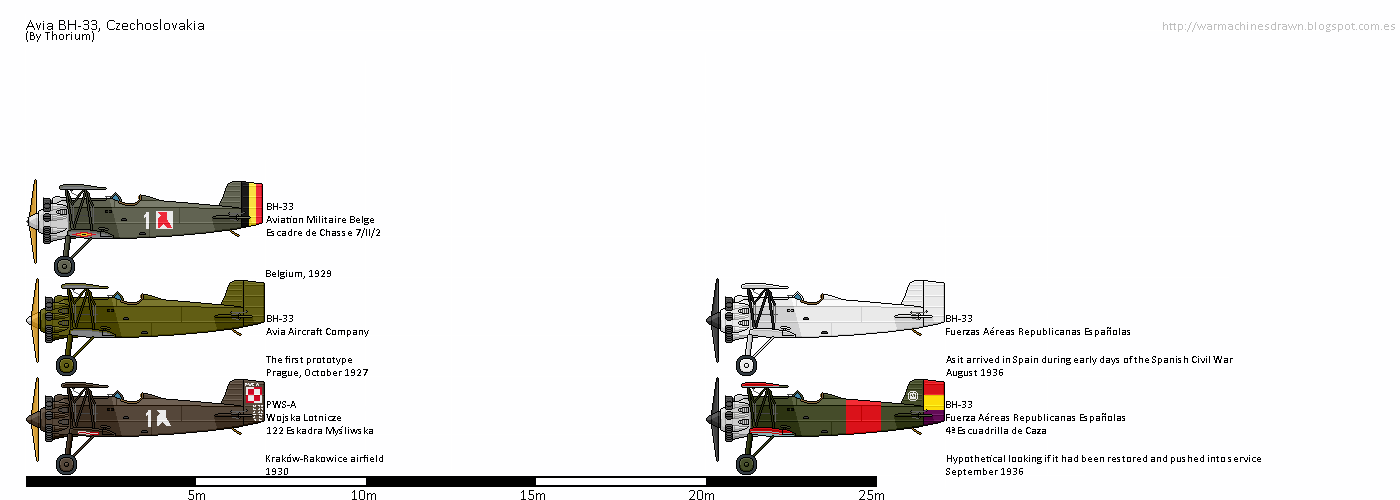
Avia BH-33
Trials were satisfactory and a new design was born, with the given name of Avia BH-33. It was the last fighter designed by Miroslav Hajn and Pavel Benes for Avia and was also the first Avia fighter to feature a fixed tail fin from the outset. Trials on the new design started in 1927 and were satisfactory enough for the Czechoslovak Army Air Corps, but not brilliant enough that they only ordered 5 airplanes. It was powered by a Walter-built Bristol Jupiter VI engine delivering 543hp at take-off and was armed with two Vickers 0.303in machine guns.
In Belgium, one Avia BH-33 powered by a Bristol Jupiter VII engine was one of the contenders for the Aéronautique Militaire fleet standaristation programme which was eventually won by the Fairey Firefly.
Regarding to Spain, apparently a single BH-33 painted entirely in white flew to Spain in the early days of the Spanish Civil War loosing it's machine-guns and synchronisation gear en route. It's unknown what happened to it, but we couldn't resist the impulse of thinking how it would've looked like if it had been repaired, repainted and push into service.
Poland adquired a manufacturing license in 1928 with PZL building 10 pre-production airplanes of this type and PWS building 50 of them as the PWS-A from 1930 onwards.
Sources:
1. https://en.wikipedia.org/wiki/Avia_BH-33
2. Salamander Books - The Complete Book of Fighters
3. http://bioold.science.ku.dk/drnash/model/spain/did.html
4. http://www.belgian-wings.be/Webpages/Navigator/Photos/MilltaryPics/interbellum/avia_bh33.htm
Tuesday, 12 July 2016
Avia BH-26
It was a single-bay unstaggered biplane with equal-span wings with a fixed tail-skid undercarriage. An unusual feature for an Avia produced airplane was that it featured long-span ailerons balanced by a small auxiliary airfoil placed in the upper surface of the lower ailerons.
The design was typical of the World War I and the artermath years with the pilot and obersver sitting rear-to-rear in open cockpits, with the observer post, placed in the rear, being armed with two 0.303in Lewis machine guns placed in a Skoda-built ring. The airplane itself was powered by a 450hp Walter-built Bristol Jupiter IV radial engine and it had also another pair of 0.303in Vickers machine-guns placed in the front. Most probably it also had a small load capacity, but we haven't found any info about it. Just like other Avia designs, originally had not fixed fin, just a rudder, but it was changed when entered in service.

Sources:
1. https://en.wikipedia.org/wiki/Avia_BH-26
2. Salamander Books - The Complete Book of Fighters
Monday, 11 July 2016
Avia BH-23
The BH-22 was developed in parallel to the BH-21 and was am unarmed lighter aerobatics version trainer of it. Thirty examples of the BH-22 were manufactured and, on one of them, the designers Pavel Benes and Miroslav Hajn, decided to install armament and searchlights in 1925.
Modifications were completed in 1926 and it was tested that same year, under the name of BH-22N. It was powered by a 180hp Hispano-Suiza 8Aa built by Skoda and it was armed with two 7,7mm machine guns.
Anyway, the Czechoslovak authorities weren't interested on the project and no production orders were placed.

Sources:
1. Salamander Books - The Complete Book of Fighters
2. https://en.wikipedia.org/wiki/Avia_BH-23
Sunday, 10 July 2016
Avia BH-21 - Czechoslovak users
It was designed by the same team composed by the engineers Pavel Benes and Miroslav Hajn who designed the BH-17, it's most direct predecessor.
The BH-21 and the BH-17 share some design features, in fact it could be said that the final BH-21 version was a heavily revised and modified BH-17. It's most welcomed feature was the improvement of the pilot's field of view. It was powered by a 300hp Hispano-Suiza 8fb which were built by Skoda under license and was armed with two 0.303in Vickers machine guns placed in the frontern upper part of the fuselage. It was put into production in 1925 and in one year 182 airplanes were produced, 137 of them were assigned to the Czechoslovak Army Air Force and the rest were either sold to Belgium or produced under license by the Belgian SABCA.
Two experimental variants were also built. The BH-21J, which was a regular BH-21 powered by a Bristol Jupiter engine which served as the predecessor for the BH-33 and the BH-21R which was a racing variant and was powered by a boosted Hispano-Suiza 8fb engine delivering 400hp of power.
It wasn't proven as it was retired just before the beginning of the World War II, however it served as a pivotal point for the BH-33 and BH-34 which much more advanced fighter types. The BH-21R earned some renown as it was the winner of several racing competitions in 1925.

Sources:
1. https://en.wikipedia.org/wiki/Avia_BH-21
2. Salamander Books - The Complete Book of Fighers
Saturday, 9 July 2016
Avia BH-21 - Belgian Users
As the Belgian Aeronautique Militaire was greatly reinforced after the World War I, it was equipped with a mix amount of airplanes, ranging from British and French airplanes and even German ones, like the Fokker D.VII as war plunder. That situation created what today we would call a logistical nightmare as every type of aircraft had different engines, fuel types, spare parts... and so on.
That situation made obvious that a standarisation of their fighter fleet was needed which eventually would be completed in 1931 when they adquired the Fairey Firefly.
As, back in the mid 1920s when the standarisation/modernisation question was considered, the Nieuport-Delage NiD.29, a French fighter that entered service in 1918 was considered only as a minor improvements over their World War I counterparts, plus it was very hard to maneouver and weak.
In the meantime, in Czechoslovakia, the Avia Aviation Company, which was founded back in 1919 caught the attention of the Belgian authorities and achieved world prestige when their airplanes won various competitions all across Europe with their simple yet strong designs.
As the Avia BH-21 flew for the first time on January 1925 near Prague, by 1926 the Belgian authorities showed their interest for it. In order to evaluate them, the Belgian Defence Ministry bought one of them together with a French Dewoitine D.19 and a 420hp Bristol Jupiter powered Dewoitine D.9. Unlike later's standards, there wasn't a competing fly-off and the airplanes were delivered to the squadrons for them to evaluate.
As it was powered by the Hispano-Suiza engine that powered the NiD.29, spare parts weren't a problem and the BH-21 showed a good acrobatic performance so it was favoured by the Belgian Authorities. An order for 44 BH-21 was placed soon, five airplanes were to be constructed by Avia in Czechoslovakia and the 39 of them would be built in Belgium under license by the SABCA (Sociétés Anonyme Belge de Constructions Aéronautique - Belgian Aeronautical constructions Anonymous Society) company.
The first BH-21 arrived in Belgium on 1927 and the first Belgian built BH-21 rolled out from the factory on 14th September 1927. They served with the first group of the second regiment (I/2Aé) with base at Schaffen, close to the Belgian city of Diest.
Although the BH-21 was meant to replace the NiD.29, it served alongside with it both at Schaffen and Nivelles air bases until the early 1930s.
When the Fairey Firefly arrived on Belgium, both the NiD.29 and the BH-21 were gradually replaced and some BH-21 were transferred to the Belgian pilot school in Wevelgem where they served until 1934.
So, apparently, the bottom line is that it was intended to serve as an interim fighter between the obsolete NiD.29 and the Fairey Firefly in order to keep the SABCA's production lines active.

Sources:
1. http://www.belgian-wings.be/Webpages/Navigator/Photos/MilltaryPics/interbellum/Avia%20BH21/Avia%20BH21%20Frontpage.html
2. Salamander Books - The Complete Book of Fighters
3. https://en.wikipedia.org/wiki/Avia_BH-21
Friday, 8 July 2016
Avia BH-7
Just like the BH-6, it crashed various times when tested, which caused it's abandonment as a fighter.
However, Avia decided to use the design as the basis for a racing airplane by shortening the wingspan 1.4m and fairing it directly into the fuselage dispensing it with cabane struts.
Both racing version and fighter version were renamed as BH-7A, the fighter and BH-7B, the racing variant.
When the racing airplane proved to not be more successful than the fighter, it was abandoned.

Sources:
1. https://en.wikipedia.org/wiki/Avia_BH-7
2. Salamander Books - The Complete Book of Fighters
Thursday, 7 July 2016
Avia BH-6/BH-8/BH-17
The Avia BH-6 was a prototype Czechoslovak fighter built in 1923. It had wings of unequal span with the top wing being shorter than the lower one, something very unusual for the time. It was joined to the bottom one using an I type strut on both sides which sloped inwards from bottom to top. The top wing was attached to the fuselage by a single large pylon instead of a set of cabane struts.
It crashed early when it was being tested.
The Avia BH-8, on it's part, was another prototype, based also on the BH-6 and was essentialy an attempt to solve the problems that the test projects of that one showed. It was basically the same, with some minor alterations.
When tested, it showed some improvements from the previous BH-6, but as the next version, the BH-17, was ready by the time, the BH-6 development was abandoned.
Finally, the Avia BH-17 was another development of the same BH-6 which was built in 1924 and featured even more adjustments made to the original design. It shown even more good performance than the BH-8 and 24 airplanes were ordered by the Czechoslovak Air Force. However, once deployed, they proved to be seriously unreliable and were retired soon.

Sources:
1. https://en.wikipedia.org/wiki/Avia_BH-6
2. https://en.wikipedia.org/wiki/Avia_BH-8
3. https://en.wikipedia.org/wiki/Avia_BH-17
4. Salamander Books - The Complete Book of Fighters
Wednesday, 6 July 2016
Avia BH-3/BH-4/BH-19
Avia BH-3 was a Czechoslovak fighter airplane built in 1921, which was a direct descendant of the BH-1 sports plane.
It was a braced low-wing monoplane of conventional configuration and a tailskid undercarriage.
After favourable trials in June 1921, ten airplanes were ordered by the Czechoslovak Air Force and were delivered in 1923, under the military designation B.3. It proved to be temperamental in service and was shortly relegated to training duties, where it served until 1927.
The Avia BH-4 was a prototype fighter built also by the Czechoslovak Avia in 1922. It was a direct development of the BH-3 powered by a 220hp Hispano-Suiza 8Ba Vee-8 in order to improve the airplane's performance. In order to fit the new engine the airplane nose had to be considerably redesigned, and the fuselage and the undercarriage were reinforced. The performance was marginally better than the BH-3, so it wasn't worth it and it's development was abandoned.
The Avia BH-19 was another prototype built in Czechoslovakia in 1924. It also derived directly from the BH-3 and proved that the designers, Pavel Benes and Miroslav Hajn, believed that the monoplane configuration was the most suitable for a fighter aircraft (as it's obvious time proved them right). The initial test showed excellent performance but gave control problems and aileron flutter, however the Czechoslovak Army was interested and told them that they would order the airplane if those problems were solved.
However, the first prototype crashed when performing speed trials and the second one hadn't solved the problems of the first one, so, after that, the Czechoslovak Army asked Avia to cease the attempts to develop a monoplane fighter, at least during the 1920s.

Sources:
1. https://en.wikipedia.org/wiki/Avia_BH-3
2. https://en.wikipedia.org/wiki/Avia_BH-4
3.https://en.wikipedia.org/wiki/Avia_BH-19
4. Salamander Books - The Complete Book of Fighters
Tuesday, 5 July 2016
AUSA MB.901 & MB.902

The first prototype of the MB.901 (which we left it undrawn as we couldn't find a trustable pic or drawing of how it looked like) was born from a request made by the Italian Air Ministry for a multi-role airplane which could be used as an escort fighter, fighter-bomber, attack airplane and fast reconnaissance airplane. It was required in the request to be powered by two engines placed in tandem behind the cockpit. The wings were placed low at the cockpit sides.
The peculiarity of the MB.901 project was the placement of the two engines which initiall they were expected to be the Isotta Fraschini L.180, placed in tandem inside the fuselage which powered two pairs of counter-rotating propellers mounted in nacelles placed on the wings with the radiators placed also in the wings by the fuel tank hatch. The expected propellers were two metalic pair of co-axial propellers at variable pitch with two propellers on each axis. Such system was designed by Bellomo himself, together with the complex mechanical transmission mechanism at 90º in order to connect the axis with the engines placed inside the fuselage.
Given the tehcnological difficulty of such mechanism, was rarely employed, even if it offered certain advantages like a significant reduction of the weight, with the possibility of including the inversion of the propellers, something very important for the piloting during the dive bombing maneouver, and during landing. It also gave more in-flight stability.
The MB.902 prototype was powered by two Alfa-Romeo RA 1000 RC.41 delivering each of them 1050hp of power. That engine was a Italian version of the German Daimler-Benz DB 601, however, other sources claim that the installed engines were the Italian FIAT 1050 RC.581. The expected armament, as it was never installed on the prototype, were four 12,7mm Breda-SAFAT caliber machine guns, placed at the wings and fuselage plus two 20mm MG151/20 cannons. Most probably it also had some bomb delivering capability.
On 7th September 1939, a non flyable model was requested to the designer, having working engines, in order to check the effectivity of them.
Later in 1941, the designer reached an agreement with AUSA for building the first prototype, which it's maiden flight was expected for the summer of 1943. At this stage some radical designs were made to the original design of the MB.901, which is therefore known as the MB.902. The wings were modified which were placed high in the fuselage and was built with a trycicle undercarriage, but the most important modification were the place of the propellers which were placed on the wings, behind the cockpit in order to improve the visibility of the pilot.
Of the two expected prototypes, only the first wind tunnel one, made out of wood, was built. On 8th September 1943, the date of the Italian armistice, the project was cancelled and the prototype model was destroyed.

Sources:
1. https://it.wikipedia.org/wiki/AUSA_MB.902 (translated)
Monday, 4 July 2016
AUSA AUT.18

The AUT.18 was a prototype aircraft developed by Aeronautica Umbra Societá Anonima (Umbra Aeronautics Anonymous Society) soon after the beginning of the World War II.
It was designed by the engineers Felice Trojani and Umberto Nobile, hence the AUT designation of the airplane. Nobile was, at that time collaborating with the airships Norge and Italia in their expedition to the north pole.
The Regia Aeronautica issued the Progetto R (Project R), where the R stood for riammodernamento, which consisted on the modernisation of the air force, and for that they were in need of a monoplane fighter that could compete against the more modern British, French or even German airplanes, like the Hurricane, the Dewoitine D.520 or the Bf.109, many Italian aircraft developers presented their candidates, Caproni competed with the Caproni-Vizzola F.5, Fiat with the Fiat G.50, Macchi with the Macchi C.200, IMAM with the Ro.51, Reggiane with the Re.2000 and AUSA with the AUT.18. The requirement was won both by the G.50 and the C.200.
The AUT.18 made it's maiden flight on 22nd April 1939 in the city of Foligno, in the Italian region of Umbria, and was powered by a FIAT A.74, engine that could deliver 1044hp of power. It was entirely made out of stressed-skin metal covered in duralumin and featured an iwardly retracting and retractable tail-wheel. It was armed with two 12,7mm (0.50in) Breda-SAFAT machine-guns mounted in the wings, just outboard of the carriage, this was an unique feature that only this fighter had, as every other of the candidates had their main machine guns mounted in the fuselage.
Anyway, flight trials were disappointing and left the fighter behind the other fighters of the Progetto R. No production orders were placed and the prototype was returned from Guidonia (the test centre of the Regia Aeronautica) to Foligno in order to modify it on 20th February 1940. It was refitted with a FIAT A.80RC.41 engine and flew again on 5th November 1940 however the performance increase was marginal and, as the other main fighters were already in production and some of them even serving at the front lines, the prototype was abandoned.
Apparently an assault version (Assalto in Italian) was also projected. In the Italian aerial doctrine prior to the World War II, there were two types of ground support, the traditional one, delivering bombs of small caliber at the front lines, and the assalto one, which consisted on supporting ground troops using strafing tactics. As during the Spanish Civil War the strafing prooved to be very popular and even effective in some cases, some airplanes were designed specifically to make strafing attack and such is the case with the AUT.18, however it was never built.
It's unknown what happened to the modified prototype after the 5th November 1940, most probably it was transferred to Germany to be evaluated. It was also rumoured that it was captured by the British forces, but it's more likely that it was destroyed in an air raid at Orvieto.

Sources:
1. https://en.wikipedia.org/wiki/Aeronautica_Umbra_Trojani_AUT.18
2. Salamander Books - The Complete Book of Fighters
Sunday, 3 July 2016
Austin Greyhound

The Air Ministry issued the type III specification in order to obtain a replacement for the Bristol F.2b in 1918 which had to be powered by the ABC Dragonfly radial engine. As Austin Motor Company manufactured more than 800 RAF SE.5, submitted a design made by J. Kenworthy, who was a former designer at the Royal Aircraft Factory. That design was named Austin Greyhound and three prototypes were ordered on 18th May 1918.
It was a two-bay biplane made entirely out of wood with the engine covered by a conical cowling with the cylinder heads protruding. The circular shape of the cowling continued down the fuselage and both upper and lower wings were almost of the same size. It was armed with two synchronised Vickers 0.303 machine guns plus a 0.303 Lewis machine gun placed in a scarff ring in the rear cockpit. Most probably it could also carry a small load of bombs, however we didn't find any info about it whatsoever.
The first prototype was quickly built, but the Dragonfly engine proved to be overweight, underpowered and had some unsolvable reliability problems, so the testing was delayed. The second prototype was sent to the Aeroplane and Armament Experimental Establishment located at Martlesham Heath in January 1919, which followed the first and the third prototype in May and February 1920 respectively. Even if the performance wasn't bad, no production order was placed from any of the competitors and the Bristol F2b remained in active service until 1932 and the last Greyhound remained in use as a flying testbed at Martlesham Heath until June 1922.

Sources:
1. https://en.wikipedia.org/wiki/Austin_Greyhound
2. Salamander Books - The Complete Book of Fighters
Saturday, 2 July 2016
Austin Osprey
In 1917 the British War Office issued an specification for a single-seat fighter that could replace the Camel. In order to meet that requeriment, the Austin Motor Company, that had been producing airplanes at a large scale, received a license for building a single-seat triplane fighter and they were given the license to build three prototypes as a private venture.
It was made out of wood and fabric, as was usual during that period with single-bay triplane wings and was powered by a single Bentley BR2 Rotary engine delivering 230hp of power. It was armed with two Vickers machine-guns, as requested in the specification plus a single Lewis machine gun mounted in the middle wing on a movable mechanism. Apparently, that Lewis had a very limited field of fire and the diameter of the propellers blocked any forward fire, as this one wasn't synchronized. Most probably, as the initial designs of the Sopwith Snipe (the fighter that eventually was chosen as the replacement for the Camel) featured also a similar gun, this would've been deleted if it had been accepted into production.
It made it's maiden flight on February 1918 and was tested by the Royal Aircraft Establishment at Martlesham Heath in March. It proved to be heavier than expected and gave worst performance results than the Snipe, so the Snipe was chosen. As it wasn't chosen, Austin abandoned any further development on it and didn't complete more prototypes. Apparently the first prototype was still being used for trials at the Royal Aircraft Establishment until, at least June 1918.

Sources:
1. https://en.wikipedia.org/wiki/Austin_Osprey
2. Salamander Books - The Complete Book of Fighters
Friday, 1 July 2016
Austin-Ball A.F.B.1
It was designed by C.H. Brooks with the help of Albert Ball, which was flown, in prototype form for the first time in July 1917.
It was made out of wood with fabric covering and was powered by a 200hp Hispano-Suiza 8 V-8 water cooled.
It was armed initialy with a single 0.303in (7.7mm) Lewis machine-gun firing through the hollow propeller shaft plus another one mounted on a Foster above the upper wing section.
Originally the prototype had slightly swept back wings and conventional single-bay bracings, but during development process those were reverted back and also the traditional two-bay form interplane bracing were introduced. It flew for the first time with those modifications on 17th September 1917.
Just a single prototype was built with the serial number B9909 and testing results were excellent since it achieved nearly the same speed as the S.E.5a and could climb even better than that one. However, apparently it had poor lateral control, just like the earlier versions of the S.E.5 which were quickly solved.
As the S.E.5a was already in production and proved to be an excellent fighter, the A.F.B.1 had not real chance of being accepted into production, since the British authorities preferred to concentrate on the S.E.5a as it was in short supply.
It seems that further modifications were made since there's a photo of an A.F.B.1 with SPAD type wings, however further details of that modifications are unknown. Anyway, in late October 1917, the testers were instructed to remove the engine of the airplane and ship it to Ascot by train, most probably to install it into another airplane and since then the fate of the airplane is unknown.

Sources:
1. Salamander Books - The Complete Book of fighters
2. https://en.wikipedia.org/wiki/Austin-Ball_A.F.B.1
Subscribe to:
Posts (Atom)