Thursday, 31 December 2015

AD Scout/Sparrow

Unexpectedly we have another airplane to post before the end of the year. The AD Scout.

The AD Scout/Sparrow was an anti-zeppelin fighter designed by Harris Booth for the Royal Naval Air Service.

It was an unconventional design  as it was a biplane with the cockpit pod mounted over the upper wing, a rudder tail was held by four booms and featured an extremely narrow track undercarriage. It was intended to be armed with a recoilles Davis Gun but it was never fitted. Four prototypes were manufactured by Hewlett & Blondeau and the Blackburn Aeroplane & Motor Company.

After the trials conducted by the Royal Naval Air Service it was found to be seriously heavy, fragile, sluggish and hard to pilot, even on ground, that's why the project was abandoned and the prototypes were scrapped.


Hanriot HD.1 - Italian users, part three

We couldn't finish the year without finishing the series of entries dedicated to this excellent French fighter, so here it is, the last entry for this airplane. Happy new year everyone!

The Hanriot HD.1 was supplied in small amounts to the Italians who liked the design so much that they started to manufacture it in large quantities and used them to replace not just the already aging Nieuport but also some SPADs S.VII.
They considered it to be the best fighter they had flown, being even better than the SPAD S.XIII becoming that way the standard Italian fighter. In fact 16 of a total of 18 squadrons were equipped with the Hanriot HD.1 by November 1918.

The Squadrons covered in this entry are:

  • 70 Squadriglia
  • 76 Squadriglia
  • 78 Squadriglia

Tuesday, 29 December 2015

Hanriot HD.1 - Italian users, part two

We keep going with more Italian users for this fighter.

This time, we are covering the next squadrons:

  • 70 Squadriglia
  • 76 Squadriglia
  • 78 Squadriglia
  • 82 Squadriglia
  • 85 Squadriglia
We know that some of them are repeated, but they were worth it because the paint schemes are different.


Sunday, 27 December 2015

Adamoli-Cattani

Another entry, this time featuring a new Italian airplane .

Designed by Adamoli and Cattani (two Italian entrepeneurs) in 1918 it was intended to be the smallest practical biplane in the world fitted with the most powerful engine available back then, the 200hp LeRhône M.

They manage to design a conventional looking airplane, except for the hinged leading edges instead of the conventional ailerons, hence the lack of wires around the fuselage, except for those going from the vertical stabilizer to the horizontal stabilizers.
The Turinese Farina Coach building and Moncenisio offices completed the prototype.

Once the prototype was completed, the testing at the ground revealed that the engine, as it was installed, could only work at the 80% of it's capacity making it greatly underpowered. Testing continued until the end of the Great War when a new fighter aircraft wasn't needed no more.


Mosca Bystritskii

Today we bring you another not very known Russian world war I fighter.

The Mosca Bystritskii was a Russian fighter/recon airplane designed and developed during 1916 by the Muscovite company Mosca-Bystristkii.

Inspired by some contemporary airplanes like the Nieuport IV or the Morane-Saulnier G, the prototype and earliest versions, were unarmed and were two-seaters intended to perform recon duties and the fighter versions (the bis ones) were faster due to the fact that they weren't two-seaters. It was powered by an 80hp LeRhone engine or Clerget Rotary engine. The bis version was armed with either a 7,7mm unsynchronised forward-firing machine-gun with a bullet defector mounted in the propeller or, alternatively, with the machine-gun mounted above the cockpit and firing clear from the propeller. In total, 50 exemplars of it were manufactured and it's known that some of them were built after the Russian revolution.

A very interesting feature of this airplane were the backwards folding wings to make the airplane easier to transport by road or by train.

As we said previously, only two versions were made:

  • Bystritskii: Two-seater unarmed recon version.
  • Bystritskii bis: Single-seater fighter version.

Friday, 25 December 2015

Fairey F.2

Merry Christmas everyone! Today we include a not very known British airplane of the Great War era.

The Fairey F.2 was a British fighter prototype designed in 1916.

It was ordered by the Admiralty as a massive three seat long-range fighter that could perform escort missions deep within enemy territory, which would later inspire the Caudron R.11.

It featured a three-bay biplane installation and a four wheel undercarriage. The wings could be folded at one point behind the engines. It was armed with two Lewis 0,303 machine guns, one at the nose and another dorsal one just behind the wings.

it was built at Harlington and transported by road to Northolt Airfield where it flew for the first time on 17th May 1917. However, the Admiralty was no more interested on an airplane of these characteristics and it was found to be slow and hard to maneouver so it never went beyond the prototype stage.


Thursday, 24 December 2015

Hanriot HD.1 - Italian users, part one

Merry Christmas!. We keep going with the Italian users for this fighter which, as we said previously, it was widely employed by the Italian Corpo Aeronautico Militare (Military Aeronautical Corps).

The fighter squadrons (Squadriglia) covered in this entry are:
  • 70 Squadriglia
  • 76 Squadriglia
  • 78 Squadriglia
  • 80 Squadriglia
  • 81 Squadriglia
  • 85 Squadriglia
We will write about the performance during the war later.


Tuesday, 22 December 2015

Hanriot HD.1 - Belgian users

We continue with the Belgian users of this airplane which was manufactured in France but saw little to none use under French command.

The Belgians took the bulk of the earliest production of this airplane in 1916 and realized that they had to manage with those unwanted airplane models rejected by their allies. Under Belgian hands it proved to be highly successful and it remained as the standard Belgian fighter until the end of the war.

The most successful Belgian HD.1 pilot was Willy Coppens who fitted his airplane with an experimental 11mm Vickers Machine gun to perform better at ballon busting duties, something where he excelled. In fact most of his victories were ballons and most of them were taken down while piloting a HD.1.

Also,  regarding the 9th squadron, we could only find one of them not flown by Willy Coppens.


Monday, 21 December 2015

Curtiss Model S

Today we start this pre-Christmas week with a new American airplane. One of the first designs (albeit unsuccessful) of the Curtiss company.

The Curtiss Model S was the first attempt of the Curtiss airplane company at a fast and maneouvrable single-seat fighter.

The very first model, S-1 Speed Scout, was designed under the parameters of what the European manufacturers had called a Scout back in 1914. This concept was simply to design a tractor airplane capable of just scouting enemy activities and, it wasn't considered the need to be armed. However the war soon showed that they needed to be armed, even if they retained the term Scout. Curtiss developed several Curtiss S models during 1916-1917 but succeeded in selling only a few ones to the US Army and Navy.
The inadequacy of these airplanes cannot be blamed on the lack of skill of Curtiss designers, but on how far the American airplane had fallen behind the European one, which was operating under the requeriments of the Great War. American designers were cut-off from the latest European technological advances and had to progress from the 1914 designs on their own without the estimulus of the war.

Many models were made:
  • S-1, AKA Speed Scout, AKA Baby Scout. The original design, it was the smallest airplane that Curtiss could build to fit the 90hp OX engine. The design was very conventional for the time, but the wingspan was very inadequate. It didn't sell and Curtiss company kept the prototype for themselves
  • S-2 Wireless: It was basically a modified S-1 fitted with new wings that eliminated the need for bracing wires. It had some shocking problems when landed which were solved by fitting new Ackermann spring wheels. However these wheel system didn't have resistance to side loads and wasn't widely employed.
  • S-3 (Model 10): The only production model was the triplane variant, which four of them were sold to the US Army early in 1917. These used the basic fuselage engine and tail of the previous models. Those 4 airplanes were the first single-seat scouts of the US Army even if, in terms of technology they were one or two years behind their European equivalents.
  • S-4 (Model 10A): A seaplane version of the S-3. It was intended to be a scout airplane for the US Navy. The wingspan was increased in order to carry the extra weight of the twin central floaters. The front struts collapsed during 1918 and the aircraft was struck off.
  • S-5 (Model 10B): A modified version of the S-4 featuring a single floater and two small-ones under the wings. It struck-off on August 1919.
  • S-6 (Model 10C): An improved version of the S-3 and the first Scout armed with twin forward-firing gas operated Lewis machine-guns. The Army ordered 12 of them in 1917 but only one was delivered.

Saturday, 19 December 2015

Hispano Barron

Today we show you a rare Spanish native airplane.

In 1919 the Hispano company wanted to take part on the fighter airplane contest to be held that same year and they hired the designer Eduardo Barron (the same who designed the Barron W) to design their airplane.

Barron, who, back in 1917 had supervised the construction of a copy of the SPAD S.VII at Hereter workshop, called Pujol Comabella España took inspiration from that airplane. The fighter designed by Barron was a single-bay unstaggered wooden biplane with fabric skinned and powered by a 180hp Hispano-Suiza 8A eight cylinder water cooled engine.

It was armed with a 7,7mm machine-gun in the upper-wing. (The drawing depicted below is unarmed because that's how it took part on the 1919 contest).

During the contest it was flown by the Chilean pilot Luis O'Page and competed against two other native fighter designs: The Hereter T.H. (AKA Alfaro 8) and the Diaz Type C. This last one eventually won the contest. Contest which proved to be pointless because it resulted cheaper to buy surplus better airplanes from the already over Great War.


Friday, 18 December 2015

Hanriot HD.1 - Foreign users

Today, we are altering our criterion a little bit. Despite being a French design, it wasn't produced for French users but for foreign users, Italy and Belgium, mainly. That's why we consider France as a foreign user, despite it was manufactured in France, but also in Italy by Macchi, which manufactured more exemplars than the parent firm. Also, given the importance this airplane had in the Belgian army, we are going to reserve entries exclusively for Belgian and Italian ones.

The Hanriot HD.1 was a French single seat biplane fighter aircraft. It was rejected to serve in the French army in favour of the SPAD S.VII and thus, it was offered to both Belgian and Italian armies where it served successfully. In fact, it became the standard Italian fighter of the Great War. Of a total of 1200 airplanes built, 831 were manufactured under license by the Italian Macchi company.

This airplane, influenced by the Sopwith designs, mainly because Hanriot had produced under license the Sopwith 1/2 Strutter, was produced in 1916.

It was powered by a 110hp LeRhone rotary engine and, although it wasn't very fast, it was highly maneouvrable and was very popular among the pilots due it's easiness to control. In order to keep the good climbing and altitude numbers, it's armament was oftenly restricted to a single synchronised vickers machine gun, althought there was place for a second one. This airplane introduced a new feature (for the era): The machine guns were at the side of the cockpit and not in front, providing more safety in the case of a crash. However in the Italian built versions the machine-gun was fitted on the front of the cockpit and not at the sides.

The users covered in this entry are:

  • Ecuador: The newly created Ecuadorian military aviation school bought their second airplane which named it 'Telegrafo Iº' (Telegraph 1st). It achieved renown within that country when the Italian born pilot Elia Liut crossed the Ecuadorian Andes flying that airplane.
  • France: Apparently the French naval aeronautics employed some floatplane sub-variant of the HD.1 in order to defend their naval bases. It seems that they sold all their exemplars to the US Navy. As we couldn't find reliable info about how they looked like, the drawing should be considered as speculative.
  • Paraguay: The Paraguayan National Air Force bought three airplanes from Italy. As we couldn't find graphical information about their colours under Paraguayan command, the drawing is speculative.
  • Switzerland: The Swiss Army Aviation bought some HD.1 in order to equip their fighter squadron based in Dübendorf, near Zürich. One of them is still displayed in the Dübendorf aviation museum.
  • United States: The US Naval Aircraft Factory adquired 10 HD.1 which used them to make trials on take-off platfroms from warships in the post-war years. They were also employed as advanced trainers. 
  • Venezuela: The Venezuelan Military Aviation School adquired some French made HD.1 during the late 10s/early 20s in order to equip their fighter squadron.
  • Austro-Hungarian Empire: It is known that at least one ex-Italian aircraft performed a forced landing in Austro-Hungarian soil and they captured the airplane and pushed it into service with their air corps. 


Wednesday, 16 December 2015

Halberstadt CL.II - Domestic Users

It took us longer than expected because the German paint schemes on this airplane are very hard to do, but here we are again!

The Halberstadt CL.II was a German two-seater escort fighter which was also good at performing ground attack missions. It served in great numbers with the Imperial German Air Service.

In  1917 the German Army inspectorate of flying troops required a new type of two-seat airplane smaller than the already existing C type of airplanes. This new type, which was to be known as CL-type (Light C type). It was intended to equip the protection flights to escort reconnaissance airplanes. To meet that requirement Halberstadt developed it's previous unsuccessful Halberstadt D.IV into a two-seater and they originally designated it 'Halberstadt C.II'.

The mounting of the observer's machine gun, in it's characteristical ring, provided a very good field of fire allowing to fire towards targets on the ground. Also, a tray able to hold ten stick grenades was added on the left side of the fuselage. It could also hold a wireless radio in the observer cockpit with it's own generator. Generator that could also be used for heated flight suits. 700 airplanes were manufactured by Halberstadt and 200 were manufactured by BFW (Bayerische Flugzeug-werke).

After entering service it proved to be very successful having an excellent manoeuvrability, rate of climb and field of fire which made it a fine opponent for the contemporary single seat fighters. It also proved to be good at providing fire-support which was the role the remaining CL.II were used in, making the units equiped by these airplanes to be redesignated as Schlachstaffeln (Battle flights).

The ground support they could provide was that good that it became a major factor in the German counter offensive at the Battle of Cambrai in 1917. The success of this airplane convinced the German Army inspectorate of flying troops of the necessity of more airplanes of this kind and that's how more airplanes of this type like it's inmediate follow-on, the Halberstadt CL.IV or the Hannover CL.III were encouraged to be designed by their respective manufacturers.

Only two variants were made:

  • CL.II: The main production version, powered by a 150hp Mercedes D.III engine
  • CL.IIa: Made by the BFW, it was powered by a BMWIIIa engine. Barely used during the Great war but used by the Polish air force during the Polish-Soviet war.

Saturday, 12 December 2015

Fairey Campania

We continue drawing, this time with the biggest airplane we have drawn yet.

The Fairey Campania was a ship-borne patrol floatplane with twin main floats and backward folding wings. It was the first airplane designed specifically for carrier operations.

When, in the middle of 1916, the Campania was fitted with a forward flight-deck, where they could launch aircraft from, the admiralty issued a specification for a purposely built two-seat reconnaissance aircraft that could operate from ships.
Fairey designed a tractor biplane in February 1917 it was made out of wood and was covered in fabric. The two wings could fold backwards for storage, in order to save space. It was armed with a lewis machine gun placed in the observer cockpit and could also carry up to 6 53kg bombs under the wings or fuselage.

As the trials with the prototypes (which after testing they operated from the Royal Naval Air Service air station of Scapa Flow) were successful, many Campanias were shipped on board of HMS Campania, HMS Nairana and HMS Pegasus seaplane carriers all of them. As the HMS Campania was the only one fitted with a flying deck, only the airplanes operating from that ship took-off using the wheels in the floaters, the rest took-off in the traditional floatplane way (after being deployed in the sea using a crane, obviously).

It didn't achieve any distinguishable record, but served well in it's role as spotter. During the north Russian campaign, in the Russian Civil war, some Campanias from HMS Nairana, took part on what maybe was the first combined air land and sea attack on history joining entente land forces and driving Bolshevik forces away which had been fortified on Modyugski Island. Once the port of Arkhangelsk was taken, the Campanias operated from there.

They were declared obsolet in 1919.


Friday, 11 December 2015

Halberstadt CL.II - Foreign users

We start with a new airplane and with an entry shorter than usual.

The Halberstadt CL.II was a German escort fighter/ground attack airplane designed during the first World War that excelled during that conflict.

As we are centering in the foreign users of this airplane, and they were rather... scarce, only two non-German nations employed it after the war. Lithuania and Poland.


Under Lithuanian command, they were among the very first (if no the first) attack airplanes that equipped their air force. They may have seen some action at any of the Lithuanian independence wars (1918-1920).

Under Polish command, they saw action specially in the Polish-Soviet war where they served in at least two squadrons, the 2nd squadron and the 14th, both dedicated to the ground support role, where this airplane excelled.


Thursday, 10 December 2015

SPAD SA Series - Domestic Users

We finish with this unorthodox design covering it's domestic users and prototypes.

The SPAD SA was designed in 1915 by Louis Béchereau, the same designer who designed the SPAD S.VII. In order to achieve a forward-firing system it adopted an original solution. Instead of placing the machine-gun over the top wing, it placed a nacelle in front of the engine with a gunner operating it.

This system proved to be problematic because it made the communication between the pilot and the gunner difficult, if not impossible. The nacelle vibrated very badly and some times it tend to part company from the airplane in the middle of the flight. Even a mild-crash or nose-over could hurt badly or even kill the gunner. It was much better the other two systems, the pusher configuration, like the Airco DH.2 had or the machine-gun mounted over the top wing like the nieuport 11 had.

Some variants tried to fix the aforementioned problems and therefore it saw several variants:

  • SPAD SA.1: The prototype
  • SPAD SA.2: Main production variant. Some small improvements
  • SPAD SA.3: Gunner trainer variant with a complex system that allowed the pilot to fire a rear-firing machine gun from the cockpit.
  • SPAD SA.4: Improved version of the SA.2
  • SPAD S.D.: Three seater version
  • SPAD S.G.: Single seater fighter version. The nacelle was still present but without the gunner.
  • SPAD S.H.: Prototype for the SPAD S.V which was the prototype for the SPAD S.VII
Given it's riskiness it wasn't very like by the French pilots and was quickly replaced, in fact only 107 were manufactured, and it never equipped an entire squadron.


Wednesday, 9 December 2015

SPAD SA Series - Foreign Users

Today we bring you a new French airplane which, despite not being the best that France offered during the war, it achieved some renown when piloted by Russian hands.

The SPAD SA. was a tractor biplane of unorthodox design which, in order to achieve a forward firing airplane (don't forget that when this airplane was designed, neither France nor any of the entente countried had the synchronized machine gun technology) , placed a machine-gun equipped nacelle in front of the pilot placing the engine between the pilot and the gunner.

In foreign service it was offered to Italy, who rejected it and to Russia, where they received some field modifications like the replacement of skis instead of wheels. Although the Russian spectatives for this airplane were low (since the word spad in Russian means 'Slump' or 'Plummet') at least two crews achieved some success with this airplane. In november 1916 one aerial victory was claimed by the 2nd Lieutenant Vladimirovich and his gunner Bashinskiy.
It's also known that at least one served with the Bolsheviks during the Russian civil war before it was retired for being obsolete.


Tuesday, 8 December 2015

Royal Aircraft Factory S.E.5 - British Users, Part fourth, Fifth Entry

This is the final entry dedicated to this excellent fighter.

The RAF SE.5a excelled as a fighter. Although initially had some problems with the Hispano-Suiza engine which delayed it's practical entry into the war until well into 1918. Together with the Sopwith Camel it regained the air superiority in mid 1917 and kept it for the rest of the war.

Various versions were made:
  • SE.5: Single seat fighter biplane, powered by 8a Hispano-Suiza engine. Few examples manufactured.
  • SE.5a: Single seat fighter biplane. Improved and main production version. The problematic Hispano-Suiza 8a replaced by a more trustable Hispano-Suiza 8b V-8 engine and in some cases by a Wolseley Viper piston engine. Built under license in Texas by the Austin aircraft company.
  • SE.5b: Experimental semi-sesquiplane version. Featuring an streamlined nose and retractable radiator. We couldn't find nor blueprints neither good photos of it.
  • Eberhart SE.5e: Version made out of spare parts by the Eberhart airplane company. Powered by a Wright-Hispano E engine and featured plywood-covered fuselages. Check this post to see it.
The squadrons covered in this entry are:
  • No.92 Squadron, RFC
  • No.2 Squadron, AFC
  • No.24 Squadron, RFC
  • No.84 Squadron, RFC
  • No.60 Squadron, RFC
  • No.56 Squadron, RAF

Sunday, 6 December 2015

Royal Aircraft Factory S.E.5 - British Users, Part three, Fourth Entry

We keep going with the British users for this fighter.

This time we cover the next squadrons:

  • No.56 Squadron (continued from the previous entry)
  • No.60 Squadron
  • No.74 Squadron
  • No.84 Squadron
  • No.85 Squadron

Saturday, 5 December 2015

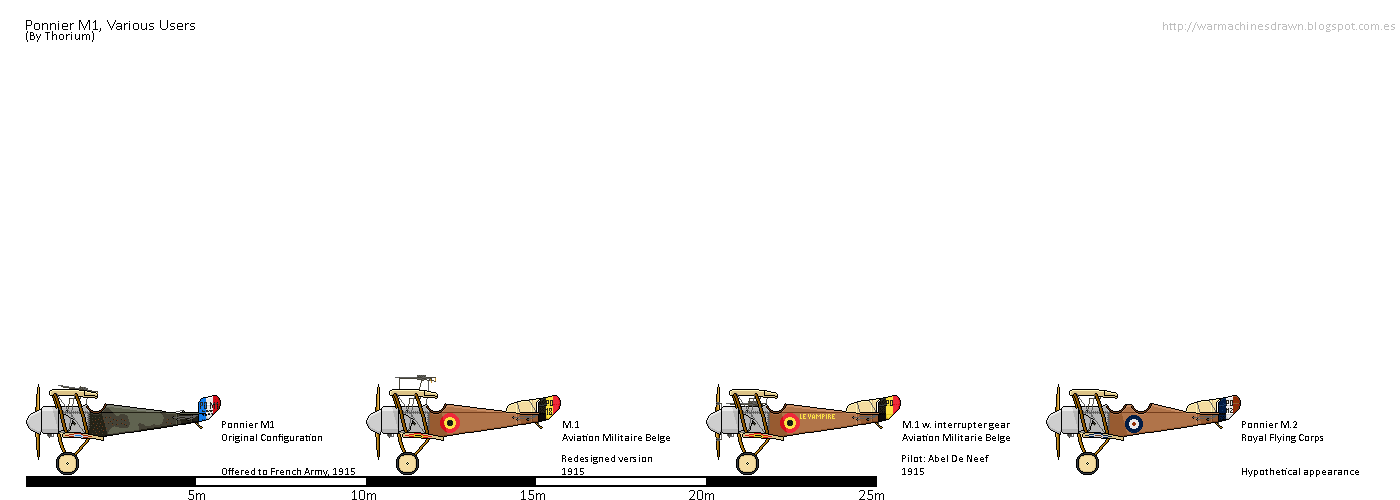
Ponnier M.1

We give the RAF Se.5 some resting and, instead, we switch to a somewhat not very known French airplane that wasn't employed by the French Aeronautique Militaire, but by the Belgian Aviation Militaire.

Avions Ponnier had been trying to win a pre-war contract with their 1913 Ponnier L, but they couldn't win. In 1914, just after the beginning of the war, they tried again, this time with an airplane designed by Emile Dupont, the same one that one year later would design the, much more efficient Hanriot HD.1.

It was powered by a single 80hp le Rhône 9c engine and featured a very large domed spinner which left a very small gap for cooling between it and the engine enclosure. In every version it was armed only with a single lewis machine gun, which changed positions depending on the variant. The most interesting variant was the one flown by the Belgian ace Abel De Neef which featured an interrupter gear in order to shoot the machine gun through the propellers in a way similar to the Morane-Saulnier N.

All things considered, it wasn't a good airplane. Some contemporary fighters like the Nieuport 11 had much better performance. It was also deemed unusable by the Belgian ace Willy Coppens and therefore only 20 of them were manufactured. The only operator was the Belgian Aviation Militaire and, given the great superiority of other enemy fighters, they were only employed in night ground-attack missions without any great success.

It's also claimed that a second two-seater trainer version was planned and even offered to the Royal Flying Corps but never materialized.


Thursday, 3 December 2015

Royal Aircraft Factory S.E.5 - British Users, Part two, Third Entry

We continue with the domestic users of this excellent British fighter.

The squadrons covered in this entry are:
  • No.29 Squadron (continued from the previous one)
  • No.32 Squadron
  • No.40 Squadron
  • No.41 Squadron
  • No.56 Squadron (Albeit incomplete)
You may notice that there's one regular SE.5. We will explain the differences between versions later.

*Updated: Corrected some minor details.

Wednesday, 2 December 2015

Royal Aircraft Factory S.E.5 - British Users, Part one, Second Entry

As the British employed this excellent fighter widely, we have decided to split the domestic users in various entries in order to not get an overloaded one.

The squadrons covered in this entry are:
  • No.1 Squadron Royal Flying Corps
  • No.24 Squadron Royal Flying Corps
  • No.29 Squadron Royal Flying Corps (Although not completely)
The SE.5a proved to be an excellent dogfighter and it was quickly renown as one of the best fighters in the battlefield. It comes no surprise that it was piloted by many aces.

*Update: We realized that some airplanes had different headrest so we have corrected some of them.


Tuesday, 1 December 2015

Royal Aircraft Factory S.E.5 - Foreign Users

We keep drawing. This time it's the turn for the airplane that, arguably, was the best airplane of the whole Great War.

The Royal Aircraft Factory S.E.5 was a British biplane fighter of the first world war.
Given that we are covering the foreign users of this airplane, we are going to center on the S.E.5a model.
The S.E.5a model was an improved version of the initial S.E.5 model. It was powered by a 200hp Hispano-Suiza 8b engine and some of them were powered by a 200hp Wolseley Viper.

It was license built in the USA by the Austin Motor Company and also by Ebehart Aeroplane company.

The countries covered in this entry are:
  • Argentina: The Argentine Naval Aviation bought some of them as late as 1927 and used them as advanced trainers.
  • Australia: Some SE5a were given to Australia as part of the imperial gift after the end of the Great War and they constituted the backbone of the very early Royal Australian Air Force (RAAF). They served until 1929 when they were replaced by the Bristol Bulldog.
  • Canada: The Canadian Air Force employed SE.5a together with Sopwith Dolphin in the No.1 fighter squadron. However, as we couldn't fin graphical info, both the colours and registrations are speculative.
  • Chile: The Chilean Military Aviation Service bought some SE.5a in 1924 to equip the newly formed 1st Aviation Company.
  • Ireland: Apparently one SE.5a served in the Irish Air Corps during the Irish Civil War. It operated from the Fermoy aerodrome, in southern Ireland and was destroyed due to an engine failure. We couldn't find graphical evidence, so the drawing must be considered as speculative.
  • Japan: The British Aviation Mission on Japan took one Viper-engined SE.5a to Japan after the armistice in order to serve in the Imperial Japanese Navy Air Service. We couldn't find any graphical info about that airplane so it must be considered as speculative.
  • Poland: The Polish Air Force bought at least one ex-RFC from the United Kingdom and was used in the Polish-Soviet war.